


Return to this issue's Table of Contents.
J U N E 1 9 9 9
Inside an Eco-Compound
 N the morning a dry wind called puelche blew through the mountains, and settlers for hundreds of miles set the forest on fire. The sky turned white with smoke. We loaded a wooden skiff with sacks of supplies, shoved off from Caleta Gonzalo, and headed up the fjord for the inner world of Re�ihu�. Four of us were aboard -- Tompkins, McDivitt, I, and one of the employees, an affable young outdoorsman named Andr�s, who had been educated at an expensive school in Santiago and had once tried to form a commune. His job now was to build up the organic farm in Gonzalo, primarily to supply the caf� with vegetables. He was going to Re�ihu� today in the hope of catching another ride to the main demonstration farm, which was under construction in the strategic pass between this fjord and the next, a low place called Pill�n.
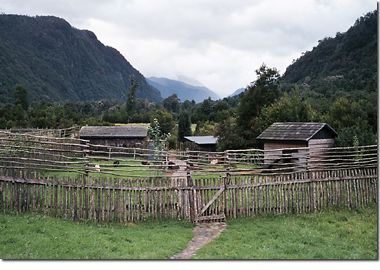 |
| The organic vegetable farm at the Caleta Gonzalo complex |
Tompkins sat in the skiff's stern, steering with the outboard motor, looking tense and angry. He had radioed to Re�ihu� to send his pilot out on a patrol, and he knew that so far the fires had not spread to his preserve. But it was clear that such petty distinctions did not matter to him: none of the wilderness was his, or all of it was, and he suffered personally when damage was done to any part of it. The situation was grave. In southern Chile during the past few days about 50,000 acres had burned. The flames did not kill the biggest trees, but they might as well have. By burning through the walls of undergrowth, they opened the way to settlers who came in and harvested the standing timber and introduced cattle, and so patch by patch continued to consume the forest and wreck its fragile soil -- a band of havoc visible from the air as a brown cancer spreading along the coast and up the valleys into the pristine green of the Andes.
I knew something already about that pattern, because during the previous two years I had set off with a Chilean friend among the settlers, and had walked along their foot trails and slept in their clearings, and had heard their hostility toward the forests that besieged them. Not even Indians, it is said, were able to penetrate this interior -- which may explain why they completely disappeared, killed off or absorbed by the European peasants who colonized the outlying island called Chilo� in the sixteenth century. Those colonists became Chilotes, a famously poor and isolated people who, as a result of just the sort of environmental exhaustion that Tompkins fears, have over the past hundred years fled by boat to hack holdings into the wild forests of the mainland. It has been a hard exile. I met settlers three generations distant from Chilo� who still regretted the loss of their home. They lived in lonely cabins that, were it not for the plastic litter, would have fit into the Appalachian frontier of two centuries ago. They survived by cutting wood, planting potatoes, and keeping a few animals -- and on the coast by scavenging for shellfish and collecting seaweed to sell to passing boats. They had enough contact with greater Chile to see themselves at times as heroic nation-builders. But in truth they lived here because they had no choice. Even after three generations they still hated this place for its rot, its moss, its fallen trees, and its winters of incessant rain, when they had to get drunk, they said, to keep from going insane. They were like we used to be. They hated nature.
Tompkins knew about their hatred. The fires today seemed all the worse because they had been allowed to spread onto fragile slopes too steep and denuded to be of use to anyone. From his place in the back of the boat Tompkins pointed to a column of smoke boiling above a ridgeline to the north. Over the roar of the outboard he shouted, "That's a typical stupid guy. He started that burn yesterday. My man goes over there and says, 'Hey, you'd better watch your fire here!' And the guy says no! 'No, nothing's going to happen. This is the way we always do it.' And then he goes to sleep in his little house over there, in the middle of the day, and of course the fire takes right off. Today it's burning up the whole side of the mountain." Tompkins smiled bitterly. "And does anyone care?"
Andr�s, the Gonzalo farm manager, wanted to explain. Earlier he had pointed to a school of dolphins, and then to a colony of sea lions along the fjord's rocky shore. At one point he said, "This is the most virgin place in the world, I'm sure of it. They made a study. It's because the woods are so thick. If you go in for a distance, you will know the feeling. There is so much bamboo and underbrush that you can't walk upright, because something will always go into your eyes, so after a week you stand bent over like a prehistoric man. And then when it rains ten days, twenty days, thirty days, there is nothing dry. The humidity is everywhere. Even if you've got everything in plastic bags, the humidity will get in anyway. I don't know how, but it will do it. So then you start getting crazy. The first thing you start thinking about is Where can I get warmth? How can I make a fire? The fire has to be big, but that's not easy, because everything is wet.
"And then suddenly you've had fifteen days of sun and puelche, and this only happens every few years, and so you just go for it. You don't worry about making your land pretty, cleaning it up, maybe saving some trees. You don't worry about whether you really need this part of the forest. No. It's the burning season, and burning is in your genes. So you go and put fire to the brush, and you sit down and drink some mat� and let the world burn."
 HE difference from Tompkins's way of living could not then have been clearer. Re�ihu� first appeared as a gap at the top of the fjord -- a steep-walled valley sweeping down from the wild mountains to the east, cradling a river that pushed a delta into the sea. The valley floor was flat, and about two miles wide. The snow-capped Michimahuida volcano rose beyond it, floating above the haze. Against the scale of that scene our approach was slow. Only at the end could we make out the shore itself, a wide and treeless tidal flat covered with bright salt grass. We threaded past three moored workboats, followed a series of stakes marking the channel, cut the motor, and drifted in to nose against a gentle embankment. The silence then was absolute, unbroken even by the lapping of water. The hamlet of Re�ihu� lay on slightly higher ground, just out of sight beyond the first tended pastures, ten minutes by foot up an immaculate gravel trail.
I call Re�ihu� a hamlet for want of a better word. It was once a pioneering ranch, a slash-and-burn cattle operation that gradually consumed the valley until by the 1980s it had been largely abandoned, leaving a scattering of tenant-settlers and feral cattle to a few miserable cabins and stump-littered fields. Tompkins bought the place -- a 20,000-acre spread at the heart of his future preserve for the price, he told me, of a lousy condominium in San Francisco -- and set about returning the upper valley to its natural state, rounding up all the wild cattle except for one wily cow who hid in the brush. Tompkins moved the settlers out as well, but only from Re�ihu�'s upper valley, and under generous terms: he paid them to dismantle their cabins and haul away their trash, and he offered them permanent jobs in lower Re�ihu� at the 1,000-acre farm that he would keep for himself once he gave the surrounding land to Chile. Those who took him up on the offer moved to a place very different from anything they could have imagined.
I call it a hamlet because it was more compact than a settlement and more intimate than a village -- a colony of gray-shingled houses, connected by slatted wooden walkways, set among greenhouses and gardens bursting with vegetables and flowers. Tompkins is a furiously creative man, and he designed it alone, building a place so unexpected on the Chilean frontier that it seemed at times to be a fantasy. But it was more than that. Forty people lived there year-round. At one end stood an elegant schoolhouse, with a big kitchen and a single large classroom on the ground floor, and quarters above for guests and the two teachers. At the other end, among trees, was a dormitory capable of lodging a dozen people. Most of the houses were in between; with spare wooden floors and natural light Tompkins had made of each one an exercise in the aesthetics of simplicity. To the extent possible he had used existing structures and recycled materials, but his work was not a casual thing. His tenants were his employees. He did not charge them rent, but he expected them to remove their shoes indoors, as he did, and to respect the beauty that surrounded them.
He and McDivitt lived in a house at the center, in the semi-privacy of a garden, facing north across the main pathway toward a grass landing strip and a wooden hangar in which two small airplanes were kept. The house was a two-story structure, a remake of the original farmhouse. Its typically uncluttered interior was centered on an open kitchen and illuminated by large windows looking out onto grass and trees. The cooking was done on an efficient wood-burning stove, which also provided hot running water and, by means of a gravity-siphon system, heated radiators throughout the house. There was no refrigeration, and during the day there was no electric power, here or anywhere in Re�ihu�. There was no telephone, computer, satellite connection, or fax machine. There was not even a typewriter. There was a ground-floor office with crowded bookshelves. But it was primarily the long, rough-hewn dining table in the main room that served as a desk. Tompkins sat there in profound concentration while he read and answered his correspondence and wrote orders to the staff in fluid longhand. In her matter-of-fact way McDivitt did the same.
Their purpose remained the preservation of the wild forest, but it was the detailed peripheral work of building the farms and communities that had come to consume their time. I had the impression that there were moments when they would have preferred to be alone and far away: during the few hours each night that the Re�ihu� generator ran, they turned on electric lights and prepared delicate salads and perfect pasta, or lounged on the sofas by the fireplace and listened to opera. But even then they were often interrupted by people coming to discuss the day's residual problems: Two chickens were dead. A cow looked sick. A pipe had burst at a badly welded seam. A trespasser had been spotted twenty miles away. Oh, and Alfonso was shirking his school-cleaning duties again, while Carolina was going around saying someone took her sweater. This was very specific stuff for a generalist like Tompkins, who managed nonetheless to keep thinking in global terms.
One evening he said to me, "We want people to be able to look over here and see that somehow our little community thrives. When people realize that you're trying to make things thrive, and that if things thrive it will be good for everybody, it's not all that hard to get them interested in what you're doing, you see. We've got the big honeybee project starting up over at Pill�n, and we're telling people, 'Hey, if you're interested in bees, come over any time and talk to our beekeepers, and see if they can help you.' People like that. We also try to get involved in areas where the macro-economy is going against people anyway, which is what's happening here with cows. I go to cow auctions now, and I've learned a lot about cows and the market, and what the problems are. So we sit around with the farmers and talk about our cows. I never thought I was going to talk about cows! There are too many cows, and the cows are put in the wrong places. These people are burning up the sides of the mountains, and running their cattle up on rocky terrain, and they're biting into the forest. But if they could learn that there's value in the hills with flowering trees, and they could make an income between fishing on the coast and making knitwear and finding an outlet for it like the caf� in Gonzalo, and then they could have bees and honey instead of running cattle up the sides of mountains -- maybe this would be helpful. What we're doing here is intimately integrating a social program with an environmental program. I think about this every day, all day, even while I'm working in the fields. How to make our little local community work. It's about the preservation of the agrarian mind."
During another of Tompkins's musings, about Nestl�'s dominance in the Chilean milk market, Kris McDivitt smiled and said to me, "Please, wait, just a moment, that's lecture two-eighty-seven-C-three. Remember the file and you won't have to hear what he thinks about Nestl�. You'll know it's in there somewhere."
Tompkins said, "She's got them numbered."
She was too sharp to philosophize, and too experienced. It surprised me that such a woman could fall as much in love with an old acquaintance as she clearly had with Tompkins. A Santiagan who knows them both said to me, "Poor lady, I pity her, she has had to put up with a lot." But in Re�ihu� I got the impression that she puts up with what she chooses to.
One afternoon, while walking with me through the upper pastures, she got annoyed when I called Re�ihu� a utopia, because she associated the word with impracticality. She said, "It's a word that completely misses the point of what we're doing here." I understood her to mean that utopias lie beyond her concerns. She never talked to me about Re�ihu�'s purpose. She preferred simply to describe the workings of what she called the community.
Aside from the two Americans, the community at Re�ihu� included three beekeepers, two gardeners, two teachers, a farm manager, a bulldozer driver, a backhoe driver, a tractor driver, a housekeeper, a boatman, a pilot, a slew of girlfriends, wives, and children, and variable numbers of seasonal farmhands and overnight visitors from other parts of the project. The pay was on the high side of normal for the area. The employees worked six days a week, with Sundays off. They rarely went to town, because town was too far away. They rarely even went to Caleto Gonzalo. Fifteen typewritten pages spelled out the code of conduct. The first section began, "Honesty. We hope that all employees will be honest. We will not accept dishonest acts like thefts and lies. There are no grades to dishonesty. Either you lie or you don't lie, either you steal or you don't steal. There is no such thing as partial dishonesty."
There were also rules against drunkenness, drug use, violent behavior, and the possession of firearms. Of course there was no television. Garbage had to be separated and appropriately recycled, burned in the household stoves, or, if it was organic matter, turned over to the community compost collector. A housing inspector made regular rounds with a checklist, and when necessary ordered the chimneys to be cleaned. There was an emergency plan for lighting the runway's edges with flashlights in case an airplane got caught out after dark.
The list went on. Each employee had the right to graze one cow, to breed it with the Re�ihu� bull, and to keep the calf for six months. The alternative was to keep five sheep, but this was risky, because of the pumas in the forest. Every family had to buy two chickens and pay a nominal monthly fee toward the chicken operation, in return for which it received six to fifteen eggs a week. In addition, every family received produce from the garden, including lettuce, garlic, squash, peas, beans, cucumbers, tomatoes, and huge numbers of potatoes. The planting and harvesting of the potatoes had become communal events in which even the children got involved. Other communal events included communions and baptisms, religious and national holidays, various celebratory asados associated with the farm work, and an annual folk-music weekend that attracted settlers from a hundred miles around.
The most sensitive part of Re�ihu� was the school, which had seventeen students, in kindergarten through sixth grade. In order to allay suspicions that Tompkins was indoctrinating the children, or running a cult, the school was strictly maintained as a public institution, checked by government inspectors, and led by a government-salaried teacher who adhered closely to the national standards. Tompkins paid the salary of the second teacher, and discreetly supplemented the classes with offerings of folk music, organic gardening, sports, and (at the parents' request) English. The regulation lunches were quietly "augmented" with fresh milk, whole-grain bread, and vegetables from the garden.
All that, and the ordinary functioning of the far-flung operation, was overseen by McDivitt, who during my stay walked every morning before breakfast to the boatman's house for scheduled radio calls -- to outposts around the fjord, and to Puerto Montt, Chait�n, and beyond. She listened to weather reports, responded to the first of the morning's problems, amended her earlier instructions for the day's work, and began again the regular task of juggling the necessary movements of people, airplanes, and boats. She said she liked the sense of its all coming together. "Caleta, Caleta, Re�ihu�," she would call. Crammed into a corner under theboatman's stairway, the radio crackled and squealed and often did not respond. "Caleta, Caleta, Re�ihu�." It was just as well that she did not dream about utopia.
The truth was, since moving to the forest she had become something of a radio buff. In a system parallel to the big fixed-station units, she had equipped the key people throughout the fjord with hand-held VHF transceivers, which she bought by the dozen from a store in Los Angeles, and which, she believed, had drawn the community closer together by keeping people in touch during the day.
She liked all radios, including the little AM receivers that the employees carried around for listening to soccer games and personal news. When I asked about this, she told me that personal messages were broadcast during the regional news hour, from twelve to one. "'Here is a message for Francisco P�rez in Re�ihu�: your mother sends her love; she was in Puerto Montt yesterday. Happy birthday Carlos Chamat in Chait�n from your cousin Hector. Make sure you're on the bus tomorrow: your parents will be waiting for you.' It's all done by radio! It's very interesting, when you listen to it. And it's a formal system."
I said, "You know, we have it in the U.S., too, on the border. Some of the norte�o stations in Mexico broadcast messages."
"Is that right? I really like it. I like everything it implies -- that there are still places where you can't get, where there's no phone, where you can't call, where you can't send a letter."
I said, "There are a lot of places like that. Like here. In the world."
"Fine by me."
Fine by Tompkins, too, I imagined, though he was so caught up in his thinking about global problems that he probably found it hard to appreciate such practical details of daily life. That was the difference between this husband and this wife. It surfaced again one evening during a tussle about the school curriculum. Re�ihu� had recently been presented with a choice between a new national "rural" curriculum emphasizing carpentry and manual skills and a "modern" curriculum intended to prepare children for high school -- in this case at one of the boarding schools in Puerto Montt or in a town on Chilo�. Tompkins was pleased with the idea of a rural curriculum, which he took as a vindication of his beliefs. But it was up to the parents to decide on the school's direction, and it seemed likely that they would opt for modernity. McDivitt understood why.
She said, "There's a split, because there are some kids here who will be farmers. But many are going to go on to high school outside, and their parents are concerned that they'll be behind when they hit the urban setting. It's baloney, because the town schools are terrible -- forty-five students in a class, and teachers who are worn out, sort of whipped. But it's also understandable. The parents don't want to worry that somehow they're hanging up their kids. They want their kids to prepare themselves for what they see will be the necessary skills in the future, which are not shop and farming and fishing and gardening but rather ... "
"Computer operating," Tompkins said scornfully.
" ... English, computer operating, and stuff. And they're not wrong, necessarily, in the culture that they see. They're not wrong!"
Tompkins said, "Well, that's another story. I disagree with you about whether they're right or wrong. Because the right or wrong of it depends on what kind of a world you think your children should go into."
"No, Doug. That is not the statement. These parents are rural" -- she hesitated -- "agricultural workers. And what they see -- let's take Magali and Vincente specifically, then we can take Juan and Amalia separately. They think that to prepare their kids . . ."
"I know," Tompkins interrupted. "But when you say they're not wrong, what do you mean they're not wrong about?"
She spoke emphatically. "In the culture that they are encouraging their kids to move toward, and that they hope their kids will participate in, those are the skills that people are looking for. In that sense I'm not wrong."
"I'll tell you where you're wrong. They want the best for their kids, agreed?"
"They do."
"Now, you have to find out what's best for their kids! I don't agree that they're right from their point of view, because I don't think they've got the point of view right."
"You're taking it to the second step. I'm taking it to the first."
They were dancing, turning around each other, not needing to agree. He was an authentic missionary, and she was his necessarily practical wife. A century ago they would have struggled like this for the conversion of Africa. I had the impression I was watching a modern version of an old theater piece. The script required McDivitt to grow silent after a while. Tompkins began to talk about the burning of the Black Sea.
The online version of this article appears in four parts. Click here to go
to parts one, three, and four.
William Langewiesche is a correspondent for The Atlantic and the author of Inside the Sky: A Meditation on Flight (1998).
Top illustration by Kevin Soderlund. Photographs by William Langewiesche.
Copyright © 1999 by The Atlantic Monthly Company. All
rights reserved.
The Atlantic Monthly; June 1999; Eden: A Gated Community (Part Two);
Volume 283, No. 6; page 84-105.