


Return to this issue's Table of Contents.
A U G U S T 1 9 9 9

Today's young adults may be the most politically disengaged in American history. The author explains why, and puts forth a new political agenda that just might galvanize his generation
by Ted Halstead
 VERETT Carll Ladd, a political scientist, once remarked, "Social analysis and commentary has many shortcomings, but few of its chapters are as persistently wrong-headed as those on the generations and generational change. This literature abounds with hyperbole and unsubstantiated leaps from available data." Many of the media's grand pronouncements about America's post-Baby Boom generation -- alternatively called Generation X, Baby Busters, and twentysomethings -- would seem to illustrate this point.
The 1990s opened with a frenzy of negative stereotyping of the roughly 50 million Americans born from 1965 to 1978: they were slackers, cynics, whiners, drifters, malcontents. A Washington Post headline captured the patronizing attitude that Baby Boomers apparently hold toward their successors: "THE BORING TWENTIES: GROW UP, CRYBABIES." Then books and articles began to recast young Americans as ambitious, savvy, independent, pragmatic, and self-sufficient. For instance, Time magazine described a 1997 article titled "Great Xpectations" this way: "Slackers? Hardly. The so-called Generation X turns out to be full of go-getters who are just doing it -- but their way."
More on politics & society in The Atlantic Monthly and Atlantic Unbound.
Related feature:
Roundtable: "My So-Called Generation"
GenX writers respond to the August cover story, in an Atlantic Unbound Roundtable.
From the archives:
"Will America Grow Up Before It Grows Old?", by Peter G. Peterson (May, 1996)
"Within the next fifteen years the huge generation of Baby Boomers, whose parents brought them into the world with such optimism, will begin to retire. As they do, they will expect the munificent array of Entitlements....But consider who is expected to pay for this late-in-life consumption: the relatively small 'bust' generation in whose productive capacity we have failed to invest."
"Justice Between Generations," by Phillip Longman (June, 1985)
Unless a number of trends are soon reversed, the Baby Boomers are headed for a disastrous retirement.
"The New Generation Gap", by Neil Howe and William Strauss (December, 1992)
It isn't yet at a sixties boil, but the emerging conflict between fortysomethings and twentysomethings will help to define this decade.
From Atlantic Unbound:
Web Citation: "Politics Made Simple," by Nicholas Confessore (June 23, 1999)
A new political site aims for the GenX mind -- and shows us what the world does not need now.
Related links:
The New America Foundation
A think tank (founded by Ted Halstead) dedicated to "bringing new voices and new ideas into America's public discourse."
2030 Center
"An action tank founded and run by young leaders to conduct research and advocacy about economic issues affecting America's future."
Generation X Coalition
"The Generation X Coalition was originally formed in 1996 as a not for profit, membership/ advocacy organization. Our intent was to give a political voice and forum to our generation."
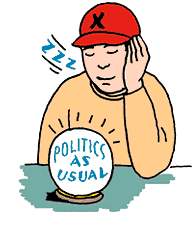
 LTHOUGH political and civic engagement began to decrease among those at the tail end of the Baby Boom, Xers appear to have enshrined political apathy as a way of life. In measurements of conventional political participation the youngest voting-age Americans stand out owing to their unprecedented levels of absenteeism. This political disengagement cannot be explained away as merely the habits of youth, because today's young are markedly less engaged than were their counterparts in earlier generations. Voting rates are arrestingly low among post-Boomers. In the 1994 midterm elections, for instance, fewer than one in five eligible Xers showed up at the polls. As recently as 1972 half those aged eighteen to twenty-four voted; in 1996, a presidential-election year, only 32 percent did. Such anemic participation can be seen in all forms of traditional political activity: Xers are considerably less likely than previous generations of young Americans to call or write elected officials, attend candidates' rallies, or work on political campaigns. What is more, a number of studies reveal that their general knowledge about public affairs is uniquely low.
The most recent birth cohort to reach voting age is also rejecting conventional partisan demarcations: the distinction between Democrats and Republicans, which has defined American politics for more than a century, doesn't resonate much with the young, who tend to see more similarities than differences between the two parties. Even those young adults who are actively engaged in national politics see partisan boundaries blurring into irrelevance. Gary Ruskin, an Xer who directs the Congressional Accountability Project, a public-policy group in Washington, D.C., puts it this way: "Republicans and Democrats have become one and the same -- they are both corrupt at the core and behave like children who are more interested in fighting with each other than in getting anything accomplished."
Surveys suggest that no more than a third of young adults identify with either political party, and only a quarter vote a straight party ticket. Xers are the group least likely to favor maintaining the current two-party system, and the most likely to favor candidates who are running as independents. Indeed, 44 percent of those aged eighteen to twenty-nine identify themselves as independents. Not surprisingly, young adults gave the strongest support to Ross Perot in 1992 and to Jesse Ventura in 1998.
More fundamental, Xers have internalized core beliefs and characteristics that bode ill for the future of American democracy. This generation is more likely to describe itself as having a negative attitude toward America, and as placing little importance on citizenship and national identity, than its predecessors. And Xers exhibit a more materialistic and individualistic streak than did their parents at a similar age. Moreover, there is a general decline in social trust among the young, whether that is trust in their fellow citizens, in established institutions, or in elected officials. These tendencies are, of course, related: heightened individualism and materialism, as Alexis de Tocqueville pointed out, tend to isolate people from one another, weakening the communal bonds that give meaning and force to notions of national identity and the common good.
 ANY explanations have been advanced for the political apathy of Generation X, but none seems to tell the entire story. One theory holds that television, which the average child now watches for forty hours a week, is to blame for the cynicism and lack of civic education among the young. Another is that growing up during the Reagan and Bush presidencies, when government-bashing was the norm, led many Xers to internalize a negative attitude toward politics and the public sector. A third theory blames the breakdown of the traditional family, in which much of a child's civic sensitivity and partisan orientation is said to develop. And, of course, the incessant scandals in contemporary politics deserve some blame for driving young people into political hiding. Each of these theories undoubtedly holds some truth, but a simpler and more straightforward explanation is possible -- namely, that young Americans are reacting in a perfectly rational manner to their circumstances, at least as they perceive them. As they enter adulthood, this explanation goes, Xers are facing a particularly acute economic insecurity, which leads them to turn inward and pursue material well-being above all else. They see the outlines of very real problems ahead -- fiscal, social, and environmental. But in the nation's political system they perceive no leadership on the issues that concern them; rather, they see self-serving politicians who continually indenture themselves to the highest bidders. So Xers have decided, for now, to tune out. After all, they ask, what's the point?
To be sure, today's young have a great deal to be thankful for. Xers have been blessed to come of age in a time of peace and relative material prosperity -- itself a significant historical aberration. And the positive legacy they are inheriting goes much deeper: Generation X enjoys the fruits of the civil-rights, women's-rights, and environmental-conservation battles waged by its parents. Finally, who could deny that today's young are benefiting from significant leaps in technology, science, and medicine? But for all these new opportunities, the world being passed on to young Americans is also weighed down by truly bedeviling problems. Prevailing ideologies have proved incapable of accommodating this seeming contradiction.
Ever since the pioneering work on generational theory by the German sociologist Karl Mannheim, in the 1920s, political generations have been thought to arise from the critical events that affect young people when they are most malleable. "Early impressions," Mannheim wrote, "tend to coalesce into a natural view of the world." At the very heart of the Xer world view is a deep-seated economic insecurity. In contrast to Baby Boomers, most of whom came of age during the period of unparalleled upward mobility that followed the Second World War, Xers grew up in a time of falling wages, shrinking benefits, and growing economic inequality.
Since 1973, while the earnings of older Americans have mostly stagnated, real median weekly earnings for men aged twenty to thirty-four have fallen by almost a third. In fact, Xers may well be the first generation whose lifetime earnings will be less than their parents'. Already they have the weakest middle class of any generation born in this century.
Falling wages and rising inequality have affected all young Americans, regardless of educational achievement. During the said-to-be economically strong years 1989-1995 earnings for recent college graduates fell by nearly 10 percent -- representing the first time that a generation of graduates has earned less than the previous one. And circumstances are far worse for the roughly 67 percent of Xers aged twenty-five to thirty-four who don't have a college degree. In 1997 recent male high school graduates earned 28 percent less (in dollars adjusted for inflation) than did the comparable group in 1973, and recent female high school graduates earned 18 percent less. When politicians and the media continually extol the economy's performance, many Xers just scratch their heads in disbelief.
The economic hardship facing today's young cannot be overstated: America's rate of children in poverty -- the highest in the developed world -- rose by 37 percent from 1970 to 1995. During the same period the old notions of lifetime employment and guaranteed benefits gave way to the new realities of sudden downsizing and contingent, or temporary, employment. Forty-four million Americans lack basic health insurance today, and Xers -- many of whom are part of the contingent work force -- are the least insured of all. To compound these problems, many Xers received a poor education in failing public schools, which left them especially ill-prepared to compete in an ever more demanding marketplace.
 ESIDES struggling against downward economic mobility, Generation X is inheriting a daunting array of fiscal, social, and environmental debts. Although most media reports focus on the national debt and the likely future insolvency of Social Security, the real problem is actually much broader. When they envision their future, Xers don't just see a government drifting toward the political equivalent of Chapter 11; they also see a crippled social structure, a dwindling middle class, and a despoiled natural habitat. Despite bipartisan fanfare about balancing the federal budget, the fiscal outlook remains quite bleak for young adults -- and for reasons seldom discussed. Long before Social Security and Medicare go insolvent under the burden of Boomer retirement, entitlement payments will have crowded out the public investments that are essential to ensuring a promising future. Government spending on infrastructure, education, and research has already lessened over the past twenty-five years, from 24 percent to 14 percent of the federal budget, and the downward squeeze will only worsen. In other words, Xers will be forced to pay ever higher taxes for ever fewer government services.
Financially most frightening, however, are the nation's skyrocketing levels of personal debt and international debt. With all the focus on balancing the federal budget, not enough attention has been paid to the fact that American families, and Xers in particular, are increasingly unable to balance their own books. Xers carry more personal debt than did any other generation at their age in our nation's history; in fact, a full 60 percent of Xers carry credit-card balances from month to month. In addition, those who attend college face the dual burden of soaring tuition bills and shrinking federal education grants. From 1977 to 1997 the median student-loan debt has climbed from $2,000 to $15,000. The combination of lower wages and overleveraged lifestyles is doubly worrisome to a generation that wonders if it will ever collect Social Security.
Then there is America's ballooning international debt. For the past two decades the nation as a whole has consumed more than it has produced, and has borrowed from abroad to cover the difference -- nearly $2 trillion by the end of this decade, or more than a fifth of the total annual output of the U.S. economy. In the short life-span to date of most Xers, America has gone from being the world's largest creditor to being its largest debtor. At some point in the future, especially as interest on our international debt accumulates, investors in other countries will become reluctant to keep bankrolling us. When they do, we will have no choice but to tighten our belts by cutting both investment and consumption. In other words, just as Xers start entering their prime earning years, with their own array of debts and demographic adversities awaiting them, they may well find themselves having to pay off the international debt that Boomers accumulated in the 1980s and 1990s.
Despite the penumbra of long-term debt, the U.S. economy remains the envy of the world; U.S. social conditions, however, are certainly not. America has some of the worst rates of child poverty, infant mortality, teen suicide, crime, family breakup, homelessness, and functional illiteracy in the developed world. In addition, many of our inner cities have turned into islands of despair, a frightening number of our public schools are dangerous, and almost two million of our residents are behind bars.
Many Xers sense that the basic fabric of American society is somehow fraying. Traditional civic participation, community cohesion, and civility are in decline, and not just among the young. The long-held belief in the value of hard work is under assault, as many Americans work longer hours for less pay, watch the gap between rich and poor grow ever wider, and see their benefits cut by corporations with little allegiance to people or place. The result is a fundamental loss of trust: between citizens and elected officials, between employees and employers, and, ultimately, between individuals and their neighbors. Yet trust and civility are the pillars on which any well-functioning democracy and free-market economy depend.
Finally, Xers face large environmental debts that stem from the use and abuse of our natural resources. Well over half of the world's major fisheries are severely depleted or overfished; loss of species and habitat continues at an unprecedented rate, with some 50,000 plant and animal species disappearing each year; freshwater tables across the globe, including parts of America, are falling precipitously; each year America alone loses more than a million acres of productive farmland to sprawl; and emissions of carbon dioxide and other greenhouse gases continue to rise, threatening to raise global temperatures by two to six degrees within the next century.
Global warming is a revealing case study from the perspective of Generation X. There is nearly unanimous scientific agreement on the problem, and a consensus among economists that the nation could reduce its greenhouse-gas emissions without harming its economy. In addition, there is ample evidence -- ranging from temperature increases to abnormally frequent weather disturbances to icebergs breaking off from the poles -- to warrant deep concern. Yet our political establishment has resigned itself to virtual inaction. Why act now, politicians appear to reason, when we can just pass the problem on to our kids?
How, Xers have every right to ask, can one generation justify permanently drawing down the financial, social, and natural capital of another?
But whining will do no good. The only way for Xers to reverse their sad situation -- and to realize the promise of the economic opportunities and technological innovations of the next century -- is by entering the political arena that they have every reason to loathe. After all, collective problems require collective solutions. Xers cannot reasonably expect the political establishment to address, let alone fix, the sobering problems they are to inherit unless they start participating in the nation's political process, and learn to flex their generational muscle. Whether or not they do so will depend on two more immediate questions: Does this generation share a set of political beliefs? And if so, how might these translate into a political agenda?
The online version of this article appears in two parts. Click here to go
to part two.
Ted Halstead is the president of the New America Foundation, in Washington, D.C.
Illustrations by Seymour Chwast.
Copyright © 1999 by The Atlantic Monthly Company. All rights reserved.
The Atlantic Monthly; August 1999; A Politics for Generation X - 99.08;
Volume 284, No. 2; page 33-42.