


Return to the Table of Contents.
N O V E M B E R 1 9 9 7

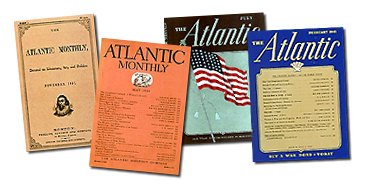
"In Politics, the Atlantic will be the organ of no party or clique, but will honestly endeavor to be the exponent of what its conductors believe to be the American idea."
-- The founders, including
JAMES RUSSELL LOWELL, RALPH WALDO
EMERSON, OLIVER WENDELL HOLMES, HENRY WADSWORTH LONGFELLOW, and
HARRIET
BEECHER STOWE, in the first issue, November, 1857
And so through the night went his cry of alarm
To every Middlesex village and farm, --
A cry of defiance, and not of fear, --
A voice in the darkness, a knock at the door,
And a word that shall echo forevermore!
For, borne on the night-wind of the Past,
Through all our history, to the last,
In the hour of darkness and peril and need,
The people will waken and listen to hear
The hurrying hoof-beat of that steed,
And the midnight-message of Paul Revere."
-- HENRY W. LONGFELLOW
"Paul Revere's Ride," January, 1861
"Mine eyes have seen the glory of the coming of the Lord:
He is trampling out the vintage where the grapes of wrath are stored;
He hath loosed the fateful lightning of His terrible swift sword:
His truth is marching on."
-- JULIA WARD HOWE
"Battle Hymn of the Republic," February, 1862
"So far our government has done nothing effective with its forests ... but is like a rich and foolish spendthrift who has inherited a magnificent estate in perfect order, and then has left his rich fields and meadows, forests and parks, to be sold and plundered and wasted at will, depending on their inexhaustible abundance."
-- JOHN MUIR
"The American Forests," August, 1897
"I have often thought it would be a blessing if each human being were stricken blind and deaf for a few days at some time during his early adult life. Darkness would make him more appreciative of sight; silence would teach him the joys of sound.
"Now and then I have tested my seeing friends to discover what they see. Recently I was visited by a very good friend who had just returned from a long walk in the woods, and I asked her what she had observed. 'Nothing in particular,' she replied. I might have been incredulous had I not been accustomed to such responses, for long ago I became convinced that the seeing see little."
-- HELEN KELLER
"Three Days to See," January, 1933
"The advanced arithmetical machines of the future will be electrical in nature, and they will perform at 100 times present speeds, or more.
"Moreover, they will be far more versatile than present commercial machines, so that they may readily be adapted for a wide variety of operations. They will be controlled by a control card or film, they will select their own data and manipulate it in accordance with the instructions thus inserted, they will perform complex arithmetical computations at exceedingly high speeds, and they will record results in such form as to be readily available for distribution or for later further manipulation. Such machines will have enormous appetites."
-- VANNEVAR BUSH
"As We May Think," July, 1945
"I have tried to make it clear that it is wrong to use immoral means to attain moral ends. But now I must affirm that it is just as wrong, or even more, to use moral means to preserve immoral ends."
-- MARTIN LUTHER KING JR.
"The Negro Is Your Brother," August, 1963
"Even among the 'architects' of our Vietnam commitment, there has been persistent confusion.... Was it, for instance, a civil war, in which case counterinsurgency might suffice? . . . Who was the aggressor -- and the 'real enemy'? The Viet Cong? Hanoi? Peking? Moscow? International Communism? ... And confused throughout ... was the question of American objectives."
-- JAMES C. THOMSON JR.
"How Could Vietnam Happen?" April, 1968
"In order to enact Reagan's version of tax reduction, 'certain wages' had to be paid, and, as Stockman reasoned, the process of brokering was utterly free of principle or policy objectives.... Once the Reagan tacticians began making concessions beyond their 'policy-based' agenda, it developed that their trades and compromises and giveaways were utterly indistinguishable from the decades of interest-group accommodations that had preceded them, which they so righteously denounced. What was new about the Reagan revolution, in which oil-royalty owners win and welfare mothers lose?"
-- WILLIAM GREIDER
"The Education of David Stockman," December,
1981
"Should America not make investment its number-one policy priority in the medium term [1992-2007], it will surely have to pay the price in the long term. It will not be a price denominated solely in terms of labor productivity, real wages, and global political influence. The price will also include an utter lack of preparation for the most stunning demographic transformation -- from workers to dependents -- in American history."
-- PETER G. PETERSON
"The Morning After," October, 1987
"I view the United States of these last years of the twentieth century as essentially a tragic country, endowed with magnificent natural resources that it is rapidly wasting and exhausting, and with an intellectual and artistic intelligentsia of great talent and originality. For this intelligentsia the dominant political forces of the country have little understanding or regard. Its voice is normally silenced or outshouted by the commercial media. It is probably condemned to remain indefinitely, like the Russian intelligentsia in the nineteenth century, a helpless spectator of the disturbing course of its nation's life."
-- GEORGE F. KENNAN
"The Last Wise Man," April, 1989
"Just beyond the horizon of current events lie two possible political futures -- both bleak, neither democratic. The first is a retribalization of large swaths of humankind by war and bloodshed: a threatened Lebanonization of national states in which culture is pitted against culture, people against people, tribe against tribe -- a Jihad in the name of a hundred narrowly conceived faiths against every kind of interdependence, every kind of artificial social cooperation and civic mutuality. The second is being borne in on us by the onrush of economic and ecological forces that demand integration and uniformity and that mesmerize the world with fast music, fast computers, and fast food -- with MTV, Macintosh, and McDonald's, pressing nations into one commercially homogenous global network: one McWorld tied together by technology, ecology, communications, and commerce. The planet is falling precipitantly apart and coming reluctantly together at the very same moment."
-- BENJAMIN R. BARBER
"Jihad vs. McWorld," March, 1992
Copyright © 1997 by The Atlantic Monthly Company. All rights reserved.
The Atlantic Monthly; November 1997; The Atlantic Monthly 140th; Volume 280, No. 5; pages 8-9.
 |
 |
 |
 |
 |
 |