


The Shaping Forces in Music
by Ernst Toch
An excerpt from the work described by Thomas Mann as
"beyond any questionLarger forms
A side-glance at the construction of a drama will help to illustrate and interpret this phenomenon. The drama, too, unfolds itself through the medium of time, and uses the mechanism of logical and psychological consecution. Here a plot is created, developed, lifted from level to level by continuously added intrigues, the ascending line covering the predominant portion of its range; until in the last (often short) act, the intricate threads disentangle, and no superfluous wordiness hampers the precipitation to the end.
 The comparison with the drama, though applicable as an overall principle to
small forms like Ex. 321, intensifies with the larger musical forms. As the
drama will not roll on uninterruptedly, but subdivide into smaller sections --
acts, scenes -- so the larger musical form, even if still in one movement, will
provide, by subdivisions, for resting points and breathing space. And while the
short descending line will be relatively straight and taut, the long ascending
line, ascending as a whole, will show curves, notches, retarding moments,
similar to those of the melodic line (Ex. 134). A tragedy will not loosen its
grip after the climax; but before it, on the long way up to it, provision might
well be made for some temporary, refreshing laughs. They will help the reader
or spectator to brace himself for the ever tightening grip of the plot; and
interspersed as welcome little spots of contrast, they will prevent the
interest in the main problem from flagging and tiring. In the same way a light
comedy, straight to the point after the climax, will benefit by weaving into
the ascending section an occasional musing contemplation or a similar
incidental excursion into the more serious and weighty.
The comparison with the drama, though applicable as an overall principle to
small forms like Ex. 321, intensifies with the larger musical forms. As the
drama will not roll on uninterruptedly, but subdivide into smaller sections --
acts, scenes -- so the larger musical form, even if still in one movement, will
provide, by subdivisions, for resting points and breathing space. And while the
short descending line will be relatively straight and taut, the long ascending
line, ascending as a whole, will show curves, notches, retarding moments,
similar to those of the melodic line (Ex. 134). A tragedy will not loosen its
grip after the climax; but before it, on the long way up to it, provision might
well be made for some temporary, refreshing laughs. They will help the reader
or spectator to brace himself for the ever tightening grip of the plot; and
interspersed as welcome little spots of contrast, they will prevent the
interest in the main problem from flagging and tiring. In the same way a light
comedy, straight to the point after the climax, will benefit by weaving into
the ascending section an occasional musing contemplation or a similar
incidental excursion into the more serious and weighty.
In musical form these little contrasts within the main trend are not felt as impairing the drive; on the contrary, they set it off to better advantage, giving each section a new impetus.
A masterpiece of form will reveal these qualities even though it may follow none of the classical forms and may therefore deny any traditional approach of formal analysis.
Listen to a good recording of Wagner's "Meistersinger" Prelude; first let it just affect you, then listen again with a score or piano-score.
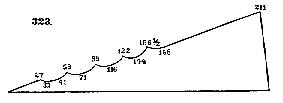
The almost constantly ascending line covers the overwhelmingly major part of the piece, up to bar 211. The following diagram (Ex. 323) may illustrate its periods of tension and relaxation. The numbers refer to the respective bars, and the idea is to mark these bars in the piano score before reading it together with a recorded or live performance.
The ascending fragments of the line tend to preserve the key (C major) and the pushing, driving, vigorous, masculine character. The receding fragments provide the change of mood (Lyrical, feminine in bars 27 - 37, 89ff; grave, impressive in 59ff; humorous, mocking in 122ff) which is also largely supported by change of key.
With the exception of the sudden change at 122, the indentations do not appear as pronounced as in the diagram; rather they are softened by smooth modulations and occasional bridges (37 - 41, 89 - 97). A constant undercurrent of moving contrapuntal voices, often supported by or resulting in massed, tension-charged harmonies, keeps driving, urging, rolling the masses like molten metal in the process of founding, and constantly building, building, building. Each of the mounting fragments marks the achievement of a higher level, until, in a broad, last, irresistible sweep (158 - 211) a gigantic, crushing climax is reached, triumphant like the hoisting of the victorious flag in conquered territory. From this peak, the piece plunges to its end in a few bars.
Wagner was often accused of making a hodgepodge, a potpourri of the themes contained in his operas, for their respective overtures. In "Rienzi" he still kept to the traditional overture in the sonata form. But feeling somehow restrained in his personal ideas by this -- or probably any -- traditional form, he created his own form and mastered it. True, he used the themes of the opera for material. But why should such material be less fit for perfect form, if tamed and subjugated by the master's hand? And if it is true that in highest art. content and form coincide (which means that inspiration creates its own form) it is equally true that form as a tool -- self-created or accepted -- retroactively can have an inspiring effect on the artist, as even the mere objective tool may have -- the blank manuscript paper, canvas or marble block.
So in a piece like the "Meistersinger" Prelude, form is neither a loose potpourri nor just the "grouping of a given thematic material", as the notion of form is frequently defined. Irregular and unruly in every detail as it seems to be, akin nowhere in detail or in toto to any of the traditional forms, its form is compellingly, irresistibly, inescapably present -- omnipresent, sovereign, responding in the highest degree to the shaping forces in music.
A promise is given in the beginning of the piece which is magnificently fulfilled in the end. A goal is set up which, approached step by step in constant onward drive, is gloriously reached. We set out in venturesome youth and, seasoned by the events of the journey, we return wise and mature.
In such interpretations by way of feeling and touch, we may approach such nondescript, yet ever so present form. At the same time, while none of the traditional forms is catalogued by this approach, a most important basic principle is revealed: The principle of tripartition. To it most of the forms can be traced, regardless of their substructures, proportions, standards, terms.
It is of little concern whether we call the three parts exposition, development and reprise, or the sections of the three-part song-form, or Menuetto, Trio and da Capo, or just A B A. The affinity and correlation of the flanking parts will always be felt as against the middle part, the bearer of intensification, plot, contrast. Whence we came, thither we return, after all the blooming and climaxing, after all the turbulence and trepidation. The principle of tripartition, as manifest in art, is rooted in nature, in our souls, in our very existence.
The following example may illustrate how high this curve, scarcely more than an indication in Ex. 321, may bulge and vault in the master's hand to result in utterly delightful, masterly form.
The composer could easily have satisfied the academic requirements by entering the reprise after the half-cadence in bar 18. The modulation back to the tonic was consummated, nothing was in the way of the return.
Instead, what happens? Ignoring the easy path, the passage swerves to a remote key and from there, traveling through ever new keys (25 - 33) soars high up, to land again on the dominant (bar 33) and to enjoy now, only now, the infinitely more gratifying reprise.
And while we are on the subject: Again it would have been easy to make the conventional reprise, perhaps concluding it in the main key by merely transposing the last four bars (9, 10, 11, 12) into F major. Nothing of the kind happens. First of all the theme itself is diverted right after the first pair of bars. And now, like a faint reverberation of the preceding surge, the tide again rises in threefold sequence (38ff) until it breaks upon the unexpected D major triad (43). Nonplussed, as it were, the passage turns back and, groping about in utmost tenderness, floats down, and, finally, only now, home.
What is this? An "episode"? An "extension"? Any other standard device?
Anything can be an extension, if, in such a classification, we are satisfied to include any insertion of a larger or smaller number of additional bars. Under such circumstances, the formative function of such additional bars can be utterly meaningless, and their classification under any heading can be as futile as an identical equation or an identical definition.
What elevates these two "extensions" of the Schubert Menuetto to the real function of creating, not a form, but FORM, is the fact that they, precisely they, are the very theater of the tension-relaxation duel, which we cannot escape feeling when we listen to the piece.
Here we see inspiration molded into sublimest form and, equally, form elevated to sublimest inspiration -- the consummate absorption of each by the other.
Return to "My Grandfather's Last Tale"
Copyright © 1996 by The Atlantic Monthly Company. All rights reserved.
 |
 |
 |
 |
 |
 |