Contents | April 2001
In This Issue (Contributors)
More on books from The Atlantic Monthly.
From the archives:
"Zero" (June 2000)
The debate over when the new millennium begins is by now a familiar one, and involves, as everyone knows, a missing year. But why was the year missing in the first place? The answer has to do with the belated invention of an essential number. By Dick Teresi
The Atlantic Monthly | April 2001
New & Noteworthy
The Hole in the Universe: How Scientists Peered Over the Edge of Emptiness and Found Everything
by K. C. Cole
Harcourt, 286 pages, $24.00
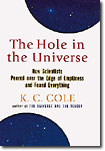 n page 91 of this book K. C. Cole advises the reader, somewhat plaintively, "Don't try to grasp all of this at once." The injunction, and its reiteration elsewhere ("I urge the reader not to worry if this doesn't make complete sense"), might strike some as authorial dereliction. But any writer who has ever grappled with Cole's subject will know better, and will spot such warnings as badges of integrity. Cole has set out to describe for lay readers a world that scrambles the comprehension even of its most adept theoreticians: the world of modern physics.
Cole, a veteran science reporter for the Los Angeles Times and the author of The Universe and the Teacup, a praised paean to mathematics, has here chosen for her conceit an intellectual history of nothing. This ranges widely, before she is done, from the blood contest over the quantity zero, whose millennium-long fight for acceptance as a regular digit was won astonishingly late in Western mathematics, to Zen Buddhist teachings on the potential of the emptied mind. Cole approaches this dense topic through a chronicle of the void, the vacuum, whether it be within atoms or between galaxies. This avenue is profitable for two reasons. first, a great deal of scientific speculation on the nature of matter has hinged on the question of the not-matter around it. Until Einstein showed that light needed no tangible medium through which to travel, theorists filled the vacuum with "ether"—the "enfant terrible" of substances, as Einstein put it. It was subsequently banished. The tale of what happened next provides the second, and greatest, utility for Cole's enterprise. Essentially, ether has been resurrected, in a different and far more mysterious form. No longer is it an aspic in which to float the universe. No: it is a materially empty void, but a void increasingly recognized as animate and fecund—"infinitely creative," in Cole's words. "All it needs is the energy to do what it's naturally inclined to do: proliferate wildly in every conceivable form." In fact, borrowed energy "comes to life" as particles (and antiparticles) in the void.
Cole's account of this generative space takes her (and us) on a civilian's tour to the front lines of modern physics—into the phantasmagoric realms of superstring theory and M-theory and black holes. In due course Cole tackles the universe's origins, shape, and—insofar as we can speculate—possible fates. But she never strays far from her point: that "the geometry of nothing may be the cause of everything that is, as well as everything that happens, in the universe." Before she gets through exploring this vacuum, it has come to seem a membrane between the tangible and the abstract, in which the latter can give birth to the former in an instant or absorb it back again—and, in any instant, apparently does. Cole's breezy style is complemented by a bedrock respect for attribution. This is a survey, after all, and her eagerness throughout to credit her sources makes it a particularly useful entryway to the rest of the genre. At first the conceit of The Hole in the Universe—combining the history of zero (a mathematical nothing) with that of the vacuum (a physical nothing)—may strike the reader as mongrel, a grab-bag conflation. But when we grasp that Cole's protagonist, her void, is the quintessence in which the mathematical explodes from a spark of energy into the physical world we know, the organization of her book becomes apparent.
—Russ Rymer
Copyright © 2001 by The Atlantic Monthly Group. All rights reserved.
The Atlantic Monthly; April 2001; New & Noteworthy - 01.04; Volume 287, No. 4; page 104-108.