Contents | February 2001
In This Issue (Contributors)
For more by Barbara Wallraff, see The Court Record.
See a collection of Atlantic articles on language.
Submit an entry to Word Fugitives.
The Atlantic Monthly | February 2001
Word Fugitives
 by Barbara Wallraff
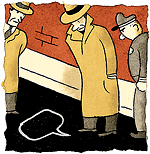 word fugitive is a wanted word or expression that someone has been unable to call to mind. Quite probably no exactly apt term exists—but maybe one should. Those familiar with The Meaning of Liff (1983), by Douglas Adams and John Lloyd, or Sniglets (1984), by Rich Hall and Friends, may find it helpful to think of word fugitives as empty mental spaces waiting to be filled by neologisms like the ones that appeared in those books. Readers familiar with Atlantic Unbound may already be acquainted with the word-fugitives idea, which made its debut online. Now readers are invited to submit for this page both word fugitives they seek and neologisms they coin to meet the needs of their word-wanting fellows. The page will appear every other month.
Here are a couple of examples, adapted from the Web, to get the ball rolling.
RECENTLY Mark Pener, of Somerville, Massachusetts, asked, "Often after I've heard of something for the first time—a food, a place, a person—I start hearing about it everywhere. Shouldn't there be a word for this?"
Certainly there are terms for many other specific psychological phenomena, from acedia (spiritual torpor and apathy) to zoning out (losing concentration). "In line with the current trend toward pathologizing every possible mental state," Peter Buchwald, of Akron, Ohio, suggested, "this should be called attention-surplus disorder." Royce Alden, of Coquille, Oregon, coined newbiquitous.
Top honors go to Rich Pasenow, of Sacramento, California. "I hate to borrow from French," he wrote, "but how about déjà new?" Appropriately enough, after Pasenow submitted this suggestion on the Web, a version of the phrase turned up elsewhere: Déjà Nu is the title of a recent album by the pop-music idol Dion.
KEVIN Taylor, of Boise, Idaho, wrote, "Here's a phenomenon that cries out for a word to describe it: the state of being amused (irrationally so, it seems to me) by the antics of one's pets."
The very existence of the monosyllabic and generic word pet implies that English is already way ahead of other languages in the domestic-fauna department; speakers of Romance languages must resort to phrases like animale prediletto and animal de estimação to get the same idea across. As for a word to convey infatuation with pets, Jim Ennis, of Huntsville, Alabama, came up with "petaphilia or pestaphilia—depending on your perspective." Denny Stein, of Baltimore, Maryland, wrote, "I suppose if I had a bird, it might make me raptorous. However, in reality I am catatonic." Glenn Werner, of Pine Bush, New York, wrote, "When one gets particularly engrossed with one's pet, especially in the presence of others, it's called being petantic."
Top honors go to Jason Taniguchi and his fellow members of the Toronto, Ontario, Serial Diners Collective (don't ask), who suggested the frolicsome term fur-shlugginer. This is a variant, those who have never been regular readers of Mad magazine may be glad to learn, on a Yiddish-sounding word that in Alfred E. Neuman's lexicon means "crazy."
THIS month Dillon Teachout, of Norwich, Vermont, writes, "Is there a word for mistakenly written homonyms—your for you're, and so on?"
An excellent question. Ever fewer people seem to be able to tell those two, or its and it's, or led and lead, apart.
AND Marcia Pollack, of Kingston, New Jersey, writes, "As you know, the word hysteria has its origins in female physiology, and it applies to the manner in which women behave when stressed. The word was probably coined by men, who, I'm sure, found this behavior of women incomprehensible. It has always seemed to me that there should be a word for the way men behave when stressed. I have on a number of occasions found myself strapped in the passenger seat of a car flying down the highway at top speed while the male driver of my car was chasing another driver and screaming, 'You SOB!' I am as mystified about this male behavior as men must be about hysterical female behavior."
Send words that serve Dillon Teachout's or Marcia Pollack's purposes to Word Fugitives, The Atlantic Monthly, 77 North Washington Street, Boston, MA 02114 or visit the Word Fugitives page on our Web site. Submissions must be received by February 28. Use the same addresses to submit word fugitives that you'd like The Atlantic's help in finding. Letters become the property of Word Fugitives and may be edited.
Readers whose queries are published and those whose coinages are singled out for top honors will each receive, with our thanks, a selection of recent autographed books by Atlantic authors. The next installment's correspondents will be sent The Truth About Dogs, by Stephen Budiansky; Drowning Ruth, by Christina Schwarz; and Word Court, by Barbara Wallraff.
Illustration by Marc Rosenthal.
Copyright © 2001 by The Atlantic Monthly Group. All rights reserved.
The Atlantic Monthly; February 2001; Word Fugitives- 01.02; Volume 287, No. 2; page 132.