


Go to this issue's Table of Contents.
J A N U A R Y 2 0 0 1

 A recent issue of The New York Times included the following passage: "Critics wonder whether the new digital film revolution for home computers merely gilds the lily of passive entertainment." I had thought the correct expression to be "To gild refined gold, to paint the lily." Has common usage changed this quotation so that gild the lily is now the accepted version?
Johanna Bass
San Antonio, Texas
Gild the lily is seen in print much more commonly than paint the lily, and where the latter does appear, often it will have been invoked just in order to let readers know that the original line is as you say and comes from Shakespeare -- King John, to be exact. If not that, then the writer may quote the entire line and work in a mention of the Bard, thus self-consciously averting questions about word choice.
Gild versus paint therefore presents anyone who wants to use a version of the phrase with a dilemma, in the traditional sense of that word (namely, as the American Heritage Dictionary has it, "a situation that requires a choice between options that are or seem equally unfavorable or mutually exclusive"). The problem was wonderfully sketched by the poet and critic Randall Jarrell, in a passage I discovered when the linguist Geoffrey Nunberg quoted it in his article "The Decline of Grammar," published in The Atlantic seventeen years ago. Jarrell, describing a literary character, wrote, "She always said to paint the lily: she knew that this was a commonplace phrase and that the memory of mankind had transfigured it, and she was contemptuous of people who said to paint the lily -- just as she was contemptuous, in a different way, of people who said to gild the lily -- but she couldn't bear to have anyone think that she didn't know which one it really was." My own, cowardly solution to the dilemma is a third possibility not touched on by Jarrell (despite the Greek prefix meaning "two," a majority of the AHD's usage panel permits a dilemma to have three or more possible solutions): I avoid using either version of the phrase.
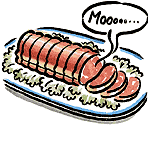 A friend of ours was chastised by another friend while dining at a restaurant. Friend A had ordered her steak rare. Upon receiving it, she was disappointed and said she had wanted it rarer. Friend B (aka The Critic) stated that that usage was incorrect -- that A should have said she wanted it more rare, and that rarer was okay for comparing near-extinct species, perfect diamonds, and the like, but not for the relative doneness of cooked meat.
Dictionaries we have consulted do not specifically deal with this issue, a fact that (along with our instincts) leads us to believe that A's usage was just dandy and B was being altogether too picky. Please advise.
Barbara Levie and Nancy Engel
Evanston, Ill.
You're right. In fact, it's considered better English to "inflect" (that is, modify the word itself) any adjective that has an established comparative form: rarer is more elegant than more rare. Note, however, that inventing new inflected comparatives is not good English. Although here grammar parts company with gastroenterology, grammar forbids A to request a portion of meat that is doner.
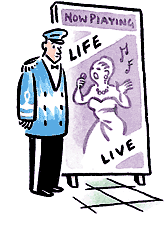 May I ask for clarification on the pronunciation of the term short-lived -- specifically the latter part: -lived. It seems to be most often pronounced with a short i, as in "Once, I lived in New York." I am more comfortable with the long i, as in "Live! from New York!" Webster's New College Dictionary allows for both pronunciations. Why is it not simply spelled short-lifed and pronounced thus: "My vacation in New York was short-lifed, because I was knifed in the back?" Friends and acquaintances -- even my wife -- seem compelled to correct me. Which of us is right?
B. P. Fitzsimmons
Darien, Conn.
The word is etymologically nearer to the noun life than to the participle lived, and people who know that tend to pronounce it as you do, with the long i. So why isn't it short-lifed? If it had been coined yesterday, it probably would be. Time was, though, when the boundaries between v (or u) and f were more fluid than they are today. For instance, an antique form of your verb knife is knive, and a verb wive has existed for well over a millennium. As for short-lived, 400 or so years ago it tended to appear as short liu'd. But the basic term has been in use that long -- since the days of Shakespeare and Ben Jonson. Hence, incidentally, it has far outlasted its ability to describe itself.
Barbara Wallraff is a senior editor of The Atlantic Monthly magazine and the author of Word Court.
Illustrations by Rollin McGrail.
Copyright © 2001 by The Atlantic Monthly Company. All rights reserved.
The Atlantic Monthly; January 2001; Word Court - 01.01;
Volume 287, No. 1; page 92.