


Go to this issue's Table of Contents.
J A N U A R Y 2 0 0 1


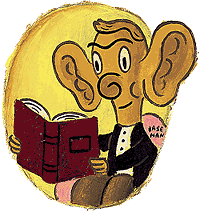
Heard a good book lately?
More on books and literature in The Atlantic Monthly and Atlantic Unbound.
From the archives:
"High-Performance Poets," by
Wen Stephenson (April 2000)
W. H. Auden, James Merrill, and Sylvia Plath read from their work in recordings previously unavailable.
"What Makes Poetry Poetic?" by
David Barber (March 1999)
A review of Robert Pinsky's The Sounds of Poetry: A Brief Guide.
From Atlantic Unbound:
Digital Reader: "Exit Gutenberg?" by Ralph Lombreglia (November 16, 2000)
At last week's eBook World conference in New York, only one thing was certain: the future of our literary culture is up for grabs.
An Audible Anthology
A collection of of Atlantic poems, read by their authors.
Soundings
Classic poems read aloud by prominent contemporary poets.
Elsewhere on the Web
Links to related material on other Web sites.
Books on Tape
A comprehensive catalogue of unabridged audio books for rent or sale.
Digital Audio Players
A guide to digital audio players available on the Web. Posted by Big6, a site devoted to information-technology education.
Like most other members of high-tech society, I have esteemed the eye and thought of the ear as a slow-speed analog backup. Let Homer and Chaucer have their oral traditions -- I had a 300-page book to get through before bedtime. Who cared whether or not I could understand what a gabbling Parisian was saying, as long as I could read his newspapers? Even the parts of the reading experience that involved anything other than the eye seemed retrograde.
What I've begun to suspect is not that the ear is superior to the eye but that each has its drawbacks. You can take things in much faster with the eye, but they seem more likely to stay if they come by ear. Perhaps this is because aural signals seem to connect more-varied stimuli to more regions of the brain than the sight of print does. After all, a three-second passage from any familiar piece of music -- The Beach Boys' "I Get Around," "It's a Small World," "Gaudeamus Igitur" -- instantly calls up not only the rest of the music but also, often, the sights, smells, and emotions of associated events. It's hard to think of a written paragraph with the same broad power.
Or perhaps the difference is simply intake speed. I have begun to think that when it comes to reading, there's a law of conservation of memory: an hour's worth of attention will lead to an hour's worth of retained ideas and images, whether they come from one chapter read aloud or four chapters seen on the page and recalled, on average, a fourth as well. This is, at least, my hypothesis after spending the past year listening to recorded books whenever I was driving -- a campaign for which the Richard Ford experience was the impetus. I've rented quite a few from Books on Tape; I've bought several, from Rinker Buck's picaresque Flight of Passage to Vladimir Nabokov's (no adjective necessary) Lolita; and I've downloaded recorded novels and biographies from online sites for playback on Walkman-style digital audio players with headsets. Many of the books I've heard were ones I thought I already knew, but the vividness of the earborne re-introduction made me doubt whether I had read them at all.
These findings might seem discouraging for someone who makes his living writing for the page and the computer screen. But I have tried to look on the bright side. There is nothing like the eye for quickly taking in data -- the name of the freeway off-ramp, the list of incoming e-mail. Maybe most of what's printed in newspapers and magazines should be considered in the same way -- as having done its job if it provides information for people to act on rather than to retain.
One of the big discoveries of recorded-book immersion is how exceptionally memorable a true performance is. Anything that comes through the ear has a chance of sticking, but some combinations of voice and word are so effective that, like music, they are practically impossible to forget. Maybe Philip Roth wasn't thinking of the actor Ron Silver's voice when he wrote American Pastoral, but the match is so perfect that it's as if he were. As soon as I am reminded of Silver's performance, I can reel off episodes featuring the book's central figure, Swede Levov -- the dialogue is as easy to remember as the lyrics of a song. Anyone who has read Lolita knows that Vladimir Nabokov was one smart writer. Anyone who has heard Jeremy Irons's reading of the book -- incalculably more powerful than the controversial movie version in which Irons starred, since there is nothing to distract from the nuance of his voice -- will feel more forcefully than is possible through the eye alone that each of Nabokov's exotic, improbably chosen words was the inevitable one.
With these examples, I try to inspire and improve the voice in my head. Less droning like a tedious politician. More verve and edge, like an Irons without the Brit-ness. If there's a voice in your head sounding out these words to you, I hope it's sonorous and evocative. Maybe Jack Nicholson. Let it not be Elmer Fudd.
James Fallows is The Atlantic's national correspondent.
Illustration by Gary Baseman.
Copyright © 2001 by The Atlantic Monthly Company. All rights reserved.
The Atlantic Monthly; January 2001; Reading by Ear - 01.01;
Volume 287, No. 1; page 16-17.