


Go to this issue's Table of Contents.
J A N U A R Y 2 0 0 1


More on politics and society in The Atlantic Monthly and Atlantic Unbound.
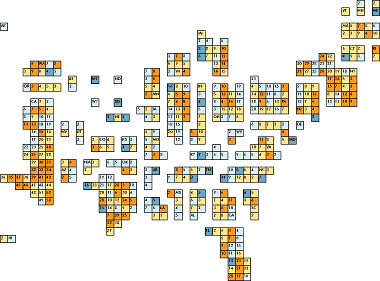
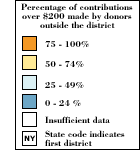 Districts in which the majority of individual contributions come from outside illustrate what analysts call the "dual constituency" problem, which divides a representative's attention between residents of his or her district and others, who make their interests known through campaign contributions. There are a number of possible explanations for why donors reach across district lines. They may have material interests in a district other than the one in which they reside, or they may be seeking to extend their sphere of influence into a poorer neighboring district. For example, in the four-way race for the New York ninth district, which winds through less-affluent neighborhoods in Brooklyn and Queens, 86 percent of all individual donations of $200 or more came from outsiders -- nearly $70,000 from residents of the Upper West Side of Manhattan alone. Elsewhere high levels of outside contributions may reflect highly politicized races in which disproportionate amounts of money were donated by either the right or the left. In Idaho's contentious first-district contest between the Republican incumbent, Helen Chenoweth, and the Democratic challenger, Daniel Williams, almost 50 percent of Chenoweth's and 80 percent of Williams's large individual donations came from outside their district. Ultimately, Williams's outside funding was not enough to overcome the disparity in spending -- Chenoweth spent a total of $1,331,487 to Williams's $876,308 -- and unseat an incumbent in a Republican state.
Carl Thor Dahlman, a Ph.D. candidate in geography at the University of Kentucky, is currently researching the international politics of Kurdish refugee migration.
Copyright © 2001 by The Atlantic Monthly Company. All rights reserved.
The Atlantic Monthly; January 2001; Outside Influence - 01.01; Volume 287, No. 1; page 57.