


Go to this issue's Table of Contents.
N O V E M B E R 2 0 0 0


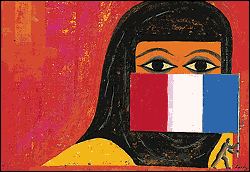
France today has more Muslims than practicing Catholics, and couscous has arguably become the country's national food
More on travels and foreign affairs in The Atlantic Monthly and Atlantic Unbound.
Elsewhere on the Web
Links to related material on other Web sites.
Zin�dine Zidane
A Yahoo "Sport Player Profile." Includes a biography, vital statistics, and related links.
"The backlash," by Carl Honor (December 8, 1998)
"The burly, blue-eyed taxi driver fears that the French way of life -- and even the national gene pool -- is under threat from people with dark skins and foreign backgrounds." An article in The Houston Chronicle that takes a look at xenophobia in France.
|
WEB ONLY
|

But the comparison can be misleading. Generally speaking, it's a smaller problem than the American race problem. Beurs are less visibly different, discrimination against them tends to be on the basis of class rather than race, and when they assimilate into society (or make a pile of money), they're French, period. But in one respect it's a more serious problem, because differences of religion are involved. Islam envisions an Islamic state to protect its rights. France, meanwhile, has one of the most stringent legal separations of Church and State in the world. This creates constant conflict between a state based on the Rights of Man and a religion that, strictly interpreted, holds that all legitimate political power flows from the Koran.
"What Is the Koran?", by Toby Lester (January 1999)
Researchers with a variety of academic and theological interests are proposing controversial theories about the Koran and Islamic history, and are striving to reinterpret Islam for the modern world. This is, as one scholar puts it, a "sensitive business."
"Female Circumcision Comes to America," by Linda Burstyn (October 1995)
Performed by new immigrants, veiled in deference to a cultural tradition of the developing world, female circumcision is becoming an American problem.
But the latest wave of immigration threatens to change what Frenchness means. Islam has left Protestantism and Judaism far behind and is now the second religion of France. No official national statistics are kept on religion and race in France (the country, with its long tradition of equality of citizens before the state, holds such distinctions -- officially, at least -- to be meaningless), but the best estimates of the country's Interior Ministry put France's Muslim population at four million, two million of them French citizens. The historian Alain Besan�on has estimated that given the meager rates of churchgoing in France (below five percent), the country now has more Muslims than practicing Catholics. In 1994 Le Monde found that 27 percent of Muslims were believing and practicing -- which means that Islam may someday be the country's predominant religion if one measures by the number of people who practice it.
But Islam's weight in France is even greater than that, particularly for the generation to come. For one thing, immigrants and their descendants are concentrated in a few important cities and regions (Paris, Marseille, Rh�ne-Alpes, Lille-Roubaix-Tourcoing). For another, although France's non-Muslim population has replaced itself at roughly the Western European rate of 1.3 births per woman, immigrants from Islamic countries have been three to four times as fertile for quite some time. The birth rate among Algerian women was 4.4 in 1981 and 3.5 in 1990. That among Moroccans was 5.8 and 3.5 in those years, and among Tunisians 5.1 and 4.2. These numbers do show natality declining toward the national average, but only slowly. Meanwhile, the disparity in birth rates and the concentration of the Muslim population means that in certain French metropolises a new generation of citizens -- those born from the 1970s to the 1990s -- is one third Muslim.
IN some places France already looks like a Muslim country. One of these places is La Bricarde, a cluster of semi-public low-income apartment towers built in the early seventies at the far northern edge of Marseille. This is part of the Bricarde-Castellane-Plan d'Aou complex, where 8,300 of the poorest people in France live, and where Zin�dine Zidane grew up. A quarter of Marseille's population of 800,000 is Muslim, and La Bricarde is a mixture of North African exoticism and Continental decadence. Lotto tickets are the most popular commodity in the rinky-dink variety store that serves the complex. On a fall day recently, in the blistering heat of the central courtyard, a teen-age girl in a tight black sweater walked with two pregnant friends past an old lady in a djellaba. Satellite dishes run up the sides of the towers like buttons on a shirt. There are 700 apartments in La Bricarde, and at least 200 dishes, all of them aimed skyward to pick up signals from Africa: France has one of the least developed cable networks in Western Europe, and Algerian television can't be picked up there except by satellite. Rock bluffs reminiscent of Arizona loom behind the towers. On several hot summer nights in recent years the residents of La Bricarde have staged their own spectacular variant on Strasbourg's rodeo, stealing cars from the city below, setting them on fire, and launching them from the bluffs.
"The future of the city is in north Marseille," says Didier Bonnet, the long-haired and dashing director of the R�gie Services Nord Littoral, a social-service organization founded in 1988 to serve the housing projects at Marseille's northern edge. Bonnet also has clients in the center city, but La Bricarde is the focus of almost all of his work, and it worries him. "Unemployment is twenty percent in Marseille," he says, "and fifty percent in certain neighborhoods. This is one of those certain neighborhoods." A quarter mile from La Bricarde is a five-year-old shopping center that is one of the largest in Europe. It was built with government help, on the condition that the store owners hire half their employees from the projects nearby. But the residents have begun to drift back into unemployment. Still, some business gets done. Nordine Taguelmint, who lives in La Bricarde and works for Bonnet, shouted "Journaliste!" to reassure a cluster of four alarmed-looking North Africans whom we interrupted in the middle of what looked like a dope deal as we came down a hill behind the projects. A hundred yards farther on Taguelmint pointed out a brand-new Porsche 911 Carrera, owned by a resident of the project.
Juliette Minces, a sociologist who studies Muslim women, reports that a progressive "ethnicization" of these housing blocks is under way. They have become associated with particular ethnic groups -- Senegalese here, Algerians there -- much the way that American public housing became associated with blacks and Hispanics in the fifties, sixties, and seventies. The residents of Marseille's projects are mostly Muslim, and a majority of them come from the Maghreb region of North Africa. Taguelmint estimates the population of La Bricarde at 60 percent foreign. Of the remainder, 25 percent are beurs and 10 percent are French blacks. Only about twenty white families are left in the projects, and all of them, Taguelmint says, feel trapped and bitter. Asked how many belong to the hard-right National Front, he replied, "All of them." All of them? He thought for a minute and revised his opinion: "No fewer than fifteen."
Claude Bertrand, the chief of staff to Marseille's mayor, admits that a succession of Socialist mayors bought a degree of social peace with ethnic sorting. "Not so much as it looked," he told me, but he grants that it happened. He assumes that such segregation will be undone in the natural course of things, primarily by the influence of television. (Other observers assert that by relying on this most American and global of media to assimilate newcomers, France risks solving its ethnic problems by dissolving its own culture -- for natives and newcomers alike.) Bertrand is unworried about the National Front, viewing its supporters as basically the same bloc -- the petits blancs, the white lumpenproletariat -- that voted Communist throughout the Cold War. In this he's right. He thinks the best way to defuse the group is by increasing employment.
Links to related material on other Web sites.
"Vivre et Survivre au Bord des Villes," by Michel Peraldi (1996)
Michel Peraldi's report (in French) on a 1996 study of sources of income in impoverished sections of Marseille.
(The online version of this article appears in two parts. Click here to go to part two.)
Christopher Caldwell is the senior writer at The Weekly Standard and a columnist for New York Press. He writes regularly on books for Slate.
Illustration by Philippe Lardy.
Copyright © 2000 by The Atlantic Monthly Company. All rights reserved.
The Atlantic Monthly; November 2000; The Crescent and the Tricolor - 00.11;
Volume 286, No. 5; page 20-34.