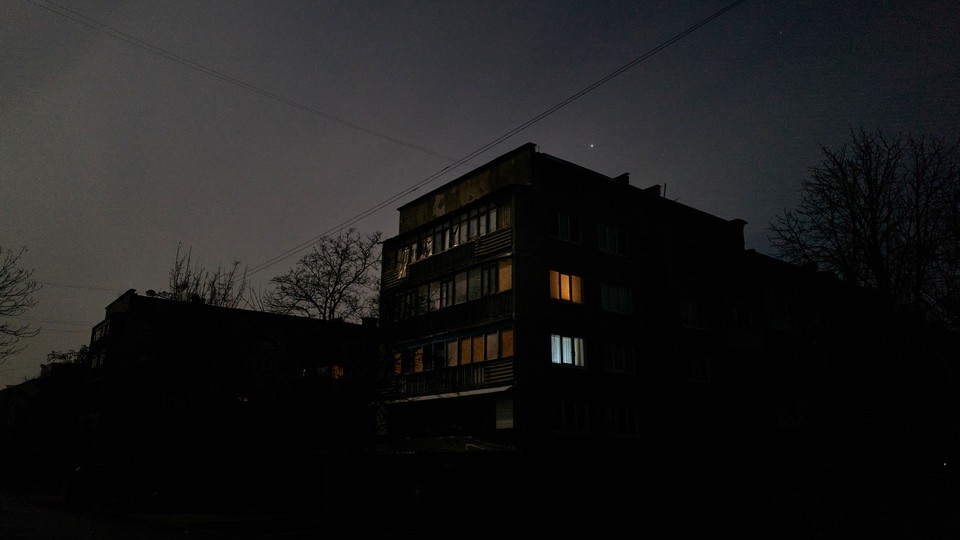
I’ve heard this story many times, in different voices, but always with the same conclusion. “Ukraine was cut off from us, so to speak—people here watch Russian television, and it’s full of anti-Ukrainian propaganda,” my former classmate told me in 2020, the last time I visited Horlivka, the small industrial city near the Russian border where I was born and raised. I was still living there when Russian-backed separatists took control of the Donetsk region in May 2014. Overnight, I became a “citizen” of the so-called Donetsk People’s Republic.
I was just 14 at the time, too young to fully grasp the enormity of what had happened. What struck me first was the change in my school. Horlivka had always been a Russian-speaking city, but before 2014, our graduation ceremonies and school concerts were held in Ukrainian. We would sing the Ukrainian national anthem at the end of every event. Then, suddenly, the Ukrainian flags were taken down. The anthem was no longer sung. The Ukrainian language vanished from classrooms. The disappearance was so abrupt and absolute that it felt unreal, like a dream whose meaning was obscure to me. I remember asking my teacher why everything had altered so drastically. She didn’t have an answer—or maybe she was just too afraid to say.
I left the so-called Donetsk People’s Republic soon after to continue my education in Ukraine, settling in the Zaporizhzhia region. But until 2020, I made frequent trips home to visit my grandparents, crossing multiple checkpoints each time. On those visits, I felt like I’d stepped into a different world. My hometown was the same, but it wasn’t. And what stood out to me most, even more than the soldiers at the borders or the symbols of the Donetsk People’s Republic everywhere, was how completely the education system had transformed.
The school building of my youth was still there, but inside it was a new reality. Russian textbooks had arrived in so-called humanitarian convoys, together with food and clothing. Now these texts populated the school library’s shelves, but there were never enough of them, so locally printed books filled the gaps. Ukrainian history and geography had disappeared from school curricula. Instead, a mandatory class was introduced: “Lessons in Donbas Citizenship.” Every student, from the youngest to the oldest, had to attend. The syllabus listed such subjects as “Donbas and Russian World” (“Russian World,” or Russki mir, is a Putinist term of art for Russia’s putative cultural claim on all Russian speakers), “Fostering a Donetsk People’s Republic Citizen Within Yourself,” and “Donbas—My Homeland.”
I flipped through these textbooks when I visited my old school. They made no mention of Ukraine, instead describing Donbas as its own country, complete with its own state symbols and identity. That the so-called Donetsk People’s Republic was internationally unrecognized merited no acknowledgment. But the text drilled students on the notion that defending the homeland was a citizen’s highest duty. One text, Initial Military Training, stated its purpose clearly: “To help students become patriots of their Republic.” A few pages in, it offered a military oath of allegiance: “I, a soldier of the Armed Forces of the Donetsk People’s Republic,” it began.
Today, three years into Russia’s full-scale invasion of Ukraine, Horlivka is officially considered part of the Russian Federation. Students there recite a military oath to the Russian Federation. But the Russian occupation really began, and the shift in identity was first enforced, when these texts were introduced back in 2014.
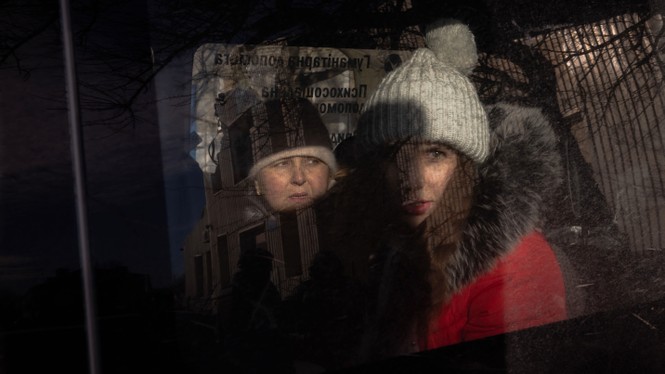
The students who will graduate this year in Horlivka started school under Russian occupation and have known nothing else. They don’t speak Ukrainian. They don’t know Ukrainian literature, history, or culture. They have been systematically estranged from their Ukrainian identity. I don’t know if they consider themselves Ukrainians at all. Their textbooks tell them they are part of “Russian World.” Their teachers tell them Ukraine does not exist. And year after year, memory cedes to its erasure.
Russia’s war against Ukraine has yielded numerous accounts of war crimes and crimes against humanity. The International Criminal Court has issued two arrest warrants on such charges—one for Russian President Vladimir Putin, and the other for Maria Lvova-Belova, Russia’s commissioner for children’s rights. But beyond even the known atrocities, something insidious is unfolding: the systematic destruction of Ukrainian identity.
I’ve read this described as “cultural genocide,” the deliberate destruction of traditions, values, and language—in this case, those that make Ukraine distinct from Russia. The term appeared in legal discussions before the International Criminal Tribunal for the Former Yugoslavia and in the drafting of the United Nations Declaration on the Rights of Indigenous Peoples. Yet, despite years of debate, there is still no universal understanding of what cultural genocide means in practice or how international law should respond to it.
In Ukraine, the first victims of this systematic reeducation were children. Their conscription into “Russian World” started in Crimea, spread to the so-called Donetsk and Luhansk People’s Republics, and escalated further after the full-scale invasion in 2022. Now the process continues in occupied cities where no independent surveys can be conducted. No one knows how many children still identify as Ukrainian—or how many will be allowed to in the years ahead.
Ukraine has no access to these regions, and those living under occupation are unable to leave. Before 2020, my friends from the occupied Donetsk and Luhansk regions could still cross into Ukrainian-controlled territory—some traveled; others studied. But during the coronavirus pandemic, those checkpoints were closed, and then came war. They never reopened.
The prospect of negotiations to end the war in Ukraine has always raised the possibility of territorial concessions to Russia. If my hometown remains in Russian hands, along with other Ukrainian territories currently under Kremlin control, the erasure of our culture will continue, and with each passing year, Ukrainian identity will attenuate and vanish.
To lose the territory and landscapes of my childhood has been painful, but not as devastating as witnessing what has happened to people—friends, neighbors, and classmates who once proudly considered themselves Ukrainian but now find themselves unmoored. Russia does not embrace them as its own, but years of war and occupation have distanced them from Ukraine. They live in limbo.
What has been taken from them—us—is not just a language or a culture. It’s a shared identity, and a future we could have built together. I’m in mourning for all of this. But I also refuse to believe that our notion of who we are can simply cease to exist. Even if Ukrainian identity is suppressed, even if it is whispered rather than spoken aloud, its memory persists—in exile, in the margins, waiting to return.