A Historic Cataclysm in the Middle East
Hamas’s attacks could be a daring single-day raid or the start of a regional war of a scale not seen since 1973.
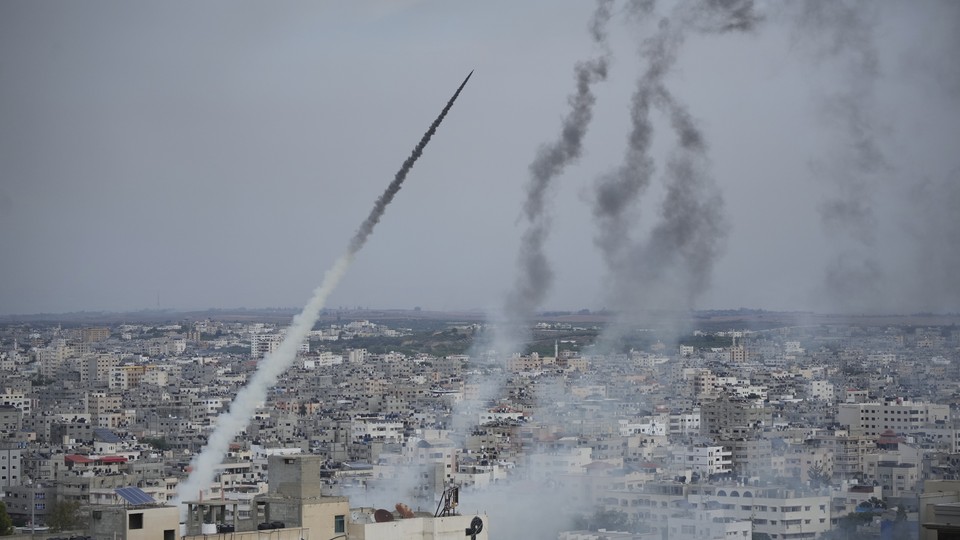
War is a perpetual concern in Israel, but it has been decades since Israelis have had to wonder whether today might be the day that their borders will be overrun and their enemies will go building to building deciding whom to slaughter. Early this morning, a few Israeli military outposts and settlements saw an apparent preview of that nightmare—an operation by Hamas that could be a daring single-day raid or the start of a regional war of a scale not seen since 1973. Hamas fired rockets at Israel thousands of times, then began a land-air-sea operation against targets in southern Israel. Commandos in gliders, trucks, and dune buggies raided Israeli military posts around Gaza. Images on social media show Israeli soldiers in states of dress and undress, apparently dead in the dirt, and Hamas fighters celebrating the destruction of armored vehicles and the looting of lighter ones. The images from Israel show carnage and cruelty comparable to Mesopotamia during the campaigns of the Islamic State.
Much worse than the images of dead soldiers are those of Israeli civilians seemingly having been killed in incursions into towns and settlements nearby. Some images show old women at a bus stop, their possessions still next to them, and their blood and viscera leaking from their corpses. Others—all still unconfirmed—are even worse, with indications that gunmen went door-to-door and killed indiscriminately while residents huddled in fear. More and more videos are emerging of civilians beaten and sometimes soaked in blood, either their own or others’. They appear to have been transported to Gaza as hostages. The dead are not spared this fate. Two videos I have seen suggest that Hamas has taken the corpses of Israeli soldiers to Gaza and encouraged crowds to desecrate them. A woman’s body is stripped partly naked and spat upon.
Shooting thousands of rockets at a time takes planning and covert logistical support. Coordinated commando raids take forethought as well. Failure to foresee these actions is enough to get Israeli generals and spies fired and relieved of command. A single hostage hidden away in some tunnel in Gaza can paralyze Israel for years. Now there are reportedly dozens, in addition to the kidnapped human remains and, of course, the dead, at least 100 Israelis as of this writing. Governments fall over failures of this scale. The Israeli right, led by Prime Minister Benjamin Netanyahu, has long argued that it was responsible for the relative peace that has prevailed for the past decade or so. That peace is now over. Netanyahu’s legacy is in shambles. And the only thing that might keep his government from taking full blame for the failure is the perception that the Israeli left may have flubbed things even worse.
The recriminations have just begun. But they might still be too early. So far the geopolitics of this war are only starting to be understood. Hamas has backers—Iran and Syria foremost among them—and unlike the flat-footed Israelis, they are likely to have had plenty of time to think through how the war will unfold. Hamas would not jeopardize its sponsorship by launching a war without consultation—in particular, a war whose tactics (hostage-taking, parading corpses) were calculated to enrage Israel and its friends.
The most predictable consequence of the war will be a pause in the process of diplomatic recognition between Saudi Arabia and Israel. The countries have long had a working security partnership, and it is an open secret that Crown Prince Mohammed bin Salman would, for the right price, expand that partnership to include full normalization. That is impossible while civilians on either side are dying in large numbers, and their mangled bodies are being exhibited on social media. Iran will be pleased to slow down this process and maybe stop it altogether.
It is less clear why Hamas would be willing to pay such a steep price for its day of victory. Israel will sting from this attack, but in time it will respond in kind, and the Gazan dead (armed and civilian) will probably outnumber the Israeli before long. That leaves many wondering whether this surprise attack—an attack so shocking that it will harden Israel’s security posture for many years—has other phases still to come that would justify the result. The most obvious next step would be the opening of a northern front, across the Lebanon border, by Iran’s proxy Hezbollah. Israel has announced the activation of reserves and alerts in the north. But the disarray in the south is so wild that one could reasonably doubt Israel’s ability to keep things together on two fronts.
“The Middle East region is quieter today than it has been in two decades,” President Joe Biden’s national security adviser, Jake Sullivan, said last week at The Atlantic Festival. “The amount of time that I have to spend on crisis and conflict in the Middle East … is significantly reduced.” If war breaks out generally around Israel, and questions arise about Israel’s very survival, the United States will have to start counting its ammunition. How much is left for Israel, after Ukraine has taken its share? And what about Taiwan, now third in line? These are hard questions, and Iran, Russia, and China would be thrilled, collectively and separately, to force them on the United States.