‘Trump Has Already Changed Our Region for the Worse’: Views From Argentina and Brazil
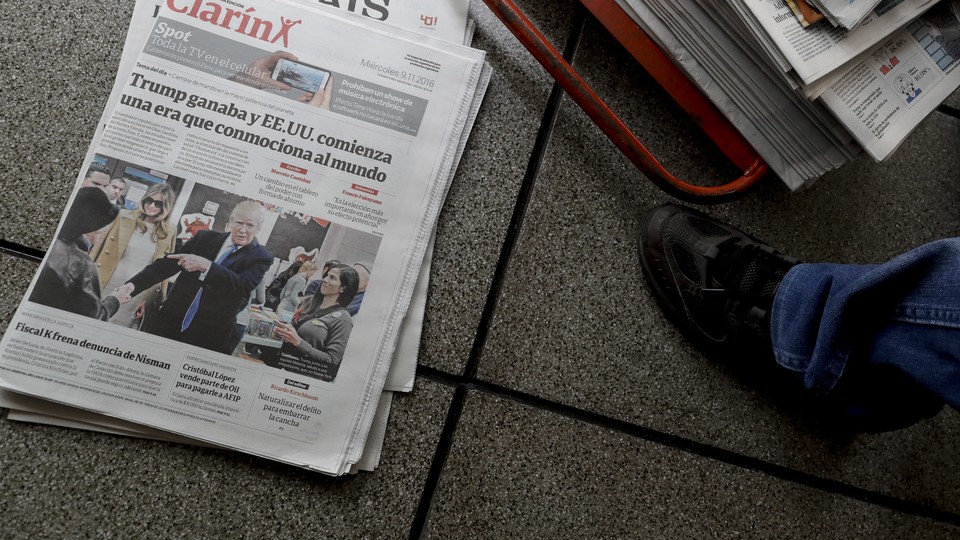
Our latest look around the world takes us to Argentina:
Hello, I’m Boris from Buenos Aires, and I want to bring a different Latin American (South America) perspective to the U.S. elections, if my knowledge allows it. This was a year of deep changes to the region, as exactly 12 months ago Mauricio Macri won against Peronist heir Daniel Scioli in a upset election. Then were the elections in Peru and the ouster of Dilma Rousseff in Brazil. And now the world is changing again, with two important questions for the Southern Cone that a Trump’s victory raises.
The first one is the hemispheric question. Macri’s slogan last year was “to open Argentina to the world,” especially with the United States. The “PJ,” the Peronist party, was protectionist like Trump and an ally of Russia and China. When Macri won, Obama visited Buenos Aires as Bill Clinton did it two decades ago. Susana Malcorra, our secretary of state, wished publicly on Monday for a Hillary Clinton presidency.
After Rousseff's impeachment a couple of months ago, Michel Temer [the new president of Brazil] and Macri developed an understanding to join the regional bloc, Mercosur, to a free trade zone such as the Pacific Alliance, TPP, or a free trade deal with the U.S. and the E.U. Now nobody know what will happen because with the last Republican U.S. president, Washington basically forgot about the region except to fight with Venezuela. Two important governments in dire need (both Macri and Temer face great internal opposition that has Russia’s backing) are seeing how their principal path to victory is closing because of bad timing.
The second question is the migrants. While Latin America is pictured as Central America in the U.S. media, the Southern Cone is a net receiver of migrants since the XIX century (most emigrants are middle- and upper-class citizens). Residency and a path to citizenship are a constitutional right granted to all people who want to live and work in our soil.
My grandfather’s family escaped Bulgaria before WWII and were rejected in the U.S. because of quotas, so they came to Argentina. Today Argentina is the destination of migrants who don’t take a northern path to the U.S. and the E.U.—a lot of migrants and refugees from Venezuela, Colombia, Haiti, Senegal, Guinea, Peru, Bolivia, and Paraguay. Will this flow increase if the U.S. closes its borders? I predict that it will, since after the E.U. started their Mediterranean operations, more Africans risked an trans-Atlantic voyage to Brazil’s and our shores.
Even without that, politicians and journalist have noticed the success of fact-free xenophobic discourse that Trump mainstreamed, so now it’s expanding. The Senate majority leader for the PJ, Pichetto, is talking about how Peru is sending all their criminals and riff-raff to our country and that must be stopped. Lanata, a prestigious journalist who uncovered the kickbacks scheme of our previous president, Cristina Kirchner, is now filling his show with attacks to immigrants and how they are bankrupting the nation.
So, even before Trump take office, he has already changed our region for the worse.
Update on 9/21: Josh Marshall is on a blog tear over a major office building in Buenos Aires being constructed by Trump and his Argentine partners:
According to a report out of Argentina, when Argentine President Mauricio Macri called President-Elect Trump to congratulate him on his election, Trump asked Macri to deal with the permitting issues that are currently holding up the project. This comes from one of Argentina’s most prominent journalists, Jorge Lanata, in a recent TV appearance.
Both Macri and Trump are categorically denying it. But here’s a bizarre blast from Trump’s past:
As TPM’s Catherine Thompson noted back in August, Macri’s father Franco had dealings with Trump in the early 1980s when the elder Macri (a construction tycoon) tried to break into the New York real estate business. Indeed, things got so intense between Franco Macri and Trump that when Mauricio (the current President) was kidnapped and thrown into a coffin by unknown kidnappers, Franco Macri at first thought Trump was responsible for the kidnapping.
Yes, I’m not kidding about this.
Gone are the days of No Drama Obama.
My colleague Marina has more on “questions over how Trump will keep his business interests separate from his work as president.”
Bom dia, amigos leitores! Esta é a #CapaDoDia do O POVO. Acesse todo nosso conteúdo em https://t.co/2Iw9Zm5EUP pic.twitter.com/fiQEYLK2qI
— O POVO Online (@opovoonline) November 9, 2016
Traveling a bit north to Brazil, we find another reader, Andre:
These past 12 months have been grueling, os maybe talking it out could be a good thing. I’m Brazilian, and though I have had my share of international experience, I never lived in the U.S. I’ve got many American friends and coworkers, and my first boss when I was a trainee was from the U.S. Being a millennial and having grown up in the Information Age also exposed me pretty early on to American culture and values. So I guess I do have some familiarity in the end despite having only been there as a visitor.
I am somewhat removed from what’s happening over there. And yet I have to say that the shocking events of the past few months in U.S. politics have had a much stronger impact on me than I thought it would and, according to friends, should. The growth of populism in the U.S. (and in Europe, as Brexit shows) has been much more disheartening to me than the recent cycle we had in Brazil (and Latin America as a whole) for the past 14 years. Because while populist cycles have come and gone in Latin America, the harm it caused was mostly to itself. Sadly, the harm populism can cause in the heart of a hegemonic power will be felt far from its borders and long after its time.
I may be an exception amongst the educated in Latin America, many of whom look at the U.S. through ideologically tinted glasses, but I do feel America is the single greatest force for good in the world, despite its failings. Modern liberal democracy owes its very existence to the foresight of people such as James Madison, John Adams, Thomas Jefferson, and Ben Franklin. Their system of checks and balances was cleverly designed precisely to hold populistic waves at bay, lest an eventual majority would compromise the rights of future generations. They understood all too well elections in itself don’t make a democracy, as so many buffoons such as Hugo Chavez insisted. It is of utmost importance to put a check on the tyranny of the majority.
Sadly, this whole system was somehow diluted and weakened over the past few decades due to the overreach of executive power overseen by George W. Bush in the wake of 9/11, and it didn’t see enough restraining from Obama in the following years.
I do understand what put Trump in power was the widening income gap between uneducated blue-collar whites and the urban liberal and cosmopolitan elite. I do understand all to well how income inequality is a fertile ground for populism, having witnessed it first hand in Brazil and Latin America. I get the generational divide and economic tectonic shift that left so many behind in rural America. It’s the story of a popular backlash against an out-of-touch establishment, but then again, so was fascism in Europe in the early XX century. In fact, most historic tragedies can be rationally explained. It doesn't make them justifiable.
I am not insensitive to the blue-collar worker's plight, but if you want to justify this, it’s somewhat easy to justify the rise of ISIS on Syria as well. The grievance is legitimate, but it doesn’t make the reaction valid. And that popular reaction in the U.S. has sadly meant an ugly spectacle: xenophobia, racism, sexism, self-righteous anger, and bigotry.
And finally, the death knell of any democratic regime: the end to reasoned debate. Are Trump supporters necessarily xenophobic and sexist? Certainly no. Some are, but I’d like to believe they are a minority. However, it cannot be denied that Trump succeeded in his campaign despite such vitriol. That such ideas have become something to be glossed over in a president to so many Americans is nothing short of a tragedy. The world is a darker, less safe place than I used to think. Maybe I was naive before, but now it’s hard to miss the historical parallels.
Finally, another disturbing consequence of this election is who actually becomes the world’s most powerful man in the end. I have this nagging feeling it’s not really Trump, but Vladimir Putin—a man who is highly intelligent, but also dangerous, and shares none of the values so many in the West have grown to take for granted. The thought of a world in which Putin can move unchecked on smaller states without any opposition from America is frightening.
I may be in Brazil and somewhat geographically removed from all of that, but I care deeply about liberal values, individual rights, and its advancement the world over. The world doesn’t seem to be heading in that direction anymore.
