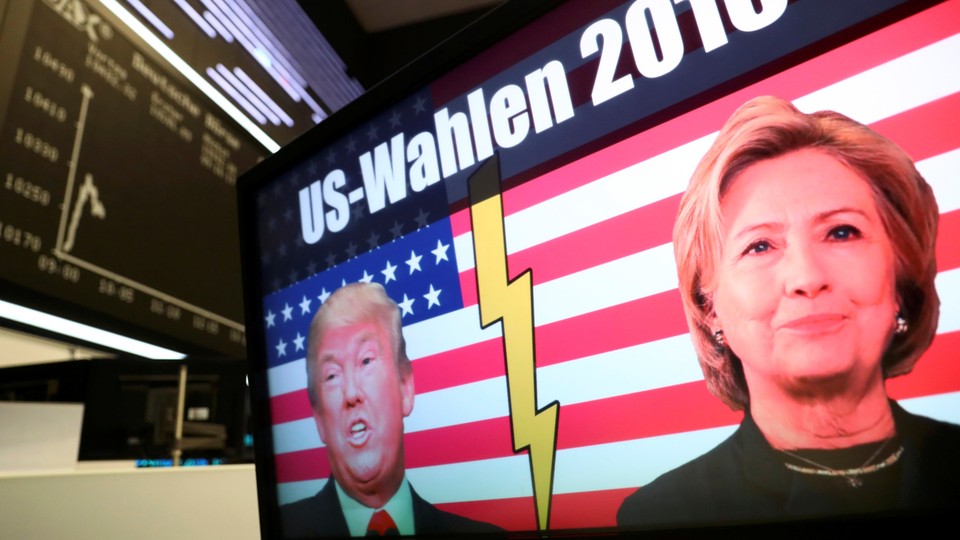
A TV screen is pictured in front of the German share price index, DAX board, at the stock exchange in Frankfurt, Germany, on November 9, 2016. (Kai Pfaffenbach / Reuters)
Editor’s Note: This article previously appeared in a different format as part of The Atlantic’s Notes section, retired in 2021.
For a primer on how precarious relations are between Germany and the U.S. following Trump’s win, don’t miss Frum’s piece from yesterday, “America’s Friendship With Europe Has Been Horribly Damaged”—and “nowhere,” he writes, “does the reaction look more dangerous than inside the most powerful state on the European continent, Germany.”
[Trump’s victory] up-ends German political assumptions about the United States, at a time when Germans are already ready to have those assumptions up-ended. The mighty German middle is becoming less mighty, discredited by Angela Merkel’s flung-open door to Middle Eastern refugees. Anti-refugee, pro-Putin forces are gaining strength at the expense of the parties of the center. Two-thirds of Germans oppose a fourth term for Merkel.
Merkel has backed herself into a crazy political dead-end. She is identifying an open-door immigration policy as the foundation of her kind of liberalism—even as, in reality, large-scale immigration is helping destroy liberalism across the countries of Europe, and even within Germany itself. Warning that a Trump-led United States might not espouse values of democracy, freedom, the rule of law, and equal human dignity amounts to a passport for Germany out of the U.S. alliance.
Three German readers sent us dispatches from Deutschland last week reacting to Trump’s win and what it might mean for their country. My favorite one is from this first reader, Dariusch, given his heterodox views:
I’m an (atheist) German-Iranian, born and raised in Germany, living in Berlin with a background in political science, currently owning a cafe and maintaining a one-person video production company. I’m a green left winger, critical of some aspects of globalisation and welcoming of others. Unlike many left wingers in Europe and Germany, I don’t have a black-white view of the world or the United States. Things are too complicated for that.
On the morning of November 9th, my girlfriend checked out a News alert on her phone and yelled out „Oh my god! Trump has won!“ I just broke out in hysterical laughter, because it seemed so unreal that a clown would be the next president of a country that shaped European and German culture and politics so tremendously over the past 70 years.
If Trump goes along with his foreign policy plans of not honoring NATO commitments in Europe, that might actually have positive effects over here, as this could be a driver for more inner-EU cooperation regarding the security architecture in our neighbourhood.
A common European army would make so much more sense politically and be more cost-effective as well. We need to emancipate from the U.S. and shape our own, independent foreign and security policy. A Trump presidency could drive this emancipation. Likewise, the protectionist economic agenda bears the potential for companies moving from the U.S. to Europe. But probably, these beneficial ripple effects will fail to materialize.
In the aftermath of Trump’s victory, right-wing anti-globalisation groups already start gaining momentum. After the elections in France, the Netherlands, and Germany in 2017, the reactionary ideology of returning to a pre-globalisation state and implement closed societies could be up for growing political gains. A President Le Pen would be bitterly opposed to any integration of the armies and is also a proponent of economic and cultural isolation. Same goes for Wilders in the Netherlands and that Hampelmann (Jumping Jack) in Austria, whose name I didn’t bother to remember. Those groups will gain ground and drive the old parties to more quickly embrace parts of these reactionary, dangerous and obsolete ideas to hold on to their dwindling power, as they already have before November 8th.
With Trump’s victory, right-wing demagogues in Europe will gain an upswing. Nothing good can come from a Trump presidency for Europe and Germany at this point. I’m really afraid that future historians will look at back to the year 2016 and say “That’s when the whole mess started”—like they said looking back on 1914 or even 1933 (but let’s not exaggerate until we have a good reason for it).
The U.S. is a deeply divided country, just like most parts of the Western world in this day. The overall positive developments of integrating societies, cultures and economies did not reach a large chunk of people who have been forgotten. This is the case everywhere, from Los Angeles to Kaliningrad. There are many deep dividing lines, along cities and the countryside, among race, wealth, religion and education.
From here, the United States don’t look like a coherent nation state. I think it’s time to rethink the political system. Two parties cannot adequately represent the diversity of opinions and people. They just form a wide compromise that nobody is really happy with. To me it seems completely strange, how the loser of the popular vote regularly moves into the White House. At the time of its foundation, the United States had the most advanced political system of the world, but 300 years later, it requires a major overhaul.
Here’s another reader, Angela (not Merkel):
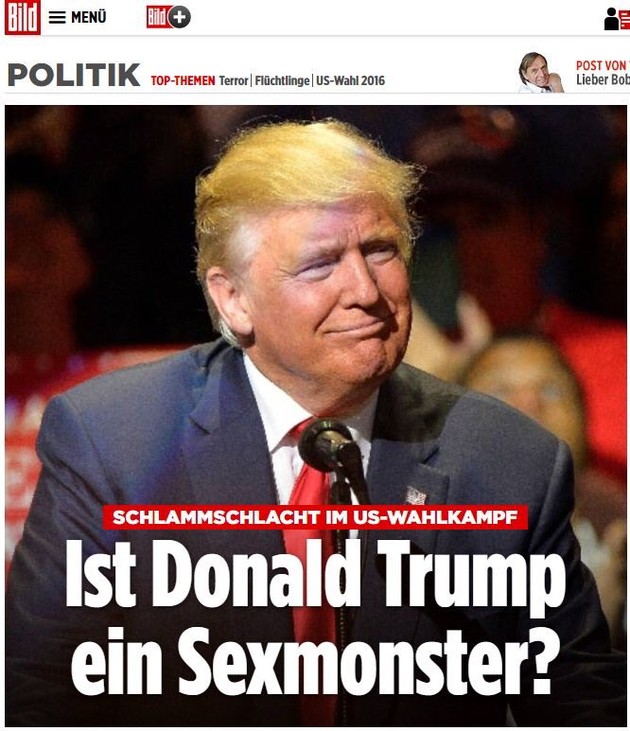
From an October edition of the German tabloid Bild
As a German citizen living in Berlin and a political scientist by trade, I am deeply concerned about Donald Trump’s victory. In the evening hours of November 8 (CET), I watched a short segment on CNN International describing the voter turnout at a polling station in Florida. And when I saw the long line of young women and what I believed to be Cuban- or Mexican-Americans waiting patiently to cast their ballot, I went to bed quietly confident that Hillary Clinton would win. Would any of those young women vote for “Grab-them-by-the-…”-Trump?, I wondered to myself. Most certainly not. Would any of those Cuban- or Mexican-Americans vote for a candidate who promised to build a wall and make Mexico pay for it? Most certainly not. And with so many people turning out to vote, I was sure Hillary Clinton would win. So I thought.
When I got up early in the morning on November 9, I realized I was mistaken. Throughout the day, I felt so frustrated and shocked that I couldn’t even bring myself to turn on the TV or the radio; I was still in denial.
Given what the now president-elect has said and done during his campaign, I am afraid that a Trump administration might adversely affect both Europe and Germany. I am afraid that Trump might undo the system of international organizations and alliances as we know it. He has declared NATO, which is a cornerstone of both German and European security, essentially dispensable, while heaping praise on authoritarian leaders. He doesn’t seem to care a lot about the rules which govern international relations and trade and which have served both the U.S. and Germany quite well for 70 years. And I am also afraid that German-American relations might take a turn for the worse as the president-elect has made no secret of his dislike for Angela Merkel and her immigration policy. And the German chancellor doesn’t seem to like Trump very much, either.
With the British Brexit vote in mind, I am amazed by the fact that the predictions of pollsters have been proven wrong once again. I am also quite amazed by the fact that a populist candidate got elected, after a divisive campaign full of brazen lies and insults—though I believe a similar thing might happen in Germany in 2017, when the federal parliament, the Bundestag, is due to be elected. Until then, the right-wing populists of the AfD (Alternative für Deutschland), who have been busy scaremongering ever since the refugee crisis began in autumn 2015, will do their best to spread even more fear of Muslims and Syrian refugees among the German population. I am pretty sure that they will eventually manage to lie their way into parliament.
It is very saddening to see that many Germans are unable or unwilling to recognize the not-so-hidden authoritarianism, antisemitism, and nationalism lurking beneath the AfD’s surface. And it is equally saddening to see that the United States, our friend and partner, whose troops once freed Western Germany from Nazi tyranny, with a democratic tradition so much longer than ours, now has a president-elect who is applauded by white supremacists and former Klansmen and who essentially declared “I alone can fix it” during his convention speech.
This doesn’t bode well for Europe, where right-wing populism has been on the rise in recent years, and it certainly doesn’t bode well for Germany. Right now, I am deeply worried about the future of Germany, the European Union, and the United States of America.
Here’s one more reader, Jörg, in the Frankfurt area. He’s mostly concerned about the environmental impact of a Trump presidency:
The European right-wing populist movements and “parties” and their ignorant and furious followers will see Mr Trump’s rise as a confirmation of their crude and equally ill-informed and mislead opinions—probably not in Germany (there is a hope left that enough people in this country retain a memory of the 1930s), but in France, Netherlands, Denmark, Greece, and others are a different matter. If they fall into the hands of these right-wing populists, Europe is going to lose all of its achievements in freedom, wealth, and true scientific and social enlightenment—in combination with Climate Change that could mean the end of civilisation as we have only just gotten to know it.
And so I come to something—Climate Change—that has great significance to us and should have much more importance to citizens everywhere, including the U.S. of America. The fact that it didn’t come up in any of the three “presidential debates” just proves how far removed you people in America are from the realities in this world. Trump has clearly no idea what is happening on this planet. No other single issue is going to affect all of us on this scale. All other decisions need to be based on this fast approaching super-crisis.
For reasons too complicated to mention here, European people (at least on the continent; the U.K. is for other complicated reasons a different matter, similar to U.S.) are more aware and better educated about scientific facts. If Trump disrupts the process of international accord on Climate Change—a fragile thing at best anyway—there is no telling what kind of rise of the average temperature will be possible. Time and speed is of the utmost crucial importance here; even a slowing down of the necessary basic structural changes could have terrible consequences. If Trump wants to stay ignorant of some basic facts of the world in which he lives in, on a personal level that is fine with all of us. But as the deciding force and power he represents now, he must grow up and stop his childish (or maybe senile) behaviour.
Now it is time for Europe (and other parts of the world) to fast become assertive, independent, and perhaps even strong. It seems that some of our politicians have seen this coming. Plans for a European army are emerging—a good start. Economy and finance must follow immediately, and a discussion about better and possibly more democratic structure is on the way.
Yes, we all have learned something about democracy from America (as America once learned from Europe). This election has taught us even (and once) more how a democratic system can be corrupted by groups and individuals egocentric enough and opposed to democracy. Thank you, America, for this. We will reflect deeply and thoroughly on this lesson.
Update from another reader, Eva:
Being a German-American (currently visiting my parents in Germany, and hearing/reading the news of both sides every day), David Frum’s article first interested me a great deal. His analysis of language in Merkel’s brief congratulatory statement the morning after the election hooked me. I am a linguist, well aware with practices used in formal statement. My linguistic background, especially the field of pragmatics, makes me a nerd sometime, plucking apart what people said, what they really said while, say, standing in line at the post office.
I was surprised by Frum’s remarks on perhaps Germany turning the tables, and not clinging to traditional positions of power. That it might be perceived as arrogance, or as patronizing. Just something that the U.S. isn’t used to very much.
While I read Frum’s article I thought huh, this is interesting—someone perceiving Merkel this way, from a tiny speech given under circumstances that were terribly uncomfortable. I do think there is some oversensitivity in Frum’s writing. Merkel is not “downgrading” the American-German relationship just because “its ties are deeper than with any country outside of the European Union.” I perceive this to be neutral, or even positively stressing how deep U.S.-German relations are. Perhaps it’s a German thing to always state the obvious the truth, when for many a “fluffing up” of reality as it really is, would be preferable. It really isn’t insulting. It’s the equivalent to you perhaps saying to a very good friend: “you know, after my mom and dad and grandmother and brother, you really are the closest and most important friend I have outside of immediate family.” It’s honest—not downgrading.
The other issue of concern is Merkel offering collaboration based on certain Western values that America and Germany share. They concern democracy, freedom, respect for the rule of law, and the equality of people of all sexes regardless of origin, skin color, creed, gender, sexual orientation, or political views.
Frum is correct to perceive a “conditional” quality here—the two countries operating together as long as their work is based on those values. What crime is there here in Merkel being the one to point out the conditionality? Is it so terrible that a smaller country does not approve of everything and anything in the big and mighty country? Is it hurt pride?
Merkel doesn’t actually say anything here that should cause an outcry. The values she has just mentioned are at the core of U.S. identity. One would expect them to not be removed or broken, or that would mean the States breaking those commitments, or changing them significantly. Which indeed should cause the U.S. to cry out with shock and confusion.
Frankly, the many fabulous things that the U.S. have done for Germany over the course of history don’t really enter here, but Frum brings them up. A good cooperation, a genuine friendship, help that can never be overemphasized, especially in the years after WW2 and during the Cold War. But you can’t argue: we did all this for you for so long, so now you have to play along with whatever because you owe us and owe us forever. The Germans still have a spine and an inherent moral compass. Trump’s many incredibly offensive remarks about different races, and women, do not belong among those “shared values” between the U.S. and Germany.
I think Merkel is not arrogant or cocky. She simply knows—much as many a person enters a marriage—that certain things are desired but not necessary, some necessary at all costs, and some simply a deal breaker. Which of us entering a serious relationship does not have their deal breakers? Someone’s a smoker? Not religious? Not from same ethnic background? Away on his job too much? There are thousands of things that people view as “deal breakers.” It is good to know them in advance, and to stick by them. That is not cocky behavior. That is simply knowing yourself well, and knowing what you can live with in advance. Merkel is simply aware of the deal breakers. Those would be qualities that go against the shared familiar qualities of the West. Racism? Offensive, nonthinking language all the time? Sexist remarks (or even deeds?) I admire when someone knows their deal breakers and sticks by them.
I wanted so much to read more moderate articles, to believe that Trump is not at all bad. Every day I think about it, but it just doesn’t sit right. I can see certain talents and fortes and experience in him, but then moral issues—those of your inbuilt moral compass—just keep popping back up, and they simply are stronger. This president, may you like it or not, will always be the president who wants to grab women by the pussy. That, among other things, will never disappear. It showed his true colors. There are simply are no valid apologies for some of the things he has said.
I wish I could be nicely divided, in a gray area, but this time it doesn’t work that way. I don’t want my spine to bend. I want to listen to my moral compass. I want to be able to look at myself in the mirror without guilt.