Editor’s Note: This article previously appeared in a different format as part of The Atlantic’s Notes section, retired in 2021.
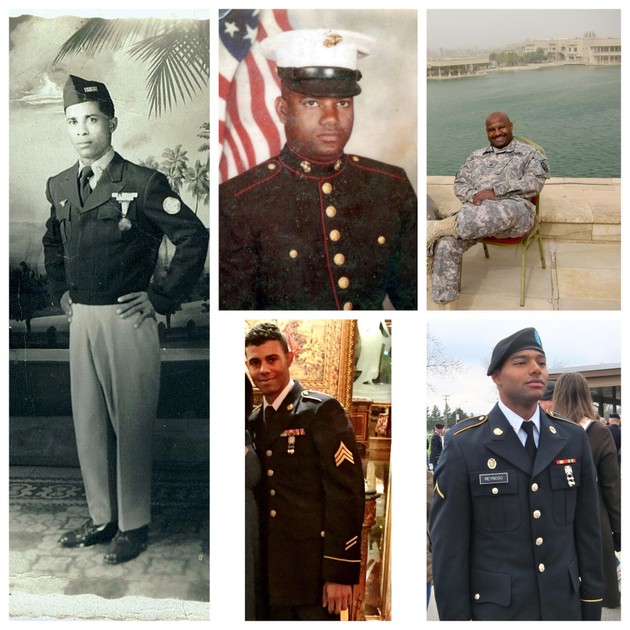
Three generations of Reynoso men (starting with the black-and-white photo, going clockwise): Luis’s father serving under Trujillo, Luis as U.S. Marine, older Luis as U.S. Army soldier, and Luis’s two sons in their U.S. Army uniforms
Reader Luis’s father—like my grandfather—worked for Trujillo:
I was born and raised in the Dominican Republic. My father was also one of many Dominican men who served under the dictatorship of Trujillo. My father was a man of his time. He arrived in the early ’50s to the capital of Santo Domingo from the province of Puerto Plata. Back then he was a young man with dreams of becoming a high-ranking individual in La Guardia de Trujillo. He could barely read and write but he always had the ambitions of being near El Generalissimo. Trujillo was his idol and he intended to emulate him at all costs.
In those days, the Dominican military was a way to upper mobility for men like my father—men of humble backgrounds and little education who aspired to rise up in the ranks and become a general or part of the military mystique that was well-respected and adored by many Dominicans of his generation. My father would eventually become the chauffeur for one of Trujillo’s senior ranking officers. This was a duty that he was very proud of because it was a highly coveted job.
“Trujillo took pride in the military,” my father would say “and if you were one of his soldiers, you were respected by all,” he would conclude. “Guardias were respected and nobody would dare commit a crime against a guardia,” my mother would add.
All photos courtesy of Luis Reynoso
I remember listening to my parents relate stories after stories about how good things were when Trujillo was in power. According to them, life was a lot simpler and the country enjoyed a much more prosperous economy. The crime rate was also low because anyone who was caught committing a crime would face a quick justice. “You could sleep with the door open and nobody would dare steal anything from you,” my mother always commented.
Trujillo did not bother with the small trivialities and bureaucracies of the justice system. And as in any society ruled by an oppressive dictator, Trujillo had a secret police that terrorized the population and instilled fears, creating suspicions among many.
El Generalissimo was assassinated in May 1961, the year I was born, and so by the time I was a teenager in the late ’70s, many of those who served under him were still around my neighborhood. Some of the men were still in the military. The mystique of Trujillo was very much palpable among the people.
Joaquin Balaguer, at one point Trujillo’s right-hand man, became president. Many people viewed his presidency as an extension of Trujillo’s reign but without the mass appeal and adulation from the masses. Balaguer was a hardliner, a well-educated man who despised university students and showered the poor with food baskets and toys. He was also a quiet and calculating operator who used his political shrewdness for political gain.
In short, Balaguer was a typical Latin American strongman. Unlike many men who were by Trujillo’s side and had climbed to the top by brute force, Balaguer did it by being his scribe and the architect of his policies. Balaguer did not take care of the military but rather used it as a tool of government. This and the fact that he was a lifelong bachelor and wifeless created rumors about his manhood—a dangerous thing for a leader in a country that values machismo. Yet, Balaguer was able to maintain a cozy relationship with the military.
And so in the late ’70s, right around the time of my adolescence, many people felt that the good times had already gone by. The Era of Trujillo had maintained a stable economy and even paid off the national debts. The ’70s, during which Balaguer was mostly president, were mired by oppression, political discourse, student protests, workers’ strikes, killings and disappearance of anyone labeled by the government radical or communist. There was also a stagnant economy and a public distrust of the uncontrollable private sector that raised the price of basic necessities at their own leisure. More than 15 years after the demise of Trujillo’s regime, the country was still trying to find itself.
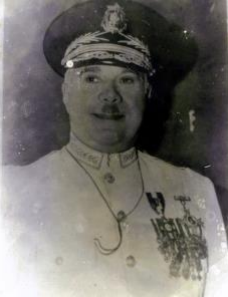
Rafael Trujillo
Many had forgotten Trujillo’s crimes and his reign of brutality against the country. There was a sense of nostalgia, yet collective amnesia. They longed for the stability, prosperity, and a sense of national security that was common in the ’50s, even if it was at a price: the nonexistence of civil liberties and prevalent human rights violations. Trujillo’s regime had a paternal appeal for many Dominicans and it’s not a surprise that one of his many titles was Benefactor of the Nation.
By the late ’70s, my father had long left the military and emigrated to New York. “The military was never the same after Trujillo was killed,” my father lamented.
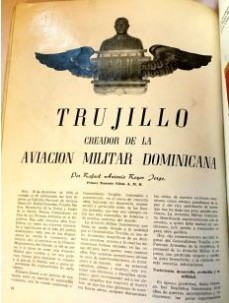
I was mostly raised by my mother, while my father left the country to look for a better future in Nueva York. Many times, I found myself going through my father’s old belongings. I admired his collections of military metals, photos, and a magazine of Trujillo that he so zealously kept private.
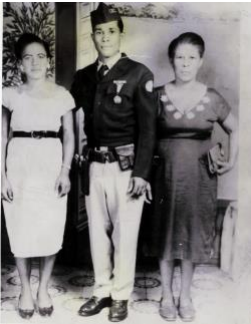
There is a photo of my father wearing the Dominican Air Force uniform with a ribbon on his chest and a picturesque background of palm trees and the ocean [seen in the collage above]. His dream was finally realized in this photo. There is another picture of my father with my mother and my grandmother [seen above]. They all look proud. My mother, next to her husband, who could count on him to provide for the family as long as he was in the military. My grandmother, who could also count on my father to help her economically and send her money to the countryside.
It was probably around the time these pictures were taken that my father was carrying out El Jefe’s crimes.
He was a small yet necessary piece of Trujillo’s gargantuan crushing and killing machine. Sometimes, I would get bits and pieces of his stories when he did not realize that I was around. Among friends, after a few cervezas and once the stupor of alcohol had dismantled away all his inhibitions, he would confess about being on patrol roaming the city for those deemed undesirables by the regime, “rompiendo cabezas,” or fracturing skulls, as he used to put it and “teaching them a lesson.”
There were many pictures of Trujillo. In those times, the ’50s, families were required to maintain pictures of El Jefe as a sign of loyalty toward the dictatorship. There was also that glossy magazine, probably commissioned by Trujillo. It had a biography of him and described his military triumphs and training. Trujillo had been trained and molded by the U.S. Marine Corps during the American occupation in 1918. The magazine also depicted the different types of armaments of the Dominican Armed Forces, planes, and troop marching. There were also ribbon-cutting ceremonies illustrating new facilities built by the dictator.
I grew up among all of these things. My parents longed for a past that would never return. Although my father had lived in the U.S. for more than five years by the late ’70s, he was reluctant to bring us here. He was hoping that his Santo Domingo would get better someday and he would be able to return. As such, he delayed his decision to bring us to the United States. I finally arrived in the winter of 1980 along with my mother and sister. My sister and I enrolled in community college and began English classes.
One day, my father sat me down and told me that I must either join the military or get a college education. He added that if I did not want to end up like him working in a factory, I had to learn English quickly. And so it was that in the fall of 1982, with a basic knowledge of the English language, I joined the U.S. Marines Corps. My father could not have been more proud of me when I return from basic training wearing the dress blue uniform. He carried a picture of me in that uniform in his wallet and he would show it to everyone.
I left the Marine Corps after three years to complete my bachelor’s degree. In 1990, after obtaining my degree, I started my civil service career working for the state of New Jersey. After that, I was my father’s favorite son. He always respected me for taking his advice. He did not have the same feelings for my sister because she never listened to him.
I eventually returned to military service in 1995. I joined the Army Reserve because I somehow missed the comradeship of the service and felt a sense of duty.
My father would go back to the Dominican Republic and visit his old friends from his military days. After all those years, he still kept in contact with them. My father would refer to this group of friends as “La Guardia Vieja,” or the old guard. Even after many years, he trusted his old military friends more than he trusted his brothers and other relatives.
My father passed away in 2004. When my sister was cleaning the house and giving away his belongings, I managed to keep the magazine and his old photos. I could not find his medals.
A few years later, one of his old friends from the military, who also happened to be my godfather, also passed away. Eventually, they all died off. In May of this year, Antonio Imbert Barrerra, one of the main plotters of Trujillo’s assassination, passed away at the age of 96.
The sense of military duty, derived from my father, has stayed in my family. In the spring of 2009, I was called to active duty and deployed to Iraq. One day during my deployment I called my wife, and she sounded very upset and frustrated. She told me that our youngest son, who had been born in New Jersey 19 years before, decided to join the U.S. Army and did not bother to tell anyone.
“If anything happens to him, you are responsible. You guys with all this military thing,” my wife exclaimed.
She knew one or two things because her father had also served in the Dominican military during the Era of Trujillo. She was also raised a few blocks away from the Dominican Air Force Academy. (The history of its building and construction had also been featured in the magazine I kept of Trujillo.)
In the winter of 2010, my oldest son, born in New Jersey in 1987, also joined the U.S. Army, and a few years later he served in Afghanistan.
Dear Luis,
Thank you for sharing your family’s story with our readers and me. I recognized your ambivalence over your father’s role, and I also saw you redeem him partially through your own choices and the example you set for your sons. That is as much as we can do as individuals: rise and continue to rise.
I also want to thank you for illustrating so candidly the complexities of Dominican masculinity, which is the most potent—perhaps toxic?—element of our culture to this day. As a woman, I have experienced it second-hand, as expectations for me are far different, but I have long recognized the limiting ways men are expected to define themselves in our country. Your father’s “dreams of becoming a high-ranking individual” attest to the lure of power and authority that compels many men—Trujillo being the ultimate example—to bend others’ lives to their will. That dynamic is still steeped in the structures of families, churches, schools, and other significant institutions that collectively define Dominican identity. In the end, it is a trap for the men, and an extended sentence for the rest of us.
I’m sure you and I could speak at length about your experiences, but I’ll draw this note to a close by thanking you again for your candor and honesty, both of which are so necessary to reach true understanding and attain meaningful change.
***
Update from another reader with a similar experience as Luis’s and mine:
My parents were both born and raised in the Dominican Republic and experienced first-hand the nefarious dictatorship of Trujillo. That trauma informed my upbringing as a Dominican American in New York City. As a result I have written a book Dividing Hispaniola: the Dominican Republic’s Border Campaign against Haiti, 1930-1961 and wrote and perform a one-man show called Eddie’s Perejil (which you can learn more about on my website). Coming to grips with the legacy of dictatorships and mass murder is critically important, particularly in the diaspora. I applaud your important contributions to our understanding of post-trauma, memory, and identity.