The New York Yankees are one of the richest franchises in the history of professional sports, valued at more than $7 billion. They are also one of the only baseball teams that refuses to cover internet access on their team plane, requiring players to pay roughly $9 a flight for the service, as Sports Illustrated discovered in March. “It’s your fault,” the outfielder Brett Gardner reportedly told the star pitcher Gerrit Cole, who signed for $324 million in 2020. “Your contract is too big, so they can’t pay for the Wi-Fi.” The team is willing to reimburse players for the expense, but few take advantage. “To be honest, I’ve never had a real job, so I don’t even know how that works,” explained the catcher Kyle Higashioka.
Ironically, shortly after this comical scandal broke, Delta began offering free internet on many of its flights. The move is likely to affect the entire airline industry as other carriers rush to keep up with their competition as well as changing consumer expectations. And because the Yankees charter their plane from Delta, their players will no longer have to pony up to browse YouTube en route to their next bout.
Complimentary Wi-Fi in the sky seems like a win-win—and not just for fabulously wealthy athletes. After all, who doesn’t like free stuff? But the truth is, we pay dearly for services like these, just not with money. Until now, planes have been the last oasis of the offline, one of the few places where we still had the option to be unavailable. Soon, that will no longer be the case, to our shared detriment. The Yankees were right: Free airplane Wi-Fi isn’t worth the cost. We need to defend our right to be disconnected.
Why draw the line at airplanes? Because that’s what’s left. Over the past two decades, we have slowly ceded our previously private spaces to the demands of constant connectivity. It began with cellphones. The devices seemed innocent, but they were invasive, gradually fostering new social expectations around communication. With phones in our pockets, we no longer had an excuse to be unreachable. And with the introduction of text messaging, we were pressed to respond even in situations where we couldn’t actually speak.
Then came smartphones, which crazy-glued us to our email inboxes and made social media almost inescapable. Our phones began to intrude on all of our interactions; texts and WhatsApps regularly interrupted our real-world conversations. Paradoxically, the more we were able to talk with other people, the less we became truly available to them.
For a time, it seemed as though this assault on our attention had peaked and we had arrived at an uneasy new normal. But then came the pandemic. Suddenly, work came home, and so did the insidious impositions of Slack, Zoom, and other office accoutrements. Without any collective decision, many of us became citizens of an always online society, constantly on call and rarely at rest.
I’ve cast these developments in a sinister light in order to highlight their drawbacks, but they unquestionably had many positive effects. I know this firsthand. Unlike most, I worked from home for nearly 10 years before COVID-19. I like to say that when the pandemic hit, people went on my employment plan and discovered what they’d been missing. But just as I am very familiar with remote work’s benefits—including flexible scheduling and lack of commuting—I am also intimately aware of its pitfalls.
Here are a few: You feel as though you are always on the job, even when you are with family or on vacation, because work is wherever your laptop is. Subconsciously, once you know you can work from anywhere, you take your work everywhere. This also collapses the separation between home and work life, because both take place in the same space. Perhaps most troubling, working remotely replaces real-world connections between co-workers with thin digital facsimiles—the sort of ties that can easily evaporate during moments of personal crisis, simply because the people involved have never actually met. These problems aren’t new; they naturally follow from the other technological innovations that preceded the pandemic, such as smartphones and social media. But working from home supersized them.
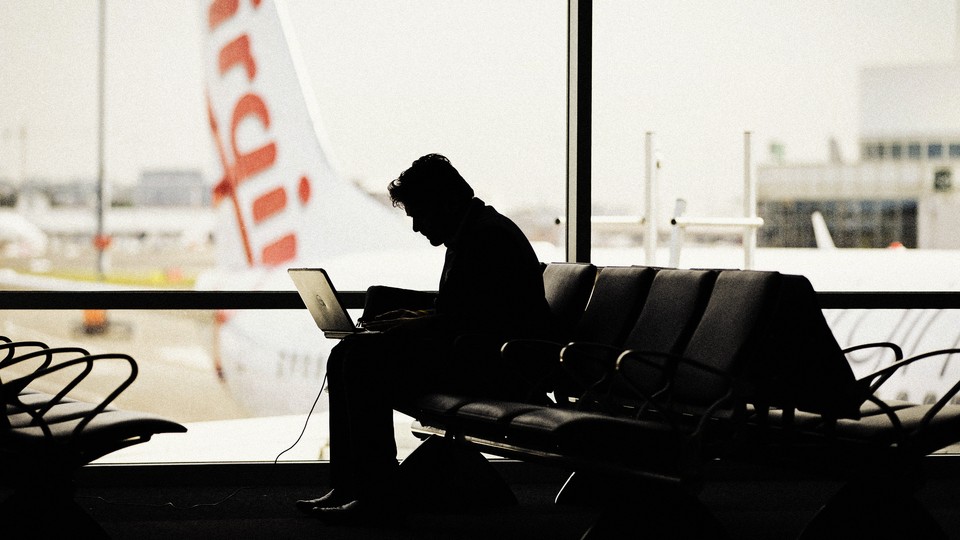
In my case, the advantages of having a portable profession outweighed the downsides. But as a reporter who traveled regularly for work, I had the privilege of escaping it in the air. For many people, airplanes are places of cramped confinement. But for me, they were a place of release, where I wasn’t on the clock, because I couldn’t be on the clock. Some planes lacked Wi-Fi entirely and others charged exorbitantly for it, which meant that people did not expect me to be online while in transit. Only through this experience did I realize what we had lost when we allowed connectivity to colonize our consciousness.
The problem here isn’t technology but its pervasiveness‚ not social-media platforms but a lack of limits on them. In this context, airplanes have become the last redoubt of the disconnected, the rare place where we are free from nonstop notifications, the demands of bosses, and the steady infiltration of the internet into our private lives. Rather than revamping airplanes to be like everywhere else, we should look to them as a model for what we might preserve elsewhere. It isn’t reasonable or realistic to expect people to forgo the many blessings of remote work or swear off their smartphones—though some thoughtful teens (and also Pete Davidson) are trying. But it is reasonable to ask ourselves whether we have conceded too much to availability and lost something essential in the process.
It’s unlikely that the Yankees meant to make this philosophical point when they declined to spring for Wi-Fi. But as a professional sports franchise that relies on human beings, whose chemistry can determine victory or defeat, it makes sense for the team to prefer that teammates spend their flights interacting with one another rather than their Instagram feed. And that’s precisely what happened: “The Yankees fly on a pretty cool custom plane with poker tables and stuff,” the pitcher Jameson Taillon told Sports Illustrated. “So I would take that over free Wi-Fi, if I’m being honest.”
We don’t need to turn our airplanes into casinos. But we should consider how we might transform our public spaces into social spaces, and design them to encourage interpersonal interaction rather than solitary screen time. This won’t happen overnight, but we can start by protecting what we already have. If we do, though there may be no country for the disconnected, we’ll still have the skies.