Recent columns by Barbara Crossette:
Saving the U.N. From Utah
(February 23, 2004)
"What is it with Utah?... Some local politicians have become convinced that the United Nations has caused the United States to 'lose' every war since World War II."
As Chile Reaches High Development Level, UN Shifts Strategy
(February 17, 2004)
"While the world may hear more from Brazil, a much larger nation in both land and population, Chile ... cannot be underestimated as a potential hemispheric leader or an important voice for the wider global South."
The Cost of U.N. Whistleblowing
(February 9, 2004)
"Three whistleblowers whose warnings helped draw attention to incompetence and abuses.... all lost their jobs, unfairly, because they complained."
Those U.N. Inspectors Were Not Wrong About Iraq
(February 2, 2004)
"The crucial question not being asked is why the public or the media should be surprised and outraged by Kay's empty-handed return from Iraq. The answer is that nobody bothered to ask the real experts—those maligned U.N. arms inspectors, who could have predicted all this more than a year ago."
Much of World's Conflict Fueled by Small Arms
(January 28, 2004)
"In the heightened climate of fear over more spectacular strikes by international terrorists, it is difficult to convince nations that the threat of ordinary guns should not be overlooked."
Breathing New Life Into an Old Federation
(January 13, 2004)
"A little more than three years ago, a few prominent Americans thought it was time to reinvigorate the World Federation of United Nations Associations, a body created in 1946."
More from U.N. Notebook.
U.N. Notebook | March 1, 2004
 Arab Women Leaders Exerting Growing Influence at UN

by Barbara Crossette
....
UNITED NATIONS—Few if any U.N. publications in recent years have had the impact of the 2002 Arab Human Development Report. Written by Arab intellectuals, it concluded that Arab societies were crippled by three "deficits"—a lack of political freedom, isolation from the ever-changing world of ideas and the repression of women. As the report, now in a second edition, continues to reverberate around the Middle East and beyond, what is too often overlooked is that this bold venture was the brainchild of a woman, Rima Khalaf Hunaidi, who asked the Arab thinkers to take a hard look at themselves.
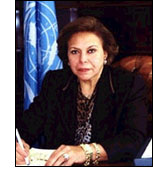 |
Mervat Tallawy
|
Khalaf Hunaidi, director of the U.N. Development Program's Arab regional bureau, is one of several Arab women in senior positions at the United Nations who could be powerful voices for change in Arab nations and the wider Islamic world, if more leaders would listen. Mervat Tallawy, executive secretary of the Economic and Social Commission for Western Asia, and Thoraya Obaid, executive director of the U.N. Population Fund, are two others who should be getting a wider hearing—not least in Washington—as Westerners cast around for an understanding of contemporary Arab life.
Arab men also making their marks at the United Nations tend to get more attention. Millions of television viewers are beginning to recognize Lakhdar Brahimi, a former Algerian foreign minister who as Secretary General Kofi Annan's special envoy in Afghanistan played a major role in establishing the nascent political order there. He has now turned to the job of fixing Iraq. Mohammed El Baradei, an Egyptian, has given the International Atomic Energy Agency more muscle and prominence.
But if leading Arab women at the United Nations seem to be in the background, that is no reflection of a meekness or deference to male-dominated cultures. Tallawy, an Egyptian who fought her way up to Cabinet rank through a government where women were not always welcome, is the top U.N. economic and social officer in the Middle East and refuses to change her Western clothes or cover her head or face when meeting conservative Arab leaders.
"I wouldn't accept that they force their law on me," she said in a recent interview. "I am as Muslim as they are, and I know Islam very well and I can defend my attitude for sure." She's had years of practice. As a young foreign service office in the 1960s, when she was barred from overseas postings because she was a woman, she confronted the foreign minister, she said. "I told him, if this is a policy to drive us out of the Ministry of Foreign Affairs, I think we have longer years to serve in the Foreign Office than yourself." She outlasted him, and became the first female Egyptian ambassador in 1987.
A former social affairs minister in Egypt later—she walked out of the Cabinet when the prime minister at the time refused to budget more money for poverty and give more leeway to human rights groups—Tallawy has a keen eye for seeing the roots of social problems.
Here is her take on what has gone wrong with education and religion in her neighborhood: "What is new in our region is that the religious people are less educated than before, less intellectually involved in their theological studies than before," she said. The result is untutored interpretation of religion, she said, which both governments and centers of learning did not try to reverse at the outset of the trend through the promotion of better scholarship. Her comments echo conclusions of the Arab Human Development Report, to which she contributed.
But Tallaway is cautious about claims that economic improvement or better education will be enough for women, without changes in the predominant psychology. "Of course economic independence for women is great," she said. "But in Saudi Arabia I met a lady who runs a company [worth] $8 billion, inherited from her father. Educated at Stanford. But when she goes out, she has to put on this," Tallaway said, pretending to cover her head with a veil. "She has money, power, name, family everything. And the society is obliging her to be a mockery like this."
Tallawy also believes too much attention goes to elite women in cities when real change has to come from the grassroots. "If we want to do something for women, it's to hit the culture and the tradition by hitting the underdeveloped areas in the country; by introducing modern things," she said. "Don't leave them to poverty, don't leave them to ignorance, don't leave it to the supremacy of the head of the tribe. Invade this circle by development, so his power will be broken."
Khalaf-Hunaidi, a former Jordanian deputy prime minister who led the country's economic team, said when the Arab Human Development Report was first published that she had encouraged her team of writers from numerous disciples not to fault others but to look inside their societies and ask, "Why are Arab countries lagging behind?" She saw what she called "a serious development problem" among Arabs, despite relatively high incomes and education levels. "There were some very scary signals," she said, noting that the report was commissioned before the Sept. 11, 2001, attacks on the United States.
When Obaid, the first Saudi to head a U.N. agency, was appointed executive director of the Population Fund in 2001—an appointment that drew criticism from some Western women's organizations—she told reporters that it was very important that people in the Middle East see her in this high position. Since then, she said in an interview Friday, she has had calls and emails from Arab women asking for advice on making the most of their skills.
Obaid has not always had an easy time of it. Diplomats say she has been under pressure not only from conservative Islamic governments opposed to the Population Fund's support for a range of activities and policies from stressing women's reproductive rights to advocating condoms against the spread of AIDS, but also from the Bush administration, which cut all U.S. contributions because of unproved allegations of the fund's involvement in abortions in China.
This year marks the 10th anniversary of the 1994 Cairo conference on population and development, and the Population Fund, known as UNFPA, the initials of an earlier version of its name, is expected to be under some strain to preserve the gains of Cairo from assault by nations from Obaid's own region that want to scale back advances in women's rights, as does the Vatican. She will get no assistance from the United States in this battle.
But her work is getting support from the rest of the world, including some of the poorest countries grateful for the help they get in family planning and a number of women's health issues. In 2003, Obaid said, UNFPA was able to close the gap left by the abrupt withdrawal of $34 million in U.S. contributions.
"We have an increase in our donor base," she said. "We went from about 92 countries in 2001 to 147 countries in 2003, and the growth there is in the developing countries." Contributions are sometimes minuscule, but they add up.
"War-torn countries have come in with $500 or $1,000, but it was a show of support and commitment," she said. "The permanent representative of Afghanistan came to us with a $100 bill as Afghanistan's contribution."
What do you think? Discuss this article in the Foreign Affairs conference of Post & Riposte.
More on foreign affairs in Atlantic Unbound and The Atlantic
Monthly.
Barbara Crossette, a writer on foreign affairs and columnist for U.N. Wire, was The New York Times bureau chief at the United Nations from 1994 to 2001. U.N. Wire is a free daily online news service covering news about and
related to the United Nations. It is sponsored by the U.N. Foundation and
appears on the foundation site, but is produced independently by The National
Journal Group.
For information on National Journal Group publications, see
NationalJournal.com.
Copyright © 2003 by The Atlantic Monthly Group. All
rights reserved.