Recent columns by Barbara Crossette:
Human Rights at U.N. Obscured by the Shadow of Politics
(September 8, 2003)
"Human Rights Watch lists only a handful of countries (among them Canada and Mexico, leaving a big hole in between) that act out of principle and not political expediency."
UNICEF in the Crosshairs (September 2, 2003)
"The Catholic Family and Human Rights Institute, noting the appearance of frank educational materials about sex in UNICEF-supported programs and a greater emphasis on the education of girls ... worries that 'UNICEF has moved beyond simple, and universally acceptable, programs.'"
The Wrong Kind of American Exceptionalism (August 18, 2003)
"The Europeans are powerful enough to stand down the United States, but many other countries are not. They are left to fight lonely battles against a punitive American government that has already suspended military aid to several dozen countries."
Bush Close to Backing $1 Billion Loan to U.N. (August 11, 2003)
"U.N. headquarters was built for an organization of about 50 members. It now has 191 member nations. In some offices, there is barely room to push back a desk chair without hitting the next desk."
Equal Rights For Homosexuals Contentious at U.N. (August 6, 2003)
"Gay U.N. employees say that the organization not only will not recognize long-term relationships in providing benefits but also does not help a gay partner get a visa to accompany an employee to a new posting."
More from U.N. Notebook.
U.N. Notebook | September 15, 2003
 German Teacher Provides Much-Needed Guide To The U.N.

by Barbara Crossette
....
UNITED NATIONS—A teacher in Germany, fascinated by the United Nations since his student days in Berlin in the 1960s, has produced almost single-handedly a monumental, 806-page encyclopedia of the organization, the first English-language volume of its kind. The wonder is that so small a team could finish this task in just a few years. The mystery is why it took so long for a book like this to appear.
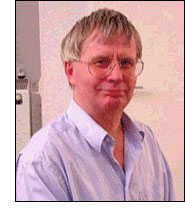 |
Helmut Volger
|
Helmut Volger, the teacher, and the United Nations are pretty much the same age—he is 59, it is 58. Through all those years, scholars, journalists and interested citizens of all kinds have had to scrounge for an easy-to-understand, jargon-free compendium of information on an organization that seems to revel in making itself hard to penetrate. The one bright spot has been the United Nations Handbook, published by the New Zealand government, a good guide for quick reference, but not intended to be discursive or controversial in approach. Last year, Facts on File produced a shorter, illustrated encyclopedia aimed at libraries from the junior-high-school level up.
Volger's new book, A Concise Encyclopedia of the United Nations, is more scholarly and does not avoid candor and opinion. Under the entry "Women and the U.N.," for example, it suggests that the much-publicized commitment to "gender mainstreaming" is pretty much window dressing, assigned a low priority when it comes to budgets and the agendas of top officials. In another entry, on nongovernmental organizations, the book sees a powerful role for them despite concerted efforts by some countries to sideline them.
The new book, published by Kluwer Law International, now part of the Brill academic publishing group in the Netherlands (price $143; information from Annebeth Rosenboom, [email protected]), can be used as both a guide to the organization—topics alphabetically arranged, endlessly cross-referenced and with additional suggested readings for virtually every entry—as well as an analytical or even critical work of scholarship. Volger, who wrote his Ph.D. thesis on the competing U.N. goals of disarmament and development, looked for contributors to his book who had special expertise or direct experience in the organization. His authors wrote for no payment, only a couple of copies of the completed work, which first appeared in German in 2000.
"When I started the German edition, I knew about 20 U.N. scholars from my work on the doctoral thesis and two monographs I had published in the early '90s," he said in an e-mail interview from his home in the outskirts of Berlin. "In order to enlarge the team of contributors, I wrote an invitation letter to all German-speaking U.N. scholars whom I knew from the U.N. literature. Moreover, I also invited former and active U.N. officials whose addresses I knew from my membership in the German U.N. Association."
Those who answered his call recommended others, and the numbers grew. "Surprisingly," he says, "I did not have much trouble to find more than 80 contributing authors who worked with great inspiration. My experience is that in the field of the United Nations you find a lot of people with a great deal of enthusiasm."
Those initial contributors and others interested in the United Nations have now formed a network called the U.N. Research Group.
Volger, who has both undergraduate and graduate degrees from the Free University of West Berlin and who recently retired from teaching history, social studies and English at an academic high school in the German capital, said that after the German-language edition of the encyclopedia appeared and began to sell, he was surprised to find that there was no comparable work in English.
With $6,000 from the German foreign ministry, he completed the English edition by cajoling his contributors to translate their entries in return for another free book. Volger and his wife, Anna, then compiled the English edition on their home computer. An English-speaking Canadian editor helped finish the text. The layout was done by an expert at Potsdam University.
"It was just the four of us," Volger said in a telephone conversation. The English version was published in the United States this spring.
Most people, Volger says, have trouble understanding the United Nations because the information it publishes comes out in "large collections of documents, figures and historic data which are difficult to read and often boring." The new encyclopedia has among its appendices a guide to cracking the U.N.'s diabolical reference system—in other words, how to translate something that falls into your hands with the title "E/CN.4/Sub.2/AC.2/1987/WP.4/Add.1."
Does the German origin of an English-language encyclopedia of the U.N. mean that Europeans are on the whole more conversant with the organization than their American counterparts? Surprisingly, Volger doesn't think so.
"There is more knowledge on the U.N. in the Scandinavian countries, but with regard to the rest of Europe, including Germany, I would say the information level of the public is roughly on the same level as in the U.S.A.," he said. "I would also assume that the politicians [in Europe] have the same level of knowledge as their American colleagues in Washington, only basic knowledge, with the exceptions of some experts on foreign policy."
Returning to the subject later, he added a qualifier: "In comparison to the U.S.A., there is no polemic criticism by the politicians towards the United Nations. The German politicians are friendly and indifferent."
Where there is a marked trans-Atlantic difference, according to Volger, is in the mass media. "I have the impression that the German quality newspapers publish more often and more detailed articles on U.N. topics than their American counterparts—mostly on peacekeeping, environmental and human rights issues," he said. "The same is true for German radio programs, whereas television programs deal with many social and humanitarian problems but do not reflect the role of the U.N. in this context."
But Secretary General Kofi Annan, only infrequently seen on American television, "appears quite regularly in the evening news when he has made a public statement," Volger said, adding that Annan "is quite popular among the politicians and in public opinion, particularly among the young people, who appreciate his personal dignity and his commitment to his work."
Volger, no stranger to commitment, has a suggestion for the United Nations, which he thinks has a serious problem presenting itself to the uninitiated public. "U.N. information should be written by teachers in the member states—or even better, by students—and not by U.N. officials," he said.
What do you think? Discuss this article in the Foreign Affairs conference of Post & Riposte.
More on foreign affairs in Atlantic Unbound and The Atlantic
Monthly.
Barbara Crossette, a writer on foreign affairs and columnist for U.N. Wire, was The New York Times bureau chief at the United Nations from 1994 to 2001. U.N. Wire is a free daily online news service covering news about and
related to the United Nations. It is sponsored by the U.N. Foundation and
appears on the foundation site, but is produced independently by The National
Journal Group.
For information on National Journal Group publications, see
NationalJournal.com.
Copyright © 2003 by The Atlantic Monthly Group. All
rights reserved.