Mad Men: A Million-Dollar Goodbye
Don and the show said farewell to a longtime character, Peggy and Stan were seduced by a photographer, and Diana revealed the secret she ran away from.
Every week for the seventh and final season of AMC's hit period-drama Mad Men, Sophie Gilbert, David Sims, and Lenika Cruz will discuss the possible fates facing Don Draper and those in his orbit.
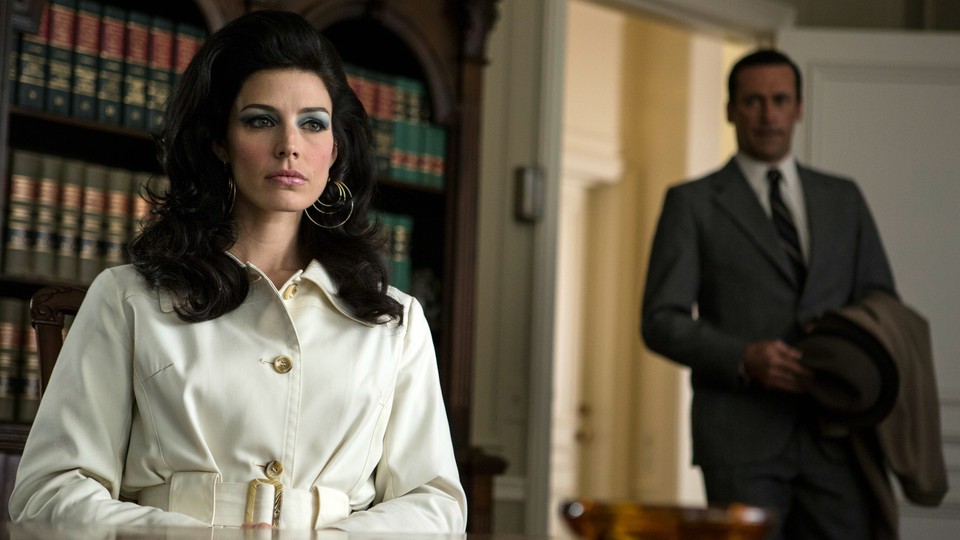
Sims: If last week’s Mad Men saw Don contemplating the past and his various mistakes, this week saw him repeating them. “New Business” was an often frustrating hour that again served as a sendoff to one of Don’s major love interests: This time it was Megan (Jessica Paré) taking a bow in an episode that also felt clogged with new faces. In town to settle her divorce from Don, Megan took a vile meeting with Harry Crane and a check for a million dollars from her ex-husband, but felt as unmoored and underwritten as she has since moving to California. Meanwhile, her mother Marie (Julia Ormond) threw caution to the wind with Roger, and a heretofore unmentioned sister sulked piously in the background; but this all played second fiddle to Don’s latest dark romantic misadventure.
Making a rather creepy effort to reconnect with the waitress (Elizabeth Reaser) from last week, Don ended up learning her name—Diana—and her sad backstory, which came out in dribs and drabs over several late-night encounters at Don’s apartment. First she told him she’d moved to the city without knowing anybody; then she confessed she'd lost a child to influenza; finally, she revealed that she'd left another child behind with her husband. All of these revelations only seemed to fuel Don’s desire to ramp things up with her, a reflection of his history of getting quickly serious with women (including Megan), but pushed to self-destructive extremes. Diana is clearly a haunted, sad person incapable of forging a new relationship, but Don seems desperate to try and help her.
Recommended Reading


Does he want to wallow in misery alongside her, swilling vodka at 3 in the morning in his daughter’s empty bedroom? Or does he want to play the competent husband again, as he watches his previous efforts in that sphere recede into the distance? “New Business” opened with a scene at Betty’s Westchester palace, with Don making milkshakes for his sons in the kitchen as Betty arrived home with Henry, completing the picture-perfect family life Don once had and eventually torpedoed. Don hastily excused himself, but it was clear neither Betty nor Henry perceive him as much of a threat anymore. Later on, Don ran into Sylvia (Linda Cardellini) and her husband in the elevator and saw them openly (and rudely) dismiss Diana as a late-night fling.
Megan’s material was much more befuddling, although it ended on a searing final note as Don walked back into the apartment they had shared together and found it entirely empty. Perhaps that’s a metaphor being hit a little too hard, but it at least got the point across, unlike much of Megan’s other material, which felt particularly muddled. While her pious sister yelled at her about divorce being immoral for Catholics, she took a meeting with Harry about finding a new agent, only to have him make a clumsy pass at her and then act indignant when she walked away.
Is Megan doomed to this cycle of seedy Hollywood behavior, with diminishing returns? Was there some parallel being drawn with her mother, who finally decided to make a real go of it with Roger in New York, husband be damned? It took her decades to admit her unhappiness—has Megan jumped that line by breaking it off with Don quickly, or is she stuck in the same rut? It’s hard to tell, since the character has lacked a real purpose since her major fifth-season arc (Zou Bisou Bisou et al) and was upstaged by her own mother this week. When Don wrote her a million-dollar check to seal the divorce, it felt like Matthew Weiner acknowledging he had no idea what to do with the initially fascinating character he created.
Sophie, what did you make of Megan’s dramatic furniture heist of a farewell? How did you feel about Mimi Rogers’ appearance, and her brief romantic dalliance with Stan? Is there any reason the show should be introducing so many new characters with five weeks left on the air?
Gilbert: David, I agree totally that “New Business” felt like an odd way to fill one of Mad Men’s last remaining hours on the air. After last week, I wondered whether the show was going to focus on more of Don’s lost loves as it works toward a conclusion, and this episode certainly did, but not in a way that seemed to allow the audience any meaningful takeaways other than the fact that Don is bad at relationships. It started with Don hanging out with his sons, engaging in friendly conversation with Betty, and ceding his milkshake to Henry before heading home alone. It ended with him again alone, this time in his own, empty apartment, thanks to Megan's mother taking what she felt was her daughter's due. It certainly feels like Matthew Weiner is wrapping up Don’s affairs for him, even if the character isn’t quite ready—at this point, Don’s women and children are all taken care of, and he barely has any possessions of his own left. If ever there were a neat and tidy time for the character to exit center stage, this is it.
Cruz: “An often frustrating hour” is an apt way to describe this episode, for some of the reasons you noted, David. One of the major themes, as with many episodes of Mad Men, was the transactional nature of sex, intimacy, and even just regular human company: Pima turned out to be more of an advertising hustler than an artist, to Stan’s chagrin; Harry slimily tried to reconfigure his meeting with Megan into a business-partners-with-benefits situation; Marie summoned Roger for his cash and then some; Don paid Megan off to put an end to the marriage; and Diana interpreted Don’s New York City guidebook as some kind of a trap, just like the $100 bill from the episode before.
All of which is fine and interesting, but it failed to move the characters much beyond what viewers already knew about them. Harry Crane’s a scumbag (remember when Megan walked in on him grossly mocking her at the start of her relationship with Don?); Stan’s a bit bullish but ultimately a softie; Marie and Roger are equals in their occasional flings. And yet I didn’t completely understand how a (presumably) farewell episode for Megan could render her so unbearably flat, with her most impassioned line calling Don an “aging, sloppy, selfish liar,” while he bowed his head quietly. To be sure, Don was an awful husband to her (he admitted as much to Neve Campbell’s character in the season’s kickoff, “Time Zones”), but this episode didn’t remind viewers much of that, instead playing Megan as the shrill, money-hungry harpy, and Don as the even-tempered, sighing husband.
I agree, Sophie, with your point that this episode seemed to more explicitly delve into the concept of women’s lib. It balanced that out with Stan’s quip about how hard it was to “keep [his] balls at this job” and with Roger and Pete grumbling knowingly to Don about just how awful women are when you’re divorcing them. But Don didn’t seem particularly fazed by much in this episode, with most of his quiet attention devoted to Diana. In her, Don has finally met someone as pathologically invested in rewriting the past as he is, only Diana’s revisions spilled out in the span of just a few evenings.
Contrasted with Megan, Diana is a bit older, wiser, and more sensitive, and she’s far more willing to admit that there’s no easy salve—a big check, a house full of furniture—for her sorrows. She used Don for what he has long used other women for, as a numbing agent, a way to forget. But she’s distinct from him in that she doesn’t want to shield herself from emotions. Having spent so much time alone, Don’s emotional capacity seems further reduced. When Diana tried to tell Don how nervous she felt around him (“There’s a twinge in my chest”), he didn’t seem to understand that she might be developing feelings for him, instead dismissing it as pain or hunger.
I’m concerned, lastly, about how backward-looking the rest of this season might turn out to be. Final seasons are tasked with the burden of wrapping up the past enough, nursing disparate arcs to satisfying conclusions, while also hinting enough at the future, however hazy. I’m not sure how much more I want to see this repeat motif of Don coming home to an empty house, or seeing his fraught (failed) attempts to connect with the women of his past. Mad Men has always been about far more than just Don’s reliably unstable personal life, and I’d love for this final season to acknowledge that with more than just a $1,000,000 check or a sneering encounter in an elevator.