The Next World Design Capital: Ireland?
A country's bid to leave behind stodgy Celtic imagery and get out of the shadow of England, Germany, and Scandinavia
Graphic and industrial design is not the first thing I think about when thinking about Ireland—the Book of Kells notwithstanding. When considering design landmarks created in Europe during the entire 20th century, the Irish contribution is rather spare. But after a period of economic boom, the now financially besieged Emerald Isle, and Dublin in particular, is making a bid to be named "World Design Capital," which since 2008 has been so designated every two years by the International Council of Societies of Industrial Design. The past capitals were Turin (2008), Seoul (2010), and next year Helsinki (2012). The WDC designation aims to build design awareness for cities that are not widely known for design achievements—it is less about legacy than aspiration.
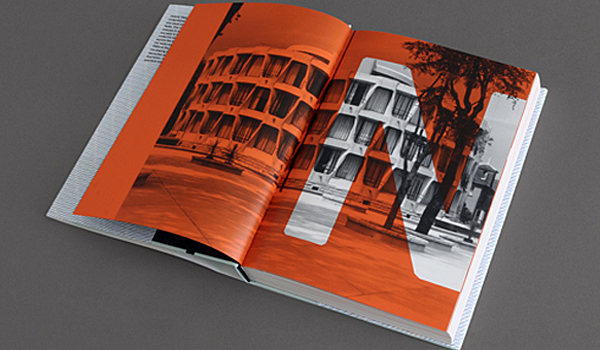
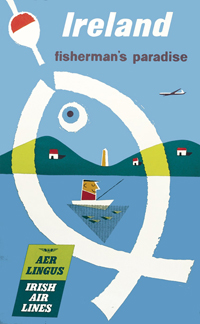
While Ireland is loaded with aspiration, its design legacy has remained somewhat invisible—until now. A new book (published in Ireland), Ireland, Design and Visual Culture: Negotiating Modernity. 1922-1992 (Cork University Press, March 2011), edited by the design historians Linda King and Elaine Sisson, covers, in scholarly fashion, everything from representations of nationality and Celtic revivals to tourist posters and how tradition and modernity intersect. Although it's not bedtime reading, this handsomely designed volume pulls Irish design out of its relative obscurity and introduces it to the design continuum.
As a fan of Irish culture, I was curious to learn from King where she placed her nation in the history of design, and particularly where it fits in relation to its closest neighbor, England. "What the book demonstrates in its 70 year span (1922-1992) is that comparison of Irish design activity with that of Britain is only one small facet of a far broader discussion that includes the relationship between Ireland and the U.S., and Ireland and Northern Europe," King notes emphatically. "U.S. advertising strategies, Scandinavian industrial production, German Expressionism and engineering, U.S. and European architecture, all had a profound influence on Irish design development."
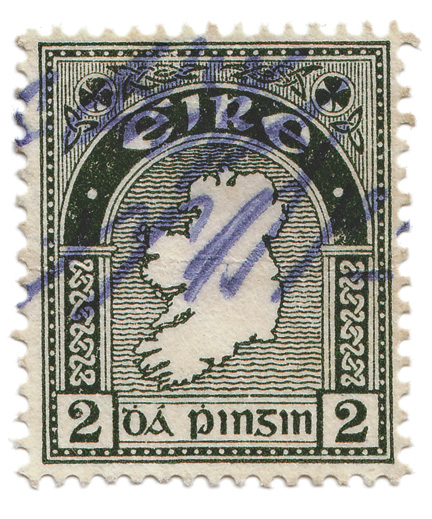
So why then, is the image of Irish design still so rooted in the stereotypical past? "In terms of inspiration, certainly in the 19th century and immediately post-independence (1921) many examples of Irish visual culture utilized motifs and decoration from early Christian manuscripts—of which the Book of Kells would be the most famous—as a way of marking Irish 'uniqueness' and providing a distinct visual language to that of Britain," King adds. "These visual devices—whether applied to Catholic-sponsored comic books, stamps, album covers, or animated films—have long been utilized as markers of Irish 'difference' and still hold currency today."
 As a member of the European Union, Ireland cannot afford to be thought of as only embracing leprechauns and other visual pastiche. Design in all its forms is an essential means of busting the stereotypes. As King explains, Ireland's relative lack of industrialization in the 19th century, combined with an emphasis on agricultural production and a political culture of economic protectionism up until the late 1950s, caused slower design activity in Ireland than in other countries. "[Because of] this process of playing 'catch-up' with other countries, Irish design is less concerned with originality of form than with adapting and localizing European and American influences."
Still, Ireland has had some notable design form-givers. The Kilkenny Design Workshops (1963 to 1988) was the first government-sponsored design agency in the world and the model was later exported to developing countries such as the Philippines, which in itself was a unique and inspired concept. "KDW was established because our design professions had not grown organically and was a government-sponsored intervention to stimulate design activity that brought in design expertise from Europe and Britain to work collaboratively with Irish manufacturers and craft-based companies," King writes.
The Irish-born architect and furniture designer Eileen Gray produced some of the most innovative and iconic designs of the early 20th century—"so much so," King claims, "that le Corbusier ensured that much of her work was attributed to him." However, King and Sisson deliberately did not include Gray, because "much of her work was done in France (she emigrated from Ireland at the age of 18), and we wanted to focus on the experience within Ireland." What's more, she mostly designed for herself or rich patrons, "so her work would not have engaged with a mass audience."
 Even singling out these individuals and organizations, King says, only scratches the surface. "Because of our focus on design activity within Ireland there is no discussion of Irish designers who emigrated and had significant influence abroad, for example the architect Kevin Roche who worked for Eero Saarinen and founded Kevin Roche and John Dinkaloo Associates, or the engineer Peter Rice who founded RFR and worked the Sydney Opera House and the Pompidou Centre." She adds, "There are also many other discrete and interesting narratives to be explored that could not be covered here that evidence the strong links between Ireland and the US. My personal favorites include: the attempt to manufacture an Irish Cadillac-type car, called 'The Shamrock' in Monaghan in the 1950s; Henry Ford's establishment of a Ford factory in Cork in 1917; and fashion designer Sybil Connolly's dress designs for Jacqueline Kennedy one of which she wore for her official White House portrait."
 But where does Irish design excel now? Arguably, in areas related to animation and film-making—including costume, production design, concept design—and Irish designers have won, or been nominated for, a number of Academy Awards in these fields. "I think that in many ways Irish design activity emerged against the odds (limited industrialization, insular political visions etc). Consequently Irish design has not always been the most innovative, but I think that the growth of Irish design activity reflects a high degree of pragmatism and tenacity that in many ways reflects the Irish psyche. It has also been far more engaged with and aware of sources outside of the British Isles than may be realized."
So just maybe, Dublin will become the next World Design Capital. May the best city win.
Images: Courtesy of James Adam & Sons