In Praise of Bluey, the Most Grown-Up Television Show for Children
The hit Australian cartoon doesn’t hesitate to explore complicated feelings in a way that kids can understand, and that their parents will appreciate.
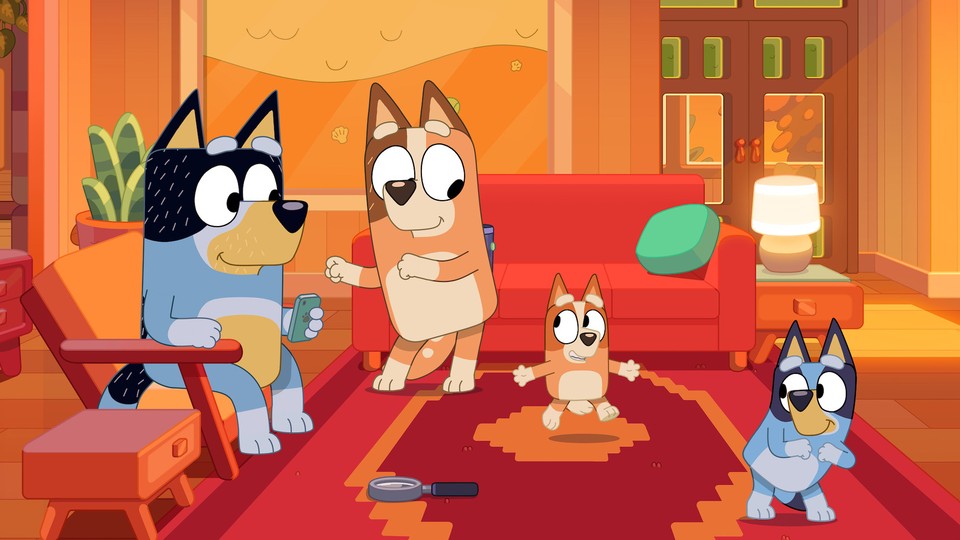
Last week, I posed a question to my wife that could have been about any number of our friends: “Do you think Bandit and Chilli will have another baby?” She pondered this, then shook her head. “Probably not. They threw their crib out, remember?”
Of course. My wife was referencing not a listing she’d seen on Facebook Marketplace but “Bedroom,” an episode from the third season of the Australian children’s show Bluey that she and I have each seen at least a dozen times. Our familiarity with Bluey is richer than with possibly any other show on the air, given that we both watch it over and over again with our 2-year-old daughter. But it wasn’t our shared knowledge that surprised me—it was that we were talking about a pair of cartoon dogs like they were people we knew.
When you have a young child, you passively end up watching a lot of children’s television, and my screen-addicted self can’t help but pay some attention to how it delivers gentle life lessons or energetic emotional rushes. But even before my daughter was born, Bluey was frequently invoked by parent friends as the kids’ show that was a cut above. Over three seasons, it’s received lavish praise for the thoughtful, funny adventures about the Heelers, a family of anthropomorphic Australian dogs: dad Bandit, mom Chilli, and their daughters Bluey (age 6) and Bingo (4). Its many episodes have confirmed the impressive depth of the show’s storytelling, rewarding my deep scrutiny in a way that a children’s show really doesn’t need to do for adults.
Most episodes (each running about seven minutes) focus on a game Bluey is playing, usually with her family or some of her school friends, who live in a city resembling Brisbane that’s populated by bipedal talking dogs of every imaginable breed. The show celebrates imaginative play and Bluey’s boundless energy, as her parents do their best to keep up with her fanciful improvisations (particularly Bandit, who puts most parents to shame with his endless ability to roll with it). But the games aren’t everything—the characters are richly drawn enough that I’ve started to think of the parents as going through the same travails as I.
One episode of the third (and latest) season, “Sheepdog,” sees an obviously overworked Chilli, after preparing dinner, making a request of Bandit that any fellow parent might recognize. “I need 20 minutes where no one comes near me,” she says sternly, something he acknowledges without hesitation. The request baffles Bluey, who spends the rest of the episode trying to ask her mother what she did wrong. The lesson, of course, is that nothing is wrong—sometimes grown-ups just need 20 minutes. But that’s a far more subtle premise to build an episode around than most kids’ TV would dare try. As helpful as they can be, shows like Daniel Tiger don’t endeavor to explain the ephemeral spikes of weariness that parents feel on a day-to-day basis.
That’s the audacity of Bluey, which is largely written by its creator, Joe Brumm: It trusts that its young audience will be able to understand stories that are about the foibles and insecurities of parents too. A Season 2 episode titled “Grandad” is about Bluey and Bingo running around the Australian bush with their cantankerous grandpa, but it’s also about Chilli’s anxiety over her father’s advancing age, and his stubbornness about not wanting to slow down. The magnificent “Sticky Gecko” is a Buster Keaton–esque cacophony of minor slapstick, as Chilli struggles to get her kids out the door for a playdate. But it also has an offhand moment that never fails to catch me off guard, as Chilli recalls that, when Bluey was born, the mother of the children they’re about to visit made her five lasagnas. “It meant so much to me!” she exclaims, expressing the profound sweetness of being unexpectedly cared for by a close friend, a feeling I’ve cherished as a new parent.
The emotional specificity is just as crucial as the precision of the physical humor, and the density of the world building. Bluey is the kind of lively show a toddler anywhere on Earth can understand, but it’s also a particular representation of contemporary parenting. It’s told from a child’s-eye view, whereby flashes of surreal magic can infiltrate Bluey’s reality, but it also takes care to always, very realistically, depict the back seat of any family vehicle as being completely littered with junk.
The latest episodes, which came out in the U.S. last month, emphasized how much the show has also succeeded at constructing a universe beyond the Heeler family, playing with different storytelling conventions and highlighting characters about the wider ensemble. The episode “Stories” focuses on Bluey’s classmates at school and their frustrations with a craft project; “Onesies,” featuring a guest-star appearance from Rose Byrne, introduces Chilli’s sister Brandy, and obliquely but powerfully delves into her alienation from the family because of her inability to have children.
These kinds of narrative swerves shouldn’t necessarily fit into the formula of a seven-minute kids’ show, where the primary imperative is always to hold a child’s attention (no easy feat). That Bluey does it without ever feeling pretentious or heavy-handed is nothing short of astounding. A new bunch of episodes has already aired in Australia, and though my toddler is plenty satisfied with the 140 or so that are available to us, I can’t wait for more—not just for variety’s sake but to see where one of television’s most unexpectedly ambitious shows will head next.