Long Live the Delightfully Dumb Comedy
Conan O’Brien reminds us that a very stupid premise can make for the most hilarious movie.
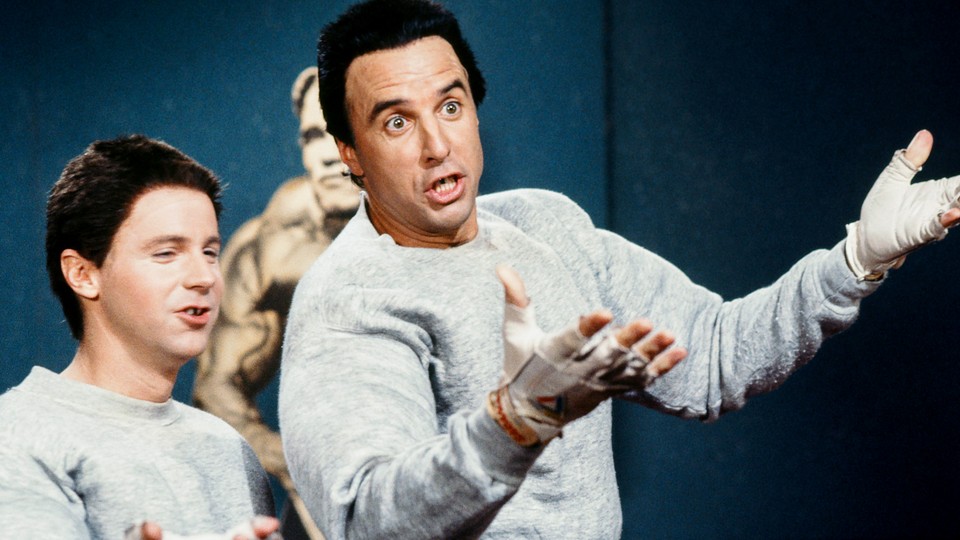
In the 1990s, a new comedy scourge descended upon cinemas: movies based on Saturday Night Live sketches. The trend was decried as the latest example of Hollywood running out of original ideas, and the films, starting with Wayne’s World in 1992, hewed closely to SNL’s formula of recurring characters and loud catchphrases. Each project would take a sketch people recognized, stretch it to something resembling feature length, and pad the premise as much as possible with special guest stars, parody songs, or action sequences.
None of the follow-ups succeeded on the level of Wayne’s World—its 1993 sequel, Wayne’s World 2, made less than half of what its predecessor did, and films such as It’s Pat and Stuart Saves His Family were notorious bombs that grossed less than $1 million at the domestic box office. But for comedy nerds, the more interesting failures are those that didn’t even make it to the screen—the ones lost in development hell on grounds of being excessively weird. A few weeks ago, Conan O’Brien, who wrote for SNL from 1988 to 1991, devoted a few episodes of his podcast to pseudo-reviving one such project: Hans and Franz: The Girlyman Dilemma—“a title you probably couldn’t use today,” he concedes.
On Conan O’Brien Needs a Friend, the longtime talk-show host typically interviews other celebrities, often taking strolls down memory lane with his old comedy buddies. For the Hans and Franz episodes, featuring the former SNL cast members Kevin Nealon and Dana Carvey, O’Brien reminisces about the script they’d co-written, which he considers a particularly absurd example of the micro-genre. The venture hinged on the participation of Arnold Schwarzenegger, who would have played himself in the movie. When Schwarzenegger passed on the script, the project died. Decades later, over the course of four podcast episodes, O’Brien and the film’s other intended stars read aloud from the abandoned draft.
The experiment stirred in me a surprising level of nostalgia for the type of silly comedy that just never gets made anymore. O’Brien wrote the script in 1991 with Robert Smigel, another SNL vet, who is otherwise best known for his character Triumph the Insult Comic Dog. They intended to make a feature-length story about Carvey and Nealon’s characters Hans and Franz, two overzealous Austrian bodybuilders who brag about their muscles, claim to be able to “pump up” their viewers, and criticize practically everyone else alive for being “flabby” or “girly.” Like many SNL sketches, “Pumping Up With Hans & Franz” adopted the same basic setting every time it appeared on TV—in this case, a talk show in which the pair dispensed nonsensical advice. The opportunities for a fuller narrative seemed limited.
Enter Schwarzenegger, the obvious inspiration for Hans and Franz. According to O’Brien and Smigel, Schwarzenegger was briefly interested, took meetings with the writers, and read the script. But after appearing in a series of movie comedies with diminishing returns (most notably Last Action Hero in 1993 and Junior the following year), he pivoted back to serious material. “What we did, which shocks me now upon rereading it … is that Arnold is in it more than anybody; we hung the entire project [on him],” O’Brien says on his podcast, laughing.
Schwarzenegger was the kind of early-’90s mega A-lister who could get practically anything made if he was attached, and the gamble was that he would provide enough cover for the ridiculousness: “If Arnold says yes, all the craziness is going to happen,” O’Brien recounts. By revisiting the script and diving into the oddness that could have been, O’Brien and his guests achieve the charming clubhouse vibe that all the best comedy podcasts strive for, with four veterans of the world hooting at the audacious foolishness of the story they were so committed to years prior. That self-aware tone is exactly what made these movies so funny to begin with.
In the script, Hans and Franz lose their jobs as TV hosts after referring to Martin Luther King Jr. as “flabby,” inspiring them to go on a cross-country quest to Hollywood to meet Schwarzenegger and eventually assist him in defeating a muscle-bound Austrian rival (a role intended for a Dolph Lundgren type). The main plot is wacky enough, but the side tangents are even loopier. They were left intact during the script read, even though O’Brien and Smigel both admit that the development process might have eventually eliminated those flourishes.
At one early point, Hans and Franz travel across the country on a tandem bike that fellow travelers keep jumping onto until the colossal contraption, carrying a dozen riders, splits into pieces as each hitchhiker heads off on a separate journey. Later in the first act, the script cuts to the famed critic Roger Ebert watching a screening of the film, and Hans and Franz burst in and ask him how it’s going so far. “Holding up quite well, wouldn’t you say?” Franz asks. “Didn’t think two sketch characters could sustain this long, did you?” A nonplussed Ebert says he’s not very far in yet, but after the characters leave his screening room, Ebert looks at the camera and proclaims, “It is good!”
On rereading that sequence, O’Brien and company cackle; a cameo and endorsement from the most famous film critic of his time was probably too much to hope for. “Good lord, that is low,” O’Brien says. For his part, Ebert was relatively supportive of Wayne’s World and its sequel, but of the Dan Aykroyd–starring Coneheads, he lamented that it “has essentially taken nine minutes of material and multiplied the running time by 10 while adding nothing to the inspiration.”
When O’Brien co-wrote Hans and Franz, he was just beginning as a staffer on The Simpsons, where he worked until he got the job hosting Late Night in 1993. A lot of the best Hans and Franz gags reminded me of Simpsons jokes, taking simple notions and stretching them until reality just begins to break. The portrayal of Schwarzenegger during the Hans and Franz script reading hits similar heights, exaggerating the actor’s strength, wealth, and ego. (He lives in a compound where teams of bodybuilders and scientists plot his every move in order to inflate both his musculature and his notoriety.)
As zany as the effect is, listeners can also easily imagine how the various storylines might eventually have been watered down by star demands and studio notes. There may be a first draft of Coneheads out there that’s just as freewheeling, and imagining the unrealized potential of other projects is part of the fun of listening to the reading. It also helps underscore that a film this stupid would feel like water in the desert in 2023.
These days, pretty much every studio comedy gets relegated to the small screen, including the latest SNL-adjacent project, a film written by the Please Don’t Destroy sketch team that was planned for theaters but then shunted to Peacock. The most recent SNL movie to make it to theaters was MacGruber, an underrated gonzo adventure that was basically ignored at the box office but later became a cult hit. At the time of its release, in 2010, many critics rolled out familiar complaints about taking a thin premise and struggling to elongate it to 90 minutes. Now that type of comic effort seems Herculean—and enticingly hilarious.