Can This Dinosaur Change?
Lucky Hank stars Bob Odenkirk as a sympathetic fossil: a college professor.
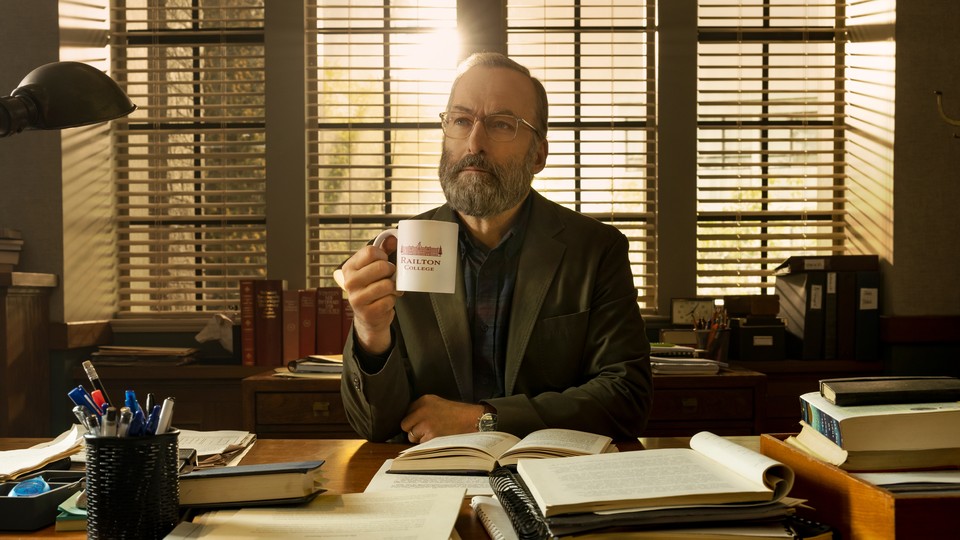
In the opening shot of AMC’s series Lucky Hank, the camera approaches from behind and encircles a bearded, middle-aged man wearing a tweed jacket, satchel slung over his right shoulder. You guessed it: He’s a college professor. He stands alone, looking across the campus pond—but mostly, it seems, looking inward. This figure, as we learn over the course of the first episode, is William Henry Devereaux Jr., or “Hank” (played by Bob Odenkirk), the chair of the English department at the fictional Railton College. If Hank is in any sense “lucky,” he’s unconvinced of the fact. His career has been a disappointment, especially when held up against that of his celebrated father and namesake: The preeminent literary critic of his generation, Hank Sr. has just announced his retirement from Columbia University, prompting a midlife crisis in his son. (Railton, which Hank mockingly dubs “mediocrity’s capital,” is no Columbia.) Johann Strauss’s Waltz of the Emperor plays over the brief scene at the pond, but if Hank’s an emperor, he’s Napoleon—exiled on Elba and bereft.
The show is adapted from Richard Russo’s 1997 campus-comedy novel, Straight Man, whose protagonist sees himself as a representative of sanity in an academic world consumed by political correctness. The story ridicules a male colleague of Devereaux’s who reflexively tacks on “or she” whenever a colleague uses “he” as an ungendered pronoun, earning him the nickname “Orshee.” He wears his thinning hair in a ponytail, teaches sitcoms instead of books, and doesn’t permit his students to write essays (they shoot videos instead). He’s a caricature of the lefty professor—a counterpoint to Hank’s old guard. In the novel, William Henry Devereaux is portrayed as a no-nonsense buttress against academic silliness and bureaucratic malfeasance. But in Lucky Hank, Odenkirk’s character is depicted as a dinosaur—a sympathetic dinosaur, perhaps, but a fossil nonetheless.
A lot has happened in American culture and its microcosm, the college campus, in the quarter century since Straight Man was published. During this moment of stark political partisanship, university campuses and classrooms are ideal stages on which to dramatize the collision of old and new mores. It’s as if the protagonist of Russo’s novel has been frozen for decades and transported across genres and years onto our screen, and finds that the times have changed, though he has not. He’s thawing out in 2023, and he’s suffering from freezer burn.
Lucky Hank, for which Russo serves as an executive producer, is quite aware of this, and has made some deft updates to the novel in response. The first episode centers on Hank’s ridicule of a creative-writing student’s work, and his unwillingness to back down when faced with demands to apologize; the student is depicted as a workmanlike but smug writer who’s just asking to be taken down a notch. Were this a scene in Russo’s novel, our sympathies would be with Hank. In the series, though, Hank comes across as a bully. Viewers recognize that he’s working through some version of impostor syndrome, brought on by the announcement of his father’s retirement, but even his wife, Lily (the luminous Mireille Enos), a high-school vice principal, calls him out on his nonsense.
And Lily doesn’t just call him out—her commitment to her students puts Hank’s to shame. When Hank has to endure the pretentious writing-workshop student, he mentally checks out—and when called back by the students, he berates them. Lily, having witnessed a student urinating against a locker in the hallway of her school and being unable to get anyone else to take care of it, buys her own cleaning supplies, gets down on her hands and knees, and cleans it up herself.
In moving from page to screen, the story has shifted not just its medium but also its genre. Straight Man is a campus comedy, yes, but it’s also a farce: Lucky Hank is a dramedy, if anyone still uses that term. The show has terrific comic moments, but it’s fundamentally more serious: about careers, midlife, disappointment, and the complexity of long-term romantic relationships. And by making Lily such a full, rich character, the show creates a worthy foil for Hank, helping put his struggles in perspective. The novel is narrated in the first person: It’s very Hank-centric. The show centers Hank too, and we often hear his thoughts in voice-over—but it also criticizes him and helps him grow, through secondary characters who are more than mere caricatures. In the novel, Lily leaves on a trip 60 pages in and is basically AWOL until the final chapter. Lucky Hank’s Lily, by contrast, though she’s pulled in many different directions, is an anchor of every episode, and an unvarying touchstone for Hank.
The Hank on-screen even seems to recognize his own out-of-time-ness. Asked by his dean to have an onstage conversation with his old friend and rival, the writer George Saunders, Hank demurs: “I’m concerned that I might accidentally say something really consistent with my personality but inconsistent with a modern college campus.” When Saunders (played by Brian Huskey) comes to Railton College for the public event with Hank, he also drops by Hank’s writing workshop. Whereas Hank is by turns absent and caustic with his students, Saunders is patient, generous; whereas Hank wishes that Saunders would put students in their place, his old friend is more interested in making room for them at the seminar table. Saunders seems to get all the recognition he needs through his work; he doesn’t need to demean students in order to feel good about himself.
I know something about middle-aged white male English-department chairs. More to the point, I know what it’s like to be the chair of English at Railton College. In 1999, I replaced the likely real-life model for Hank: the outgoing chair of the Southern Illinois University at Carbondale English department, Richard “Dick” Peterson. (Russo had left the school and stopped teaching before I arrived.) I hadn’t yet read Straight Man, which Russo worked on over long afternoons at the Denny’s on Highway 13, when I stepped into that role. Little did I know I was stepping into a novel—or its sequel.
Chairing an academic department isn’t what it used to be. (Full disclosure: I’ve written a book about what it should be.) Today, it’s a position with a lot of responsibility but little real power; the character of Hank was created, in Russo’s novel, at a time when a romantic model of the nearly sovereign department chair was still in place. By the time I came to SIUC, that imperial role was already a thing of the past; any 21st-century department chair (I started with six months left in the 20th) has to figure out how to wield soft power effectively, rather than acting, as Hank does, like a thug. I’m fortunate to have learned how to do the work over two decades with the help of wise and caring colleagues and students. Poor Hank, though: He dozed off in 1997 and awoke, with a start, in a brave new world.
Lucky Hank is just the most recent show with a department-chair protagonist. Last year, Netflix brought Don DeLillo’s 1985 novel, White Noise (and the chair of Hitler studies, Jack Gladney), to the screen; in 2021, Netflix premieredThe Chair. In that show, Ji-Yoon Kim (Sandra Oh) takes on the titular job and is forced into damage-control mode when her colleague Bill Dobson (Jay Duplass), much like Hank Devereaux, behaves like an entitled, tenured male professor from the previous generation and becomes the object of campus protests. The message is clear: We’re witnessing a seismic shift with Ji-Yoon, the first woman and first faculty member of color to chair the department. The adaptation of Straight Man has managed to illustrate the same transition within a single character (albeit across years and genres).
Viewers watch the show with an urgent question: Can Hank evolve? Can Russo’s character be brought into the 21st century? I’m not here to spoil anything, but the show’s slightly different framing of the novel’s story surely offers hope. If the college campus can sometimes function as a kind of Neverland for Lost Boys (and Girls!), Hank’s relationships with people outside his Railton bubble—with an old friend like George Saunders, with his wife, his daughter, his mother, and even his estranged father—might just provide the resources, and the challenges, that he needs to finally grow up.