A New Look at Frog and Toad
In the Apple TV+ adaptation, additional characters only emphasize the central duo’s profound companionship.
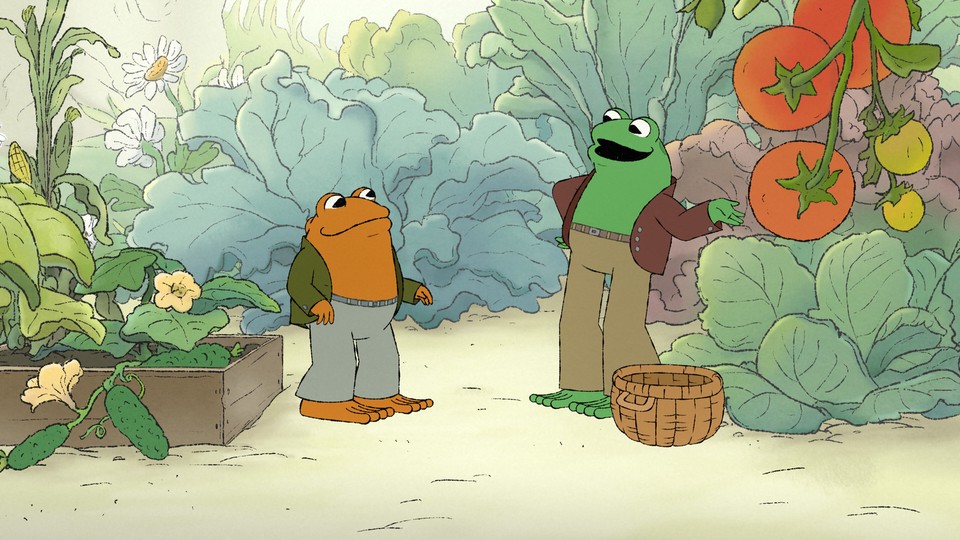
The second episode of Apple TV+’s new kids’ series Frog and Toad adapts a lovely vignette titled “Ice Cream” from Arnold Lobel’s book Frog and Toad All Year. In Lobel’s original, the story is simple. On a hot summer day, Frog and Toad sit by the pond and wish for ice cream. Toad volunteers to go get it, but as he walks back with two cones of chocolate ice cream, the heat causes them to melt onto his head, covering his face and attracting debris such as leaves and sticks. His new mask makes him look like a monster, causing other creatures to flee and warn Frog of the “thing with horns” (ice-cream cones). The tension in the exceedingly short story is that Frog won’t recognize Toad, that he’ll run away in fear after all this trouble his friend has gone to. But Frog recognizes him right away, crying, “Good heavens! … That thing is Toad!” After Toad washes up, the two return to the store for new cones: a happily ever after if ever there was one.
Apple TV+’s adaptation retains all of the vignette’s important elements, but it features the notable addition of a whole cast of woodland friends. Lobel’s version has the odd bird or mouse that does little other than carry dialogue. In the new show, Mink, Mouse, Robin, and Snail are all characters with their own personalities. Mink plays a banjo and sings about the ice-cream flavors he sells. Snail is charmingly blasé about the incongruity of their slowness in contrast to their job delivering mail. Mouse is sweet. Robin is chatty. At first, these characters annoyed me. Part of the beauty of Lobel’s original books is their intent, quiet focus on Frog and Toad as a duo. In comparison, the TV show feels, well, loud. There are many voices, many personas, even the odd song here and there. At best, I initially thought, this change distracts from our protagonists. At worst, it is antithetical to Lobel’s books. Why add all these new faces to a story that is essentially a portrait of companionship?
But the longer I watched, the more I wondered if the introduction of other creatures wasn’t an elegant way to acknowledge and explore Frog and Toad’s singular love for each other. After all, Frog and Toad aren’t just children’s-book characters; they’ve also become queer icons. Lobel’s daughter has mused that she thinks his creation of the Frog and Toad books was the beginning of his own coming out—that the exploration of same-sex amphibian love might have given him the courage to live openly as a gay man. Considering the increasing precarity of queer life in America today, with children’s books being censored for LGBTQ themes and medical treatment being severely restricted for trans children and teenagers, it feels all the more important for a contemporary television adaptation of Lobel’s work to highlight, as opposed to hide, Frog and Toad’s profound partnership.
In Lobel’s books, Frog and Toad’s love is found in the spareness of the text. We can read between the lines and marvel at his drawings, noting how the characters dote on each other. Apple TV+ takes the opposite approach. By placing its main characters in a fully fleshed-out society, we get to see how Frog and Toad interact with their neighbors, friends, and acquaintances. Because we know how the characters are in public, we can contrast their behavior in private. Take the “Ice Cream” vignette, for example. As his terrified woodland neighbors stream by, Frog panics. He joins in their fear because that’s what you do when your friends tell you something horrible is clomping down the path toward you. But when he sees the thing trundling toward him, his realization is wordless and immediate: Underneath all the mess is Toad.
In this context, we see that Frog and Toad’s bond is precious and different. In the first episode, Toad bakes what he declares to be the best cookies he’s ever made. Though Robin asks several pointed questions about the cookies, Toad makes a beeline to Frog’s house. Frog is the only object of Toad’s attention, the only creature with whom he could even think to share the best-ever cookies. Later, when spring arrives and Toad doesn’t want to wake up from his “long sleep”—Lobel’s whimsical take on amphibious hibernation—Frog doesn’t shrug and leave to spend the day with other friends. Similar to Toad’s cookies, the gorgeousness of the changing season fixes Frog’s focus on Toad. This is a moment that must be experienced with someone who complements and helps make sense of his everyday existence.
In short, Frog and Toad are more than just friends. They’re best friends. It’s the way Frog and Toad refer to themselves, and it’s a term I think is purposeful, capacious, and smart. Best friends choose each other every day. They share their lives, whether the deluge of delight on the first spring day or the doldrums of waiting for the mail to come. When we say “best friend,” we can invoke both the romantic aspects of friendship and the companionable aspect of romance. In Apple TV+’s rendition, the platonic flatness of Frog and Toad’s interactions with other characters elevates their connection. No matter how you look at it, Frog and Toad are partners in their beautiful, shared life.