The New Plastic-Surgery Playbook
Celebrities aren’t just admitting they got work done—they’re showing all the details.
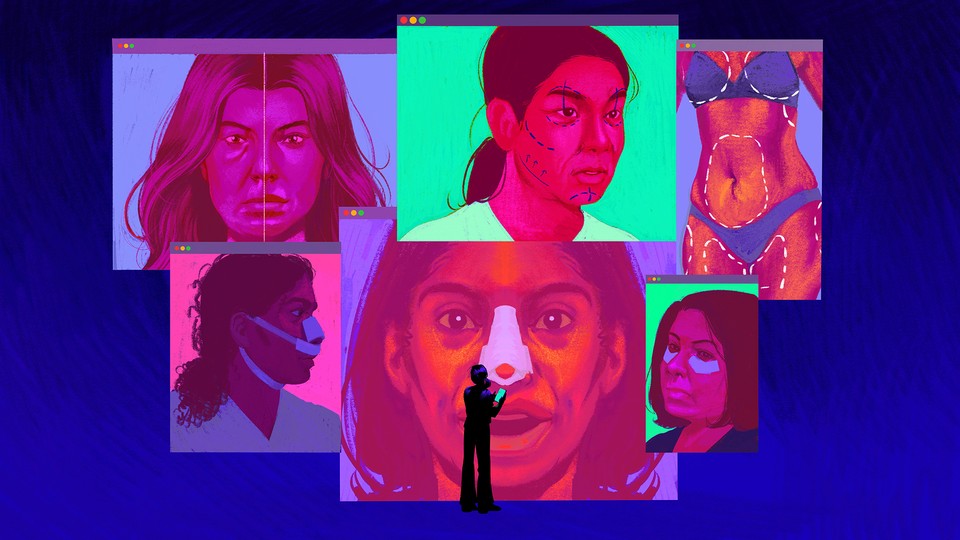

Recently the actor Denise Richards shared several photos of her bare face that triggered a wave of double takes. In some, her side profile reflects the gentle weathering expected of nearly 55 well-lived years; in others, her face rewinds to how it looked during her Bond-girl era. It was as if, as one fan put it, she’d acquired a time machine. But nobody needed to guess how she transformed: She also posted an image from the morning of her facelift. In it, ink markings peppered her features, illustrating exactly where a surgeon would soon cut her skin open.
Richards didn’t just cop to cosmetic surgery. She shared who did it, how she prepared, what recovery felt like, and—perhaps most surprising—what it looked like, via post-op photos at two days, five days, eight days, 10 days, and 3.5 weeks: A bandage swaddled the former model’s face in one, and purple bruises bloomed atop her cheeks; a handful of tiny, stitched scalpel cuts on the corners of her mouth and eyelids still looked fresh. Her goal, she told the beauty magazine Allure, had been to “put things back up, where they were before,” adding that the procedures boosted her confidence and made her “feel good.” Predictably, the photos went viral; fans applauded Richards’s honesty. “Bless her,” wrote one commenter, “for showing us that she did this instead of pretending it’s olive oil and yoga.”
Welcome to the confessional era of cosmetic surgery, where getting work done is seen as a form of self-care and posting about it is social-media currency.
Not so long ago, stars typically hid their nips and tucks, deflecting questions about plastic surgery or even denying it, instead crediting a disciplined diet or skin-care regimen. In the past year or so, not only have celebrities become more comfortable owning their cosmetic surgeries, but some of them are walking fans through every step. Last year, when a fan asked Kylie Jenner for information about her breast implants, she responded in almost clinical detail: “445 cc, moderate profile, half under the muscle!!!!! silicone!!! garth fisher!!! hope this helps lol.” Like Richards, many people also invite the public into the somewhat gruesome medical process. This month, the Bachelorette star Kaitlyn Bristowe posted a photo of the surgical drains she had after a breast augmentation—two plastic receptacles filled with blood and other bodily fluids. In many of these reveals, the script is heavy on the language of empowerment and the importance of prioritizing oneself.
In some ways, it’s an encouraging departure from a time when the masses were asked to assume that the famously beautiful got their good looks by sheer force of will. But this new playbook comes with its own risks too: When the language is technical and the information actionable, transparency can quickly look a lot like instruction.
Plastic surgery exploded in the United States in the 1990s and 2000s following a surge in advertising, Victoria Pitts-Taylor, a professor of gender studies at Wesleyan and the author of Surgery Junkies, told me. At the time, a “natural” body—one untouched by scalpels or needles—was the ideal, and the cultural norm was to condemn people who went under the knife for the sake of vanity: “People were wrestling with the idea that cosmetic surgery was something shameful or something that was meant to be kept hidden.”
Throughout the 2010s, tabloids frequently “outed” celebrities rumored to have had plastic surgery. As recently as 2021, research showed that people perceived women who plan to undergo plastic surgery as less moral than those who don’t. As a result, most celebrities strove to have fans believe their looks were effortless—or at least, not thanks to a surgeon. The ones who did openly talk about the work they’d gotten done sometimes described it as practically necessary due to the pressures of Hollywood.
But the coronavirus pandemic marked a turning point. When elective surgery reopened following the shutdown, it triggered a boom in procedures, which researchers attributed to, in part, people staring at their own face on Zoom all day long. Many people started talking about cosmetic surgery as a personal desire, a way to build self-confidence. This shift flowed right into influencer culture, in which one’s life is monetizable. Being open about cosmetic surgery allowed someone not only to “gain a more idealized image,” Pitts-Taylor said, but also to “cultivate a likability based on authenticity.” By the time Jenner dished about her implants, a new goal had emerged: that pedestaled buzzword transparency.
Celebrities who espouse the “transparency is best” approach tend to want people to know that the bodies they see on screens aren’t natural so that they can have realistic expectations of their own. As the actor Julia Fox told People last year, celebrities who don’t own up are “setting an unrealistic bar” for young women. In the interview with Allure, Richards said that it’s good to know “it’s not just serums and working out and lasers.” After years of celebrities selling an image of themselves that wasn’t always true, the honesty clearly feels refreshing to a lot of people. Stars who open up about the work they get done are frequently praised for ushering in a new era in beauty culture.
The step-by-step nature of surgery posts fits in neatly with existing internet practices. People already follow along as influencers flip houses, cook elaborate meals, or shop for the perfect suitcase; why not do the same for someone’s facelift journey? In many celebrity social-media posts, procedures have even started being framed as routine maintenance. Jessi Draper, a cast member on The Secret Lives of Mormon Wives, described her recent blepharoplasties (commonly known as eyelid lifts) and fat grafting in her face and lips—all of which require anesthesia and intense recovery—as just an in-between-seasons “freshening up.” Describing surgery as “birthday presents” is common, as are jokes about all the work one has gotten done. In March, Caroline Stanbury of The Real Housewives of Dubai posted a tongue-in-cheek video about growing old with her much-younger beau that featured an unvarnished look at her facelift recovery: a line of bloodied stitches snaking up the skin in front of her ear.
People are free to do what they please with their bodies, of course. And they are: Plastic-surgery rates have continued to rise. Surgeons say they’re seeing an increase in young patients; the so-called starter facelift has become part of the cultural lexicon as surgery is seen as not just a corrective measure, but also a preventive one. All of the surgery posts also double as marketing. Dr. Ben Talei, who did Richards’s face lift, told me that his office typically gets from 10 to 20 inquiries daily; since Richards’s results photos dropped, last month, that number has shot up to 100. When Jenner shouted out Garth Fisher, the surgeon told TMZ that his office was getting 150 calls a day.
Everyday people have started sharing their plastic-surgery journeys too. Last year, a 50-year-old woman went viral after documenting her facelift experience on TikTok; the app is saturated with diaristic recovery stories from women who have undergone all manner of procedures: Brazilian butt lifts, tummy tucks, liposuction. These candid, unfiltered posts create a feeling of democratization. Here’s what I did, so you can go do it too.
But the hyper-transparency of cosmetic surgery feeds its own lie: that a “perfect” body is possible, if one just knows who to call or what procedure to ask for. Fisher, Jenner’s surgeon, warned against “cookbook” surgery; bodies are unique, and fans can’t actually copy and paste Jenner’s chest onto their own. Price tags of extensive surgery are also out of reach for most people. The average cost of a facelift is about $11,000, and many surgeons charge much more, especially those who offer advanced techniques; Talei told me the typical cost for what Richards had done is in the mid-$200,000s. And healing from major surgery can also be taxing and uncomfortable—more than even a 30-second Instagram reel with graphic recovery photos could possibly convey.
The idea of aesthetic-surgery choices as self-care raises another problem: It implies, subtly, that people aren’t really taking care of themselves unless they’re drastically altering their appearance. Besides setting an impossible standard, it also leaves little room for what can happen if a procedure goes badly—a quest for self-confidence can quickly slide into self-criticism. Mormon Wives’ Draper, for one, recently shared that she “hates” her new face. “I didn’t quite understand what I was getting into, to be honest,” she said on Instagram. “I just kind of listened to a suggestion.”
Plastic-surgery confessions don’t exist in a bubble; they’re a symptom of a culture obsessed with anti-aging, and one that rewards candor. But, short of an actual time machine, there is no authentic way to stay young forever. These stories may have reduced the stigma of the procedures themselves, and made visible the lengths some people go to for appearances, but they’ve done little to dismantle the beauty standards that drove people to surgery in the first place. If anything, they’ve reinforced them.
When you buy a book using a link on this page, we receive a commission. Thank you for supporting The Atlantic.