Donald Hall wasn’t supposed to outlive Jane Kenyon, his wife and fellow poet. He was 19 years her senior, and in 1989, he was diagnosed with colon cancer that subsequently metastasized to his liver. Doctors told him he had a one in three chance of living more than five years. But Hall lived for roughly three more decades; Kenyon died of leukemia in 1995, when she was 47. Hall may once have thought his own cancer diagnosis was the major turning point of his life, but it was Kenyon’s death that divided his story between a before and an after.
In the after, much of Hall’s work was about grief, or Kenyon herself, including the collections Without and The Painted Bed, and his memoir of a marriage, The Best Day the Worst Day: Life With Jane Kenyon. In a December 1997 interview, he said that in the months after his wife’s death, he’d been completely unable to talk about anything but her. “I go into a diner and I have a hamburger and say ‘could you pass the ketchup?’” he joked, “and the man passes me the ketchup and I say, ‘my wife used to like ketchup, she died of leukemia.’” When the interviewer asked about Hall’s shift in appearance, nearly three years after Kenyon’s death, he explained: “My life has totally changed, and it’s as if with the beard I’ve acknowledged this change.”
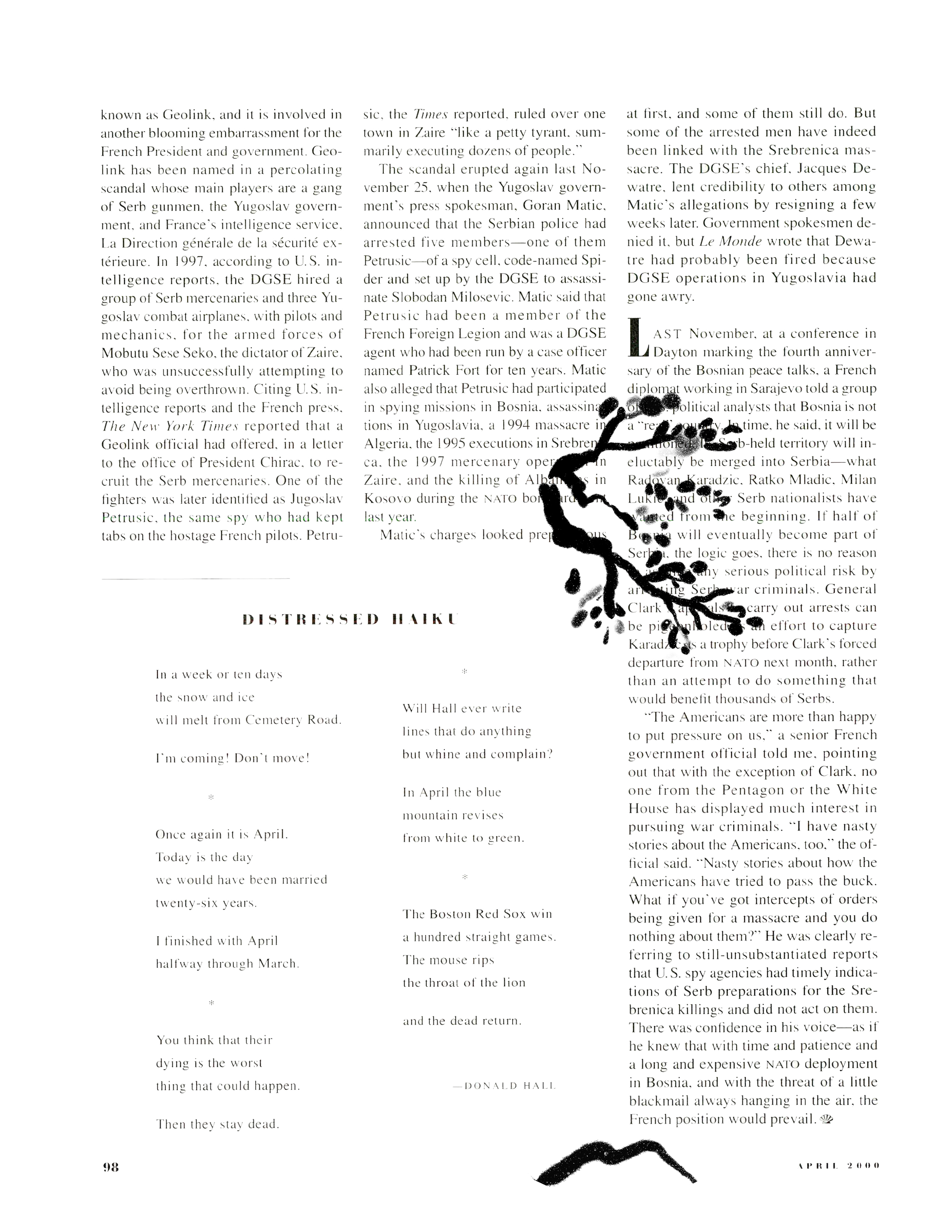
Hall’s 2000 poem “Distressed Haiku” is clearly about Kenyon—but also, in a broader sense, about moving forward in time when it means growing farther from those you’ve lost. The English-language haiku typically consists of three lines: the first with five syllables, then seven syllables, then five. Here, Hall has ignored those rules. But he’s kept with another common feature of the form: The last line somehow contradicts, changes, or illuminates what came before it. The haiku, like Hall’s life, has a turning point.
His series of not-quite-haikus (“distressed” in both subject matter and form) takes bits of his grief and explores its contradictions. Kenyon is buried in the ground, under snow and ice—but someday Hall will join her. The initial sting of a death seems worse than anything—but the years that follow are harder. Hall is preoccupied with darkness—but the Earth keeps spinning. April, the month in which Kenyon died, is also a time of biblical and natural rebirth.
In the last stanza, Hall names what seems impossible: “The mouse rips / the throat of the lion / and the dead return.” By pairing this with his other, more logical segments, he seems to be emphasizing how absurd the idea of any change over time feels, when one is stuck firmly in grief. But perhaps he’s also suggesting that, however unthinkable and unfair it may be, standing still is not an option; life, like the haiku, has its inevitable arc. “I weep every day, but I don’t howl,” he said back in 1997. “I howled and scared the dog all the time, for a long time. And I’ve probably only howled once in the past six months … That the world should go on is such an outrage—but it does.”
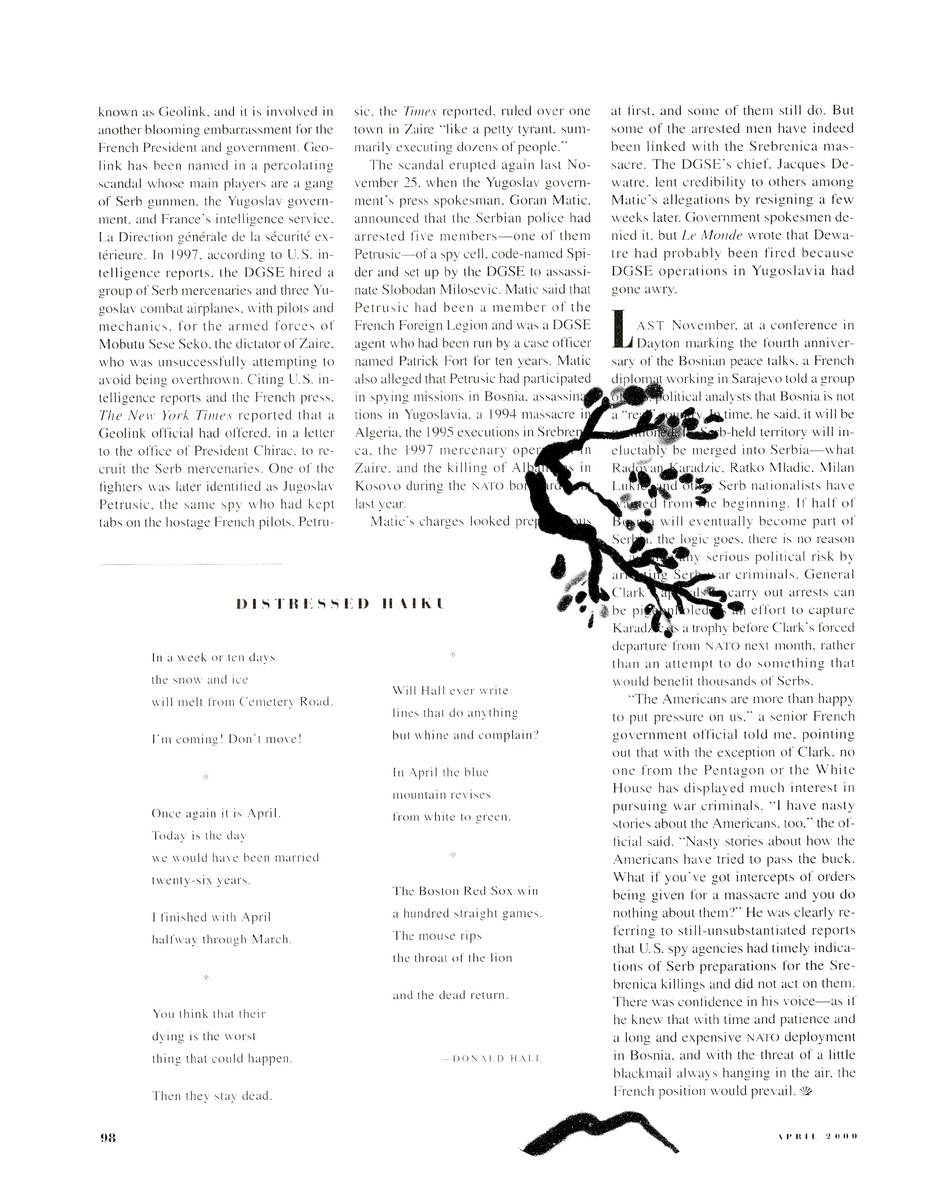
You can zoom in on the page here.