The Empty Promise of Good Intentions
Even when motives are pure, altruism is too often insufficient: Your weekly guide to the best in books

Striving to be a good person can be challenging—and there are so many ways to do it badly. In her third novel, Birnam Wood, Eleanor Catton follows an idealistic guerrilla gardening group in New Zealand. As Lily Meyer writes, Catton uses this collective’s not-always-pure pursuits to “poke, quite hard, at the dreams and pieties of people who believe they can change the world.” Many of Jonathan Franzen’s characters also believe they have a higher calling, but their antics can emphasize their flaws: In her review of Crossroads, Becca Rothfeld calls Russ Hildebrandt, the father at the center of the drama, “outwardly virtuous but inwardly self-pitying, progressive in principle but regressive in practice.” Franzen’s skepticism of these types comes through when Russ’s son Perry wonders whether humans “can ever escape our selfishness.”
Even when altruism has honest motives, it frequently reflects a distorted sense of an individual’s power to change the world. In his book Skinfolk, Matthew Pratt Guterl writes about his parents’ attempt to fight racism by raising two biological white children and four other children of different races together. They believed, as Nicole Chung writes in her review, that they could “change the world by example,” failing to recognize the fact that “transracial adoption has no intrinsic power to heal racial prejudice.” Contending with white privilege provides fertile ground for fiction as well. In Kiley Reid’s Such a Fun Age, a white mom named Alix becomes obsessed with Emira, the young Black woman she has hired to take care of her child. Her interest becomes, as Stephanie Hayes writes, “an exercise in narcissistic projection.” Through Alix’s efforts to prove her progressiveness to Emira, Reid criticizes white people’s “fumbling attempts to identify with black people—as much to burnish their own images as to genuinely connect with others.”
Well-intentioned actions might also downplay structural problems. Emi Nietfeld challenges the “fiction that anyone who works hard can have a better life.” When she was 17, she won a monetary award from the Horatio Alger Association of Distinguished Americans, which promotes the virtues of hard work and individual achievement, celebrating those it deems to have overcome challenging odds. But in reality, as Nietfeld argues, the Alger Association’s “bootstrap” mentality perpetuates the dangerous myth that it’s up to each individual to “make it”—ignoring the policy failures that mean that few people succeed and many more are left in the dust.
Every Friday in the Books Briefing, we thread together Atlantic stories on books that share similar ideas. Know other book lovers who might like this guide? Forward them this email.
When you buy a book using a link in this newsletter, we receive a commission. Thank you for supporting The Atlantic.
What We’re Reading
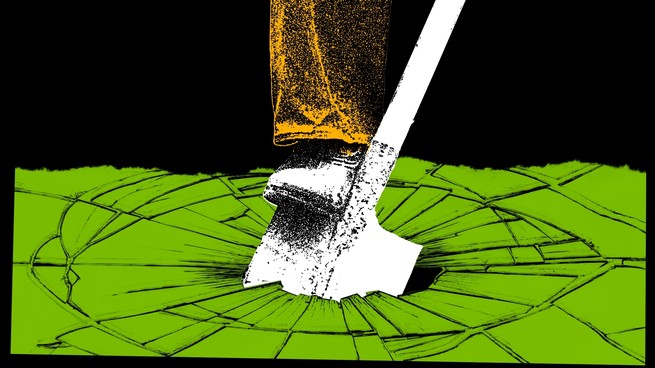
Illustration by Daniel Zender / The Atlantic; Getty.
A biting satire about the idealistic left
“Before long, though, the novel begins questioning the nature of do-gooding in a compromised and compromising world. It gradually transforms into a sincere interrogation of the relationship between morality and the ability to bring about positive change. Birnam Wood wants to know if a person has to be good to do good—and how to identify what goodness is in the first place.”

Illustration by Paul Spella; source images: Roman Nerud / Alamy; Oleh Slobodeniuk / Getty; Bettmann / Getty
Jonathan Franzen’s best book yet
“Crossroads is a rejection of Purity’s empty expansiveness on almost every front. Its protagonists could not be less glamorous, its intrigues less international. Its action is concentrated within a crumbling community, its focus trained on a family’s everyday recriminations. Though its stakes are high, psychically speaking, its core predicament is modest and emotional. Here we wonder not whether a bird species will go extinct, but whether any of the Hildebrandts can shed their selfishness and muster some measure of goodness.”

Photo-illustration by Trevor Davis. Sources: Courtesy of Matthew Pratt Guterl; Phillip Spears / Getty.
The family who tried to end racism through adoption
“Transracial adoption will never empower adoptees of color or our white family members to sidestep the realities of privilege, bias, and racism; as Skinfolk shows, we will meet and experience these things in the most intimate of ways, within the microcosm of our own family.”

David Goddard
Such a Fun Age satirizes the white pursuit of wokeness
“The overarching joke of Such a Fun Age is that while the white characters fret over what black people think of them and their progressive values, the black characters are busy getting on with their lives and trying to keep up with one another.”

Illustration by Adam Maida
“Bootstrapped urges readers to rethink their narratives of accomplishment. [Alissa] Quart encourages us to stop shaming others, and ourselves, for needing assistance and to acknowledge the ways we are all interdependent.”
About us: This week’s newsletter is written by Maya Chung. The book she’s reading next is Ordinary Notes, by Christina Sharpe.
Comments, questions, typos? Reply to this email to reach the Books Briefing team.
Did you get this newsletter from a friend? Sign yourself up.