
Return to the January 1999 A&E Preview Cover
|
Arts & Entertainment Preview - January 1999


B Y N A N C Y D A L V A & J O H N I S T E L

NYCB Jubilee

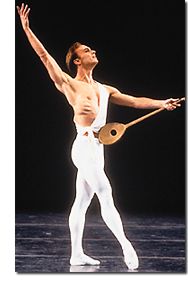 | Peter Boal in Apollo
|
The way ballet, that European art form, became American was this: In 1933 Lincoln Kirstein brought George Balanchine to America. The following year they founded The School of American Ballet, because to make dances one needs dancers trained to one's specifications, which -- for an innovator par excellence -- continually evolve. In 1946 the two men founded the Ballet Society; in 1948 this morphed into what we now know as the New York City Ballet, the epitome and apotheosis of modernism in American ballet. To mark its fiftieth anniversary, the NYCB's winter and spring seasons include more than a hundred ballets, deployed in festive special programs (tickets 212-870-5570). The schedule, in fact, is reminiscent of the calendar at my children's school cafeteria, where the chef from time to time declares a theme meal -- for instance, "Hawaiian Day," or "Mexican Fiesta." Somehow the folks at the NYCB got wind of this gambit: their schedule includes but is not limited to Russian, English, French, Austrian, German, Italian, and Polish tributes; a Robbins Celebration, a Balanchine Celebration, and an All-Balanchine Program. Two full-length ballets are also in there, along with four world premieres and numerous repertory revivals. These, apparently, will all be in house stagings, as is the company custom. In other words, the originators of the roles will not be coaching, nor will the more recently retired dancers who inherited the roles later in Balanchine's lifetime. Thus, despite the look backward, the season promises to be not a referendum on the present but a view into the future. However it all turns out (and good luck to the dancers!), this season will show us what the most wondrous of twentieth-century ballet treasures -- the Balanchine repertory -- will look like in the twenty-first.
--N.D.
Reviving Iphigenia
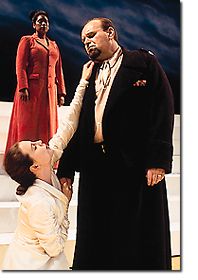 | The Iphigenia Cycle
|
In all of literature, perhaps no daughter measures up in mythic stature to Iphigenia, who was sacrificed by her father, Agamemnon, in order that the Trojan War could begin. She has drawn renewed attention from theater artists in recent years. The French director Ariane Mnouchkine used Iphigenia in Aulis as a prologue to her ritualistic epic production of the complete Oresteia trilogy several years back. Ellen McLaughlin's Iphigenia and Other Daughters (1995) is a compilation of several Attic dramas. The director JoAnne Akalaitis brings The Iphigenia Cycle to New York this month, thanks to the co-producers Theatre for a New Audience -- one of the country's few institutions devoted to producing high-quality, uncompromising classic theater for students as well as adult audiences -- and Chicago's Court Theatre, where the production debuted last season. Akalaitis is supremely suited to a re-examination of the iconic daughter, for if the theatrical avant garde ever crowned a mythic mother of invention, Akalaitis would be it. From her 1970s experiments with the downtown New York ensemble Mabou Mines and her uncompromising, Obie Award-winning approaches to Beckett to her more recent forays into the classic modern-drama canon, Akalaitis lights the lights. The director has always had an unnervingly brilliant sense of stage space and a clarity of vision. When applied to a classic text, the tragedy becomes transcendent.
--J.I.
Bird's-Eye View
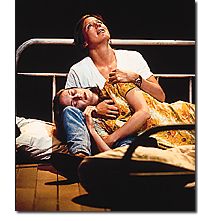 | Jennifer Van Dyck
and Gina Nagy
in Tongue of a Bird
|
"I'm in the little plane again, waiting to take off." So begins Days and Nights Within (1984), one of the playwright Ellen McLaughlin's earliest efforts. Fifteen years later taking flight has become second nature to McLaughlin: as an actress, she created the role of the Angel who nightly crashed through the roof onto the Broadway stage in Tony Kushner's Angels in America. Her playwriting career has been a steadier ride. Her latest, Tongue of a Bird, taxis for takeoff at the Mark Taper Forum (213-628-2772), in Los Angeles, this month, before subsequent productions at New York's Public Theater (March; 212-260-2400) and the Oregon Shakespeare Festival (July; 541-482-4331). Produced in London and Seattle to critical acclaim, the play combines poetic dialogue and vivid imagery in such lyrical fashion that the work practically levitates. Maxine, a search-and-rescue pilot, makes aerial sorties to look for a lost child; she's also searching for her mother and, ultimately, for her sense of self. In a monologue addressed to Amelia Earhart, Maxine explains the allure of the air: "It's solitude taken to the utmost extreme. You hear a snap and, yes, complete disconnection from the world. What wings do." As delicate as a balsa-wood glider, the play, directed by the ever-able Lisa Peterson, has the potential to carry its author to higher altitudes.
--J.I
Nancy Dalva is the author of Dance Ink: Photographs.
John Istel is a senior editor at Stagebill.
Go to ...
 
Copyright © 1999 by The Atlantic Monthly Company. All rights reserved.
|