

Return to the February 1999 A&E
Preview Cover
|
Arts & Entertainment Preview - February 1999

B Y N A N C Y D A L V
A & J O H N I S T E L

What's in a Name?

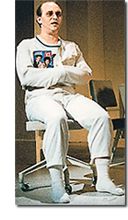 | The Day Room
|
Theater history is strewn with the literary wreckage left by fine writers
who've become enthralled with the stage. Read a play by Voltaire or Henry
James -- it's a peculiar form of mind-torture. However, don't approach Don
DeLillo's Valparaiso, showing this month at American Repertory Theatre, in
Cambridge, Massachusetts, with trepidation. Not only is DeLillo one of our
most acclaimed novelists (White Noise, Libra, Underworld), but his debut
play, The Day Room (1986), also produced by ART, revealed an incipient
theatricalist. The characters in that dark comedy, set inside a hospital
room (or is it a lunatic asylum?), shift roles until it's not clear who's
the doctor and who's the patient. DeLillo toys with similar Pirandellian
complexities in Valparaiso, an exploration of media-mad America. Michael
Majeski, a businessman, flies off to the eponymous Indiana town but somehow
ends up in Valparaiso, Florida, and then in Valparaiso, Chile. Suddenly
he's the hit of the talk- show circuit. According to DeLillo, "The man is
making the most modern journey possible, . . . into the secret places of
identity and transcendence." He must choose between "his sanity and his
celebrity." Moreover, the production has a secret weapon: Will Patton. One
of the theater's most mesmerizing performers, Patton has been lost in
Hollywood, appearing in films that don't do justice to his quirky,
mad-gleam, slow-boil intensity. Now that theater has reclaimed him -- and
hijacked DeLillo -- don't lose your way to Valparaiso.
--J.I.
Open House
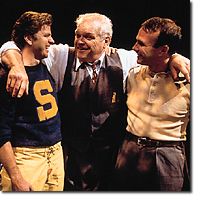 | Death of a Salesman
|
The most memorable set design in twentieth-century American theater? Many
critics would nominate Jo Mielziner's hauntingBrooklyn house into which Lee
J. Cobb as Willy Loman lugged his sample cases exactly half a century ago
this month in Arthur Miller's Death of a Salesman, directed by Elia Kazan.
Its split levels -- the realistic kitchen below an expressionistic skeleton
of roof beams -- symbolized Loman's psychic dislocation, a split between
his rose-colored past and his precarious present. No matter where the play
led Loman -- to his office, to a restaurant, or to the graveyard -- his
home loomed overhead. Just as every actor playing Stanley Kowalski in A
Streetcar Named Desire (Kazan and Mielziner's previous Broadway triumph)
must exorcise Brando's ghost, every designer must confront what Kazan
called "the single most critically important contribution" to Salesman's
first production. With this month's Broadway revival, largely imported from
Chicago's Goodman Theatre, Mielziner's triumph will be tested by Mark
Wendland. Those who've seen his work -- Timon of Athens, The Dybbuk --
understand how Wendland's designs function as another character. They move,
mutate, implode. In collaboration with the director Robert Falls, Wendland
has not so much deconstructed Loman's elemental American home as dissected
and redefined Mielziner's initial impulse. With the actor Brian Dennehy
"riding on a smile and a shoeshine," and fellow cast members Elizabeth
Franz and Kevin Anderson adding strong support, the production promises to
be the Salesman for the next century.
--J.I.
If the Shoe Fits
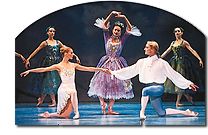 | Pacific Northwest Ballet
performs Cinderella
|
Just in time for Valentine's Day, Pacific
Northwest Ballet stages its opulent production of Cinderella, uniting
the choreography of its own artistic director, Kent Stowell, with the quite
fabulous design talents of Tony Straiges (sets) and Martin Pakledinaz
(costumes). Neither is a stranger to ballet or fairy tales or onstage
romance: Straiges's credits include Into the Woods, Sunday in the Park With
George, and designs for American Ballet Theatre and the Joffrey Ballet;
Pakledinaz, a regular designer for the Seattle Opera, has been a successful
collaborator with the dance visionary Mark Morris. Thus PNB sets the stage
for the perfect Valentine's Day: getting dressed up, listening to lavishly
romantic music (score by Prokofiev), and seeing a complicated and deeply
satisfying story: wimpy dad, nasty siblings, horrid step-mother, nothing
nice to wear, everything awful to do -- the whole Freudian panoply of
actual and imagined childhood injustices. Stowell's version of the story
introduces a dream element of Cinderella's happy life with her real mother.
His Cinderella loses an embroidered pointe shoe on the palace steps at
midnight. How perfect! A ballerina's slipper is every bit as much a means
of magic as an enchanted crystal evening shoe, and ever so much more
available. A ballerina's slipper is a symbol of desire, work, dream, and
flight, and bears the marks of the wearer's striving. Therein lies the
modern moral of Cinderella. As every woman knows, shoes have power. Some of
us are born knowing this, and some of us learn it, perhaps at the ballet.
Even if you have no use for princes and castles, you need shoes. And, as
Cinderella discovers, the girl with the right shoe gets the best life.
(Seattle Center Opera House, February 4-7, 10-14, 206-292-2787.)
--N.D
Nancy Dalva is the author of Dance Ink:
Photographs.
John Istel is a senior editor at Stagebill.
Go to ...
 
Copyright © 1999 by The
Atlantic Monthly Company. All rights reserved.
|