

Return to the April 1999 A&E
Preview Cover
|
Arts & Entertainment Preview - April 1999

B Y B O B B L U M E N T H A
L & C H A R L E S M.
Y O U N G

Going the Extra Miles

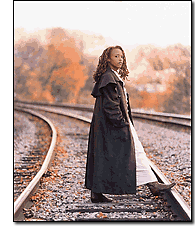 | Cassandra Wilson
|
Cassandra Wilson has something different in mind with Traveling Miles (Blue Note), her tribute to Miles Davis. Amid seven compositions associated with the late trumpeter she includes four of her originals, and the settings avoid both the horns-and-rhythm punch of Davis's acoustic quintets and the electric edge of his fusion years in favor of such decidedly non-Milesian touches as marimba, Greek bazouki, violin, mandolin, and harmonica. The atmosphere is of a piece with Wilson's recent albums, on which catholic tune choices and hypnotic arrangements transformed jazz's most promising vocalist into a singular crossover success. The results here are equally captivating. Wilson attacks the familiar songs from inspired angles -- putting a bitonal, 4/4 spin on the waltz "Someday My Prince Will Come" that drains the song's innocence while retaining its wonder; bringing the heraldic "Tutu" (retitled "Resurrection Blues") closer to rural sources with a dash of bottleneck guitar -- and makes oblique yet telling use of Mileslike moods for her own "When the Sun Goes Down" and "Piper." A few famous guests, including Pat Metheny and Angelique Kidjo, do effective cameo turns. Equally impressive are such emerging jazz stars as the mallet players Stefon Harris and Cecilia Smith and the violinist Regina Carter. Wilson's voice is the glue, with an aura both vulnerable and ominous, like the sound of the Harmon-muted Miles Davis horn.
--B.B.
Songs of Ourselves
 | Tom Russell
|
Unlike standard-issue academic historians, folk musicians have always understood that the lives of common people yield at least as much drama as the great works of great men. On The Man From God Knows Where (HighTone), Tom Russell takes on the vast topic of immigration to America with a special emphasis on Ireland and Norway, where his own ancestors came from. The result is a historically conscious cycle of twenty-six songs that summon the spirit of Walt Whitman's Leaves of Grass and Howard Zinn's A People's History of the United States: 1492-Present. Russell's warm baritone resonates with sincerity, and he surrounds himself with highly distinctive guest musicians who keep his archetypes alive as characters rather than stereotypes (the bane of modern folk). Dave Von Ronk contributes his astounding rasp in the role of the "outcaste" who arrived in America and went "a touch insane.' Annbjørg Lien lends her eerie hardanger fiddle and key harp to the story of a Norwegian immigrant who lost his crops and ultimately turned to whiskey, both distilling and drinking. And Iris DeMent sings a devastating "Wayfarin' Stranger." But most of the credit goes to Russell, whose reach is both wide and deep, balancing the grand sweep of history with the individual tragedies of his ancestors broken on the frontier. He closes with a particularly moving portrait of his alcoholic father, broken by the dream of striking it rich. "How can you be a loser if you never lose your pride?" he asks about his father -- but the question applies to most of the outcasts who never quite found their dream in America.
--C.M.Y.
The Sounds Behind the Scenes
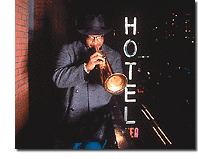 | Terence Blanchard
|
At its most inspired, the use of jazz in movie soundtracks finds one twentieth-century art form feeding another, expanding dramatic possibilities and lending the complex emotional nuances that contemporary storytelling demands. The trumpeter Terence Blanchard is the most active composer of jazz scores, having collaborated frequently with Spike Lee; but his new CD Jazz in Film (Sony Classical) is less a personal celebration than a summary of how Elmer Bernstein, Bernard Herrmann, and other Oscar-winning composers have applied swing and the blues. Blanchard has reduced cinema music to combo scale in the past, most impressively on The Malcolm X Jazz Suite (Columbia), a few years back. Here he adopts a concerto grosso format, placing bands of four to seven pieces within orchestral settings that retain the big-screen majesty of the original scores. The soloists respond well, with the tenor saxophonist Joe Henderson and the late pianist Kenny Kirkland making several effective contributions, while Blanchard's playing is filled with the quixotic shifts and teasing smears that he and his New Orleans contemporary Wynton Marsalis have turned into a neoclassical trumpet style. The real stars of Jazz in Film, though, are the composers. Hearing Jerry Goldsmith's "Chinatown" and Quincy Jones's "The Pawnbroker" (the album's most striking melodies) transports the listener to a darkened theater and raises images of the movies they so indelibly embellished.
--B.B.
Bob Blumenthal is a jazz critic for The Boston
Globe.
Charles M. Young reviews popular music for Playboy, Musician, and
other publications.
Go to ...
 
Photo credits -- Tom Russell: David Burckhalter. Cassandra Wilson: Joanne Salvo. Terence Blanchard: Joseph Pluchino.
Copyright © 1999 by The
Atlantic Monthly Company. All rights reserved.
|