
Return to the November 1998 A&E Preview Cover
|
Arts & Entertainment Preview - November 1998


B Y B O B B L U M E N T H A L & C H A R L E S M. Y O U N G

Renbourn Returns

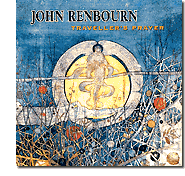 First coming to prominence in the sixties, as a member of Pentangle, the English folk band that played a hypnotic hybrid of folk and jazz, John Renbourn developed an exquisitely original style of acoustic guitar that has had considerable influence in traditional folk and New Age circles. In recent years he has limited himself mostly to live albums and instructional videos. Traveller's Prayer (Shanachie) is his first studio album in thirteen years, during which time he finally found a guitar pickup he likes. This is welcome news, because most acoustic guitars in this digital age sound like crud. Renbourn's guitar doesn't. It sounds delicate, but with full resonance and chime, and it will make happy any listener enthralled by the drama of one man and one guitar turning a host of influences into a singular and highly spiritual impression. Actually, most of the songs make use of other musicians, adding a little woodwind variety to the mood of wistful introversion, excavating ancient music and polishing
it just enough to knock the dust off, but not enough to lose the haunting essence. Pentangle fans will be thrilled to hear The Voice Squad -- Gerry Cullen, Phil Callery, and Fran McPhail -- plus Mairead Ni Dhomhnaill on "Wexford Lullaby" and "Traveller's Prayer." Renbourn arranges for a band at least as well as he plays guitar, and his album isn't complete without some glorious choral work. Great for late-night contemplation of life's purpose. Great background for letting ideas float up from your unconscious. Not great for sleeping. The melodies will hook you for a delightful case of insomnia. --C.M.Y.
First coming to prominence in the sixties, as a member of Pentangle, the English folk band that played a hypnotic hybrid of folk and jazz, John Renbourn developed an exquisitely original style of acoustic guitar that has had considerable influence in traditional folk and New Age circles. In recent years he has limited himself mostly to live albums and instructional videos. Traveller's Prayer (Shanachie) is his first studio album in thirteen years, during which time he finally found a guitar pickup he likes. This is welcome news, because most acoustic guitars in this digital age sound like crud. Renbourn's guitar doesn't. It sounds delicate, but with full resonance and chime, and it will make happy any listener enthralled by the drama of one man and one guitar turning a host of influences into a singular and highly spiritual impression. Actually, most of the songs make use of other musicians, adding a little woodwind variety to the mood of wistful introversion, excavating ancient music and polishing
it just enough to knock the dust off, but not enough to lose the haunting essence. Pentangle fans will be thrilled to hear The Voice Squad -- Gerry Cullen, Phil Callery, and Fran McPhail -- plus Mairead Ni Dhomhnaill on "Wexford Lullaby" and "Traveller's Prayer." Renbourn arranges for a band at least as well as he plays guitar, and his album isn't complete without some glorious choral work. Great for late-night contemplation of life's purpose. Great background for letting ideas float up from your unconscious. Not great for sleeping. The melodies will hook you for a delightful case of insomnia. --C.M.Y.
And the Beat Goes On
 | Roy Haynes
|
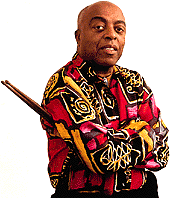
After half a century of jazz creativity, the drummer Roy Haynes is beginning to amass overdue accolades while still setting a mean pace for musicians a third his age. Names on the early pages of Haynes's résumé, such as Lester Young, Charlie Parker, Stan Getz, Sarah Vaughan, Thelonious Monk, and John Coltrane, suggest how much history has been spun over his complex polyrhythms; and more recent associates Gary Burton, Chick Corea, and Pat Metheny can testify to the still-youthful snap of his beat. Haynes continues to attract the brightest lights to his projects, of which Praise (Dreyfus Jazz) is his most recent. Two of the strongest present-day saxophonists, Kenny Garrett and David Sanchez, test their limits in Haynes's company. Haynes's trumpet-playing son Graham displays his lyrical sensitivity here on "The Touch of Your Lips," and the pianist Dave Kikoski, a longtime associate, contributes the original "Inner Trust" and a haunting trio version of the traditional "Morning Has Broken." Haynes touches on two career high points by reprising Parker's "My Little Suede Shoes" (in a combustible duet with Garrett's alto) and Corea's "Mirror Mirror." He also gets everyone to mix it up on the Brazilian "After Sunrise," and concludes with a dramatic, unaccompanied "Shades of Senegal" that suggests that a drum may be at its most powerful when it whispers.
--B.B.
Gershwin's World
 | Herbie Hancock (left)
|
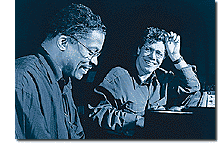
Just when numerous, numbingly similar George Gershwin centennial tributes threaten to rob the composer's music of its charms, Herbie Hancock offers the most imaginative and probing of retrospectives. The pianist reprises several classic songs and draws on the obligatory all-star cast, to be sure; but his Gershwin's World (Verve) takes a far more instructive view. As the album title suggests, the program looks beyond Gershwin to the environment that formed him and that he in turn helped form. Amid four excerpts from Porgy and Bess, "Embraceable You," and the symphonic "Lullaby," Hancock nods to Tin Pan Alley's vernacular roots, with Stevie Wonder's aid, on W. C. Handy's "St. Louis Blues"; partners with Chick Corea for a two-piano re-creation of Harlem rent parties on James P. Johnson's "Blueberry Rhyme"; verifies Gershwin's Impressionist affinities by improvising on the second movement of a Ravel concerto; and shows what "I Got Rhythm" wrought by exploding Duke Ellington's "Rhythm"-derived "Cotton Tail," alongside his old friend Wayne Shorter. The collection is expertly executed, from Joni Mitchell's penetrating "The Man I Love" and Kathleen Battle's inventions on Prelude in C# minor to the percussionists' new slant on "Fascinatin' Rhythm." The stellar cast suggests that Hancock's World, while firmly grounded in uncompromising acoustic jazz, is also fairly boundless.
--B.B.
Bob Blumenthal is a jazz critic for The Boston Globe.
Charles M. Young reviews popular music for Playboy, Musician, and other publications.
Go to ...
 
Copyright © 1998 by The Atlantic Monthly Company. All rights reserved.
|