|


Return to the March 1998 A&E Preview Cover |
Arts & Entertainment Preview - March 1998
    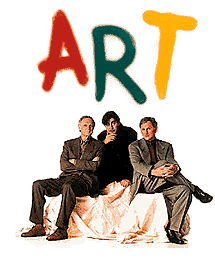 When Sean Connery's wife, Micheline
Roguebrune, saw Art in Paris, she persuaded her husband to try to option
the smash-hit play as a film vehicle for himself. But the
playwright -- thirty-seven-year-old Yasmina Reza -- insisted on having it produced
onstage in London and New York first. Connery and his co-producer, David Pugh,
coughed up the funds, and their critically acclaimed West End production,
directed by Matthew Warchus, recouped their investment in seven weeks. Warchus
now directs the award-winning comedy on Broadway (March 1; 212-239-6200). Alan
Alda, Alfred Molina, and Victor Garber play three close friends -- Serge, a
dermatologist; Marc, an aeronautical engineer; and Yvan, a wholesale-stationery
salesman -- who could be characters in a Seinfeld spinoff as written by
Roland Barthes or Jean Baudrillard. When Serge buys an all-white piece of
modern art for 200,000 francs, Marc's disdain threatens the trio's long
friendship. Some critics questioned whether the play, like the central piece of
art, is a case of the Emperor's New Clothes. But Reza, especially in
Christopher Hampton's translation, never lets the play take itself too
seriously. It's clear that the dermatologist's knowledge of deconstruction, for
example, is only skin deep. It's a play that flirts with big ideas but never
engages them. It's too busy having fun at its characters' expense and provoking
laughs that make this ninety-minute piece of art seem like a good deal. --J.I.
When Sean Connery's wife, Micheline
Roguebrune, saw Art in Paris, she persuaded her husband to try to option
the smash-hit play as a film vehicle for himself. But the
playwright -- thirty-seven-year-old Yasmina Reza -- insisted on having it produced
onstage in London and New York first. Connery and his co-producer, David Pugh,
coughed up the funds, and their critically acclaimed West End production,
directed by Matthew Warchus, recouped their investment in seven weeks. Warchus
now directs the award-winning comedy on Broadway (March 1; 212-239-6200). Alan
Alda, Alfred Molina, and Victor Garber play three close friends -- Serge, a
dermatologist; Marc, an aeronautical engineer; and Yvan, a wholesale-stationery
salesman -- who could be characters in a Seinfeld spinoff as written by
Roland Barthes or Jean Baudrillard. When Serge buys an all-white piece of
modern art for 200,000 francs, Marc's disdain threatens the trio's long
friendship. Some critics questioned whether the play, like the central piece of
art, is a case of the Emperor's New Clothes. But Reza, especially in
Christopher Hampton's translation, never lets the play take itself too
seriously. It's clear that the dermatologist's knowledge of deconstruction, for
example, is only skin deep. It's a play that flirts with big ideas but never
engages them. It's too busy having fun at its characters' expense and provoking
laughs that make this ninety-minute piece of art seem like a good deal. --J.I.In the age of the memoirist as navel gazer, Neil Greenberg's work proves that the most specific of autobiographers can, through intelligence and craft, make dances that possess general implications for a wide audience. In Not-About-AIDS-Dance (1994), The Disco Project (1995), and the new Part Three (itself a trilogy) he dances about his life and times, linking the three pieces with signature movement motifs. He also turns to words, with simple statements of fact about dancers and projections of their history on the backdrop. Linked to the beautiful physical presence of the performers, this fragmented narrative, freighted with sad happenings, is surprisingly resonant, and anything but a gimmick. How does Greenberg not merely get away with but triumph in personal history, slide projections, literary effects--areas where lesser artists drown? Simplicity, directness, clarity, and his own disposition are the keys. Greenberg's choreographic voice is a singular mixture of the wrenching and the joyous: you can search his work for symbols (the pink of the Nazi triangle, the posturing of Judy Garland, the death of his brother--which is not only symbolic but also very real) and find it dark, or you can take pleasure in its sheer exuberance and find it filled with light. Greenberg jumps from shadow into spotlight with endearing and affecting joie de vivre, morphing memory into choreography. (March 31-April 5; 212-996-1100).--N.D.
Rocket Man (February 26-March 25; 520-622-2823) is Goldstein's sixth Dietz debut and third joint project with the author in Arizona. "It's like Lonely Planet, only backwards," says Goldstein, referring to Dietz's off-Broadway hit AIDS allegory of a few seasons ago, in which a cartographer slowly fills his shop with dozens of chairs symbolizing friends who have died. Rocket Man takes a similarly sentimental absurdist tack: Donny, a landscaper, has ensconced himself in his attic, trying to access a parallel universe. As the play moves chronologically backward, the clutter disappears, leaving Donny alone in his recliner. Goldstein and Dietz's collaboration, however, continues to move forward through time, even as their subjects look back: ATC has commissioned Dietz to write a musical about, of all things, the Lincoln-Douglas debates. --J.I. Nancy Dalva is the author of Dance Ink: Photographs. John Istel is a senior editor at Stagebill.  
Copyright © 1998 by The Atlantic Monthly Company. All rights reserved. | ||||||||||||
| |||||||||||||