
Return to the February 1998 A&E Preview Cover
|
Arts & Entertainment Preview - February 1998


B Y N A N C Y D A L V A & J O H N I S T E L

Writer on the Rise

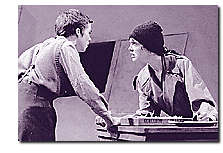 | Scene from The Cripple of Inishmaan
|
If Angela's Ashes didn't knock the blarney out of you, Martin McDonagh's
fierce and funny dramatic
fables should. A twenty-seven-year-old Londoner born to Irish parents, McDonagh
dropped out of school at sixteen and started writing "to avoid having a real
job." He's got one now. This month marks the second anniversary of his debut
with The Beauty Queen of Leenane, at the Druid Theatre Company, in
Galway, Ireland. Since then, like no other playwright in modern memory,
McDonagh has enjoyed meteoric success and accolades (he has had four critically
acclaimed plays running simultaneously in London). Offering further adulation
feels a bit like bringing a beer into an Irish bar. But crack open the script
of, say, The Cripple of Inishmaan, available in the Paris Review
(Spring 1997) -- the longest piece the magazine has run since Philip Roth's
novella Goodbye, Columbus -- and the dialogue rocks and reels off the
page, summoning the guardian spirits of Synge, Beckett, and O'Casey. Better
yet -- go see Beauty Queen, which, with three out of four members of the
original cast, has its U.S. premiere off-Broadway at the Atlantic Theater
Company (212-239-6200) on February 11, or catch The Cripple of Inishmaan
when it opens on March 10 at New York's Public Theater (212-260-2400), under
Jerry Zaks's direction. But be warned. McDonagh's Eire is an anti-Eden, peopled
by characters as earthbound as peat and potatoes and as acerbic and bitter as
the home-distilled poteen with which they drink themselves toward unattainable
dreams. Inspired by the Brothers Grimm, McDonagh views his plays as "just
stories ... little things." But like coal compressed for millennia,
these tiny tales yield glimmerings of light. --J.I.
Must-Sees From the Winter Repertory
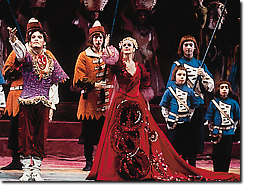 | George Balanchine's Firebird
|
To see a dancer grow in a company, moving from the back row to center stage; to
see a company grow in a dance, with newcomers taking on old roles in new ways:
these are the abiding pleasures of attending dance programs not from time to
time but all the time, as much as one can. My home-town ballet company happens
to be The New York City Ballet, and in February it promises to be a
superlative refuge. The winter repertory includes forty-seven works, among them
significant "last chances" (final performances before a ballet goes out of rep
for a time) and re-entries from the Balanchine canon. Not to miss: the
returning 1967 three-act dazzler Jewels, and the departing Scotch
Symphony, a misty and tender work one might think of as Balanchine's
Brigadoon. Also back: Divertimento No. 15, set to Mozart; Duo
Concertant, set to Stravinsky, as is the fabulous star vehicle
Firebird (whose originator, Maria Tallchief, set the stage ablaze); and
other Balanchiniana, including that indispensable benchmark of modernity The
Four Temperaments, an utterly perfect work to Hindemith. On the light side,
the Gershwin delight Who Cares? returns, with its fluffy Hershey Kay
orchestrations. It is the ballet equivalent of bubble bath, and I can hardly
wait to jump in. (Through March 1 at Lincoln Center; 212-870-5570 or
212-307-4100.) --N.D.
Two Plays That Pack a Punch
This month American Repertory Theatre (617-547-8300), in Cambridge,
Massachusetts, juggles two ideological wrestling matches--Shakespeare's The
Taming of the Shrew (through March 21), directed by Andrei Serban,
featuring the wild and wooing Petruchio in one corner and a very un-bonny
Kate in the other; and Brecht's parable about American capitalism, In the
Jungle of Cities (through March 14), staged by Robert Woodruff, in which
Garga and Schlink square off after the playwright's prologue admonishing
audiences, "Don't worry your heads about the motives for the fight, keep your
minds on the stakes."
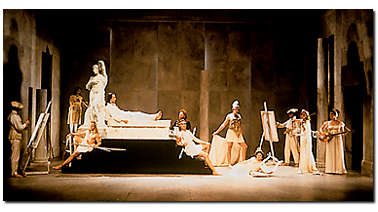
Serban's staging of Twelfth Night
Brecht, who once suggested that theater should have the
atmosphere of a boxing match, where audiences can puff cigars, won't get it at
the smoke-free Loeb Drama Center. But he'd be pleased by the artistic director
Robert Brustein's choice of directors. Serban and Woodruff, the Don Kings of
American experimental directing, both deliver sharp jabs and roundhouse rights
to encrusted classics. ART audiences know Serban for his revivals of the fairy
tale The King Stag, with masks, puppets, and costumes by Julie Taymor.
Woodruff once staged The Comedy of Errors as a circus featuring the
Flying Karamazovs, drag queens, and clowns. At both these current shows expect
an early knockout. --J.I.
Nancy Dalva is the author of Dance Ink: Photographs.
John Istel is a senior editor at Stagebill.
Go to ...
 
Copyright © 1998 by The Atlantic Monthly Company. All rights reserved.
|