
Return to the December 1998 A&E Preview Cover
|
Arts & Entertainment Preview - December 1998


B Y E L L A T A Y L O R

Second Fiddle

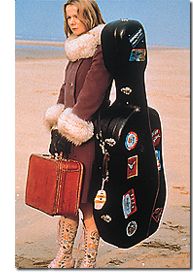 | Emily Watson as Jackie
|
The dramatic life and tragically early death from multiple sclerosis of British cellist Jacqueline Du Pré could lend themselves all too easily to the lazy narrative arc of the disease-of-the-week movie. In Hilary and Jackie the director Anand Tucker admirably sidesteps this trap by framing his movie in Du Pré's tumultuous relationship with her older sister, a seesaw dance of siblings unmatched in talent or temperament but telepathically close in their devotion to each other. Written with brio by Frank Cottrell Boyce, and directed by Tucker with a mischievously inventive visual élan, the film traces the sisters' childhood in the 1950s, dominated by music lessons and competitions, through young adulthood, when Jackie (Emily Watson) begins to outstrip Hilary (Rachel Griffiths). When Hilary settles for a stable life with minor-league conductor Kiffer Finzi (David Morrissey), Jackie impulsively follows suit by marrying the charismatic but aloof Israeli conductor Daniel Barenboim (James Frain). Emotionally ill-equipped for either marriage or the stresses of the international concert circuit, the tempestuous Jackie becomes a monster to her long-suffering sister. About halfway through, the movie loops gracefully back on itself to blame Jackie's excesses -- in part -- on the illness that creeps up on her. Yet Hilary and Jackie never succumbs to easy causality. Watson gives an impressively volatile rendition of Jackie, but she has the easy part compared with Griffiths, who, in a brilliantly modulated portrayal of the less showy Hilary, voices the film's crucial insight. "If you think being an ordinary person is any less difficult than being an extraordinary one," she cries when her sister has gone one betrayal too far, "you're wrong."
From Here to Maternity
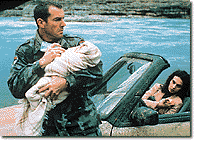 | Dennis Quaid in Savior
|
Like last year's Welcome to Sarajevo, a new film by Serbian director Predrag "Gaga" Antonijevic dramatizes the wars in the former Yugoslavia through the rescue of a child by a previously disengaged individual from the West. Irritating though it is to have every foreign event shaped by the heroism of an American, it's unlikely that Savior would have been made, let alone seen in the United States, without some major Hollywood names attached and Oliver Stone headlining the producers. In the movie an American soldier (Dennis Quaid), numbed by the death of his beloved wife (Nastassja Kinski) and son and his own savage retaliation, changes his name to the generic "Guy" and, along with his best friend (Stellan Skarsgard), turns mercenary for the Serbian faction in Bosnia. He finds himself on a journey through the war-torn region with an outcast Serbian woman (Nastasa Ninkovic) who has given birth to a Muslim baby girl. Savior is not a subtle film (the scenes of violence are devastatingly graphic), but neither are the conditions it describes. Though hobbled by Robert Orr's stagy screenplay, the movie is appropriately troubling and moving -- as far as it goes. In its effort to avoid stepping on any political toes, Savior suffers from the limitations that afflict any story focusing on the universal aspects of war: we learn much about what we already knew -- that war is hell -- while understanding little about the specifics of this war.
Painkillers
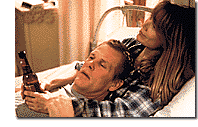 | Nick Nolte and Sissy Spacek
|
Novelist Russell Banks's somber concerns -- small-town corruption, the legacies of pain passed down in families undermined by alcoholism and abuse -- are a magnet for filmmakers who are drawn to life's darker corners. Although it's structured like a murder mystery, Paul Schrader's adaptation of Banks's 1989 novel Affliction is a quietly devastating character study of a divorced New Hampshire cop, Wade Whitehouse (played by Nick Nolte -- who better?), whose every effort to live a decent life with his girlfriend, Margie (Sissy Spacek), is thwarted by the legacy of a childhood spent defending himself and his younger brother, Rolfe (Willem Dafoe), against their bullying drunkard of a father, Glen (James Coburn). When a prominent weekender on a hunting trip is found shot to death, Wade's suspicions lead him to a course of action that inflames all his "afflictions" -- from a chronic toothache, to his futile battle for custody of his daughter, to his unabated rage against his enfeebled father. In lesser hands the line drawn from the sins of the father to those of the son might seem pat. Coburn and Nolte give marvelously abrasive performances, the vicious symbiosis of their characters underscored by flashbacks to the days that shaped the warped perspective of Wade, a good man driven to terrible deeds.
Ella Taylor is a film critic for LA Weekly.
Go to ...
 
Copyright © 1998 by The Atlantic Monthly Company. All rights reserved.
|