
Return to the October 1997 A&E Preview Cover
|
Arts & Entertainment Preview - October 1997


B Y A U S T I N B A E R

The Real Thing

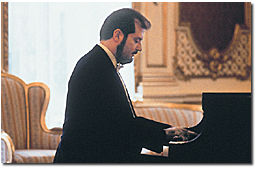 | Garrick Ohlsson's turn to shine
|
A topic in search of a doctoral candidate: the popularization of classical music
by the movies. Disney's immortal Fantasia peopled Beethoven's Symphony
No. 6 (the Pastoral) with centaurs and she-centaurs and gave Mickey
Mouse a star turn as the Sorcerer's Apprentice in the brilliant Dukas tone
poem. The elegiac Andante from Mozart's Piano Concerto No. 21, K. 467 set the
tone for Elvira Madigan, as did the volcanic opening flourish of Richard
Strauss's tone poem Thus Spake Zarathustra for 2001.
Shine, which treats musical performance as blood sport, has established
Rachmaninoff's lush Piano Concerto No. 3 in the popular imagination as an
Olympic event -- and also the personal property of the tormented Australian
pianist David Helfgott, who at this late stage in his career does not command
the technique to play it. His American tour last spring sold out, but if the
concerto rather than the human-interest angle was what you cared about, the
performance to hear was the one by the lithe young Norwegian virtuoso Leif Ove
Andsnes, with the New York Philharmonic. His reading (also available on an EMI
CD) balanced the scales between poetry and heroics, pinning swirling galaxies
of notes into coherent shapes by means of the subtlest accents. To judge from
the tumultuous ovations, no one in the hall missed the will-he-crash melodrama
of the simultaneous Shine tour. This month "Rach 3" resurfaces on a
program by the Baltimore Symphony Orchestra. The soloist is Garrick Ohlsson, an
American artist whose Paul Bunyanesque physicality bespeaks his power but
belies his delicacy. It may not be movie material, but the music should be
thrilling. And thanks to the movie, a much expanded public will be flocking
to it.
Genius, in Due Time
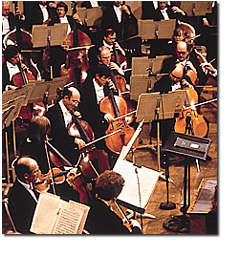 | Dutilleux at the BSO
|
In the pantheon of music's living masters Henri Dutilleux, born in France in
1916, has few peers. You would not, however, call him prolific. His apprentice
pieces he has destroyed, staking his reputation on a handful of major works
completed since the Second World War--works remarkable for their unpredictable
yet organic sense of form and for their unorthodox interplay of single
instrumental voices against the density of orchestral mass. The New
Grove Dictionary of Music and Musicians describes
Dutilleux in terms more
befitting a testimonial than a reference work: "He remains attentive to the
most diverse musical trends, but rejects anything which might distract him from
his own ideas and sensibility; each new work represents a deepening of his
thought, an attempt to go further. Yet the guiding principles remain always the
same, making Dutilleux's art a shining example of diversity within unity." Such
a composer is not a man to be rushed. Thus Seiji Ozawa and the Boston Symphony
Orchestra were forced in a recent season to postpone Dutilleux's latest major
contribution, Mémoire des ombres (Memory of shadows),
which now receives its world premiere in Boston (October 9, 10, 17, 18;
617-266-1200), bookending the New York premiere by the same forces at Carnegie
Hall (October 15, 16; 212-247-7800). The wait has only sharpened the
anticipation.
Rome is Where the Heart Is
 Times have changed. A generation ago a blazing new talent like Daniele
Gatti -- born in Milan in 1960, currently the music director of London's Royal
Philharmonic Orchestra, Bologna's Teatro Communale, and Rome's Accademia
Nazionale di Santa Cecilia -- would long since have been snapped up for
a major recording contract. In today's cautious climate he has had to wait, to
be signed at last not by an old blue chip but by hungry young Conifer Classics.
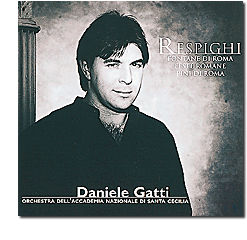
Gatti's debut album (disserved by a drab, shifty-eyed cover portrait) presents
Ottorino Respighi's ever-popular Pines of Rome, Fountains of
Rome, and Roman Festivals, played by the Santa Cecilia. Delivered
with such flair, these splashy crowd-pleasers are hard to resist. But there is
much more to Gatti than surface dazzle, and his first tour at the head of the
Royal Philharmonic concerns itself chiefly with the serious business of
Schubert, Schumann, Mahler, and Bartók. From October 11 to November 2
Gatti and the RPO visit New York, Washington, Boston, San Francisco, and
thirteen other American cities. Precious little Respighi is scheduled, but
there are always encores, for which a burst of Roman fireworks is just the
ticket.
Times have changed. A generation ago a blazing new talent like Daniele
Gatti -- born in Milan in 1960, currently the music director of London's Royal
Philharmonic Orchestra, Bologna's Teatro Communale, and Rome's Accademia
Nazionale di Santa Cecilia -- would long since have been snapped up for
a major recording contract. In today's cautious climate he has had to wait, to
be signed at last not by an old blue chip but by hungry young Conifer Classics.
Gatti's debut album (disserved by a drab, shifty-eyed cover portrait) presents
Ottorino Respighi's ever-popular Pines of Rome, Fountains of
Rome, and Roman Festivals, played by the Santa Cecilia. Delivered
with such flair, these splashy crowd-pleasers are hard to resist. But there is
much more to Gatti than surface dazzle, and his first tour at the head of the
Royal Philharmonic concerns itself chiefly with the serious business of
Schubert, Schumann, Mahler, and Bartók. From October 11 to November 2
Gatti and the RPO visit New York, Washington, Boston, San Francisco, and
thirteen other American cities. Precious little Respighi is scheduled, but
there are always encores, for which a burst of Roman fireworks is just the
ticket.
Austin Baer is a writer based in New York.
Go to ...
 
Copyright © 1997 by The Atlantic Monthly Company. All rights reserved.
|