
Return to the November 1997 A&E Preview Cover
|
Arts & Entertainment Preview - November 1997


B Y E L L A T A Y L O R

Levittown: The Soul of Suburbia

Does urban planning make the man? Not
according to Wonderland, John O'Hagan's nimble documentary update on the
people of Levittown, New York, the world's first assembly-line suburb. By
rights the inhabitants of this much-studied housing project, built in 1947 by
gung-ho developer William Levitt for Army veterans returning to America's
post-Second World War housing shortage, ought to be as conformist as their
cookie-cutter homes and gardens. Far from it: not only has the town produced a
respectable crop of stars, including rock singer Eddie Money and cartoonist
Bill Griffith, whose character Zippy the Pinhead was inspired by a
Levittown childhood, but its ordinary folks are as colorful a bunch of kooks as
you'd find in any boho urban enclave.
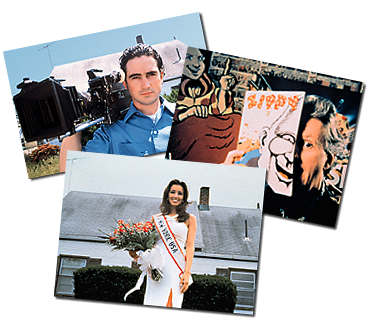
(clockwise from top) Director John O'Hagan, Bill Griffith and Zippy, and Miss New York 1996
From the beauty queen showing off her
biceps poolside, to the bird enthusiast whose pets appear to live in his hair,
to the aging couples reminiscing about swinger parties they never attended and
poltergeists they never met, the townspeople show a fabulously imaginative
gift for spicing up their featureless environment. "It was like The
Lucy Show, without the accents and without the humor," says one bitter
former Levittowner, now a stand-up comedian. O'Hagan, himself a child of
the 'burbs, finds both
humor and dignity in Levittown without glossing over its dark side, and in so
doing runs with graceful intelligence against the grain of cinema's
long-standing contempt for suburbia.
The Bigger Chill
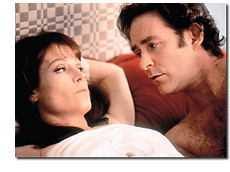 | Fooling around in the Nixon Era
|
The landscape is Cheeverish, the sex life Updikean with a dash of
Woodstock, and the air rank with hypocrisy, public and private. While Nixon fills television
screens with increasingly shrill efforts to explain away Watergate, unhappy
Connecticut narcissists paper over their loveless marriages with wife-swapping
and hippie how-to manuals.
Were it not for the puckish sensibility of Ang Lee
(The Wedding Banquet, Sense and Sensibility), who understands
better than most the desperate comedy of the modern family struggling to hold
the line without faith or community, this would be drearily familiar stuff.
Adapted by writer-producer James Schamus from a 1994 novel by Rick Moody,
The Ice Storm is full of lost souls traveling parallel tracks that never
converge. Armed only with vaguely good intentions and Summer of Love patter,
Ben and Elena Hood (Kevin Kline and Joan Allen) hang on to their empty marriage
by a thread as Elena shoplifts and Ben carries on a desultory affair with a
married neighbor, Janey Carver (Sigourney Weaver), who in turn feels neglected
by her workaholic husband (Jamey Sheridan). The two couples make equally
clueless parents, offering sporadic and inept advice to their spaced-out
children (wonderfully played by Christina Ricci, Tobey Maguire, Elijah Wood,
and Adam Hann-Bird), who mimic their elders' sexual adventures in bizarre,
precocious excursions of their own. Shot with eerie beauty and photo-realist
intensity by Frederick Elmes (Wild at Heart), The Ice Storm is a
marvel of tonal balance, its moods shading between absurdism and wistful
sadness as the movie builds toward the event that will shatter the two families
out of their self-absorbed trance.
Victorian Morality and Subterfuge
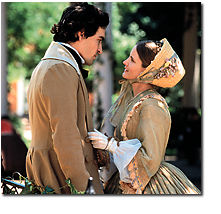 | Ben Chaplin and Jennifer Jason Leigh
|
Like Jane Campion (Portrait of a Lady), Agnieszka Holland (Europa,
Europa) takes gleeful license with Henry James. Taking license is the
filmmaker's job, and though her rendition of Washington Square
(previously adapted in William Wyler's 1949 film The Heiress) opts for
broad comedy where James would have raised half an eyebrow, Holland also keeps
faith with the author's quietly passionate spirit.
Mastering a perennial
tendency to over-agitate her acting, Jennifer Jason Leigh gives a modulated
performance as Catherine Sloper, the homely, motherless, unloved daughter of a
rich physician (Albert Finney, appropriately stiff-necked) who wants to prevent
her marriage to the handsome young Morris Townsend (played by doe-eyed British
actor Ben Chaplin), a possible fortune hunter. Despite the backroom efforts of
Catherine's excitable and devious aunt, zestfully enunciated by Maggie ("I have
the most fortuitous headache") Smith, to glue the young couple together, the
unbending doctor trades on his daughter's lifelong craving to win his love,
forcing Catherine into a choice that backfires in a way that surprises only
her. True to James's idiosyncratic vision of the heroic, Catherine, too, learns
some unexpected lessons from her suffering. Holland and screenwriter Carol
Doyle sustain the ambiguity of all their characters' motives with such agility
that only at the end of Washington Square does it become clear who is
too good for whom.
Ella Taylor is a film critic for LA Weekly.
Go to ...
 
Copyright © 1997 by The Atlantic Monthly Company. All rights reserved.
|