
Return to the July 1997 A&E Preview Cover
|
Arts & Entertainment Preview - July 1997


B Y A U S T I N B A E R

The Lincoln Center Festival '97

"Festival '96 Gives Itself a
Preliminary Grade: A-Plus." So read the headline in The New York
Times last August when the final curtain rang down on Lincoln Center's
brave new bash. In three jam-packed weeks 83,000-plus paying customers had
sampled sixty-four music, dance, and theatrical attractions that ranged from
the exalted to the exasperating, the fabulous to the fatuous, the grand to the
grandiose. Maybe the grade should have been an A-minus. In the final accounting
ticket sales fell some 2,000 units and $300,000 below conservative projections.
Still, John Rockwell, the former Times arts critic turned impresario,
had proved that the public was hungry not just for light classics on the Great
Lawn or Shakespeare under the stars but for an international cultural bazaar on
the order of the standard-setting Salzburg and Edinburgh. The decision of the
powers that be at Lincoln Center to extend their commitment to the festival
through the year 2000 cannot have been hard to reach. Now Rockwell faces the
challenge of his first encore, which needs to spark the same excitement as last
year's festival, by new means (July 8-27; for more information call
212-875-5928 or visit the
Lincoln Center Festival 97 Web site).
Palestrina Plus
The crown jewel in the festival's musical component is the first-ever joint
visit to the United States by London's Royal Opera, Covent Garden, and its
sister troupe, the Royal Ballet. True music lovers rarely attend ballet for
musical pleasure, but Benjamin Britten's Prince of the Pagodas (July 18,
19, 29), afflicted with book problems, is blessed with a gorgeous score one
encounters all too rarely.
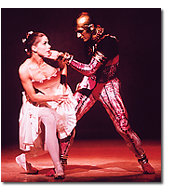 | The Prince of the Pagodas
|
The unlikely operatic contribution is no less
unusual: the anti-modernist cult item Palestrina (1917), by Hans
Pfitzner, which makes its point by way of doctrinal quarrels within the
sixteenth-century Catholic Church over the use of polyphony in sacred music
(July 21, 24, 26). This summer's performances, featuring a top-drawer cast led
by the masterly Christian Thielemann, should make the most compelling case for
the score that we are likely to encounter for many a season. The Chamber Music
Society of Lincoln Center offers an all-Pfitzner evening (July 23), while two
programs devoted to Wagnerism and its countercurrents, by the New York
Philharmonic under Kurt Masur, put his aesthetic into a broader context (July
12, 14, 19, 20). Meanwhile, for those who prefer to click on sixteenth-century
Italian polyphony, two evenings are scheduled with the early-music ensemble
Pomerium (July 20, 27).
From Beowulf to Symphonic Jazz
Adventure on the cutting edge is promised with the world premiere of Intimate
Immensity, by the living legend Morton Subotnick, which features the
vocalists Joan La Barbara and Thomas Buckner (icons of the avant-garde in their
own right), not to mention a pair of Yamaha Disklaviers, which are controlled
electronically by the movements of an angel, embodied on this occasion by the
Balinese dancer I Nyoman Wenten, performing in the ancestral style (July 16,
18, 19).
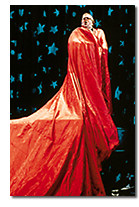 | A Mozart opera, solo
|
Overriding conventional boundaries, Ornette Coleman's Skies of
America integrates the jazz great's own octet Prime Time into the symphonic
textures of the New York Philharmonic (July 8, 9). No festival is complete
without its lunatic fringe. The Solo Magic Flute promises exactly what
the title says. Starting with the overture, the tenor Christoph Homberger sings
the entire score of Mozart's Masonic mystery by himself, unaccompanied. At
least Homberger has an invisible partner: the director Herbert Wernicke,
responsible lately for some of Europe's most stimulating opera productions
(July 14, 16, 17, 18). Then there is Benjamin Bagby, whose seraphic medieval
ensemble, Sequentia, climbed the charts with songs by the visionary Hildegard
von Bingen. Accompanying himself on the harp, he chants--in the original
Old English (which for all practical purposes might as well be Old Norse or
contemporary Hungarian)--episodes from Beowulf. Prick up your ears
for the part when the brawny hero goes mano a mano with the monster Grendel
and rips Grendel's arm clear out of its socket (July 20, 21).
Austin Baer is a writer based in New York.
Go to ...
 
Copyright © 1997 by The Atlantic Monthly Company. All rights reserved.
|