Atlantic Unbound

FEBRUARY 1997
THE ARTS &
ENTERTAINMENT PREVIEW

Classical Music
By Austin Baer
Chrysler Corporation


SHE WHO PLAYS THE KING

Xerxes
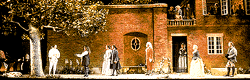
Xerxes comes to Seattle
Photo: Courtesy of the Seattle Opera

When the 300th anniversary of the birth of George Frideric Handel rolled around, twelve years ago, predictions abounded that the composer would at last assume his due place in the operatic pantheon, right up there with Mozart, Verdi, and Wagner. Things have not quite turned out that way. Of Handel's forty-plus works for the stage, not one has really established itself in the standard repertoire, but by now it looks as if Xerxes (or Serse) may prove to be the thin end of the wedge. The libretto revolves around interlocking love triangles, conducive to the display of intense emotions. In the opening aria (known to churchgoers as Handel's "Largo") the Persian emperor loftily serenades a beloved plane tree. He has a human beloved too, however, who most inconveniently loves his brother. The English National Opera production of Xerxes, by Nicolas Hytner (of Miss Saigon fame), in Hytner's own preternaturally fluent Augustan English rendering of the original Italian, is a work of art in its own right. It was a hit on video and a triumph in far-flung revivals, including one by the Lyric Opera of Chicago last year. But Hytner is not Xerxes's only champion. In Santa Fe the American director Stephen Wadsworth mounted a rival production, since seen in Los Angeles and due this month at the Seattle Opera (February 20-March 5; 206-389-7676). Though opera in translation is widely frowned upon, Wadsworth has Englished Xerxes too. But in any language what matters above all in Handel's operas is expressive conviction married to flawless vocal technique. In Hytner's production the fiery Irish mezzo-soprano Ann Murray showed the way in the title role. Wadsworth's hero is Frederica von Stade, another winner.

| February 1997 Cover Page | Pop and Jazz | Dance and Theater |

Segovia


Segovia: Canciones Populares
Eliot Fist, Guitar

"TANSMAN: Segovia"
AU (221k)
Real Audio 28.8 (41k)

"ESCOCESA: Moderato assai"
AU (221k)
Real Audio 28.8 (41k)

"SEGOVIA: La Macarena"
AU (225k)
Real Audio 28.8 (41k)

Copyright 1996
MusicMasters, Inc.


HEIR APPARENT

Eliot Fisk

The classical guitarist Eliot Fisk
Photo: Nick Sangiamo


Endorsements get no better than this: "I consider Eliot Fisk one of the most brilliant, intelligent, and gifted young musical artists of our time." Thus spake Andrés Segovia y Torres (1893-1987)--to whose work Fisk, simply expressing a truth universally acknowledged, has in turn called "all classical guitar playing" a "footnote." One product of the mutual admiration is Fisk's world-premiere recording of Segovia's Canciones Populares (MusicMasters Classics, distributed by BMG), a delicately tinted anthology of arrangements of international folk songs recently rediscovered by Segovia's widow, who entrusted them to Fisk. (Rounding out the splendid album is a wide-ranging selection of other Segovia arrangements and transcriptions, along with tributes to the master by various hands.) Continuing along Segovia's path, Fisk is always looking to expand the repertoire of the guitar, whether by appropriating music originally written for other instruments or by getting composers to write something brand-new. As his latest novelty, he introduces George Rochber's Tin Pan Alley cycle American Bouquet, which sounds like it will do both. The premiere, at New York's Manhattan School of Music on February 13 (212-749-2802), promises to be a high point of Fisk's busy February calendar, which also includes engagements with the Syracuse Symphony in upstate New York (February 6-8; 315-424-8200) and the Colorado Symphony in Denver (February 25; 303-986-8742); a date with the Shanghai Quartet in Pittsburgh (February 10; 412-624-4129); and recitals in Portland, Maine (February 12; 207-772-8630), at St. John's College, in Annapolis, Maryland (February 14; 410-263-2371), and in San Francisco (February 21; 415-726-1203).

| February 1997 Cover Page | Pop and Jazz | Dance and Theater |


A SOLDIER'S LONESOME BATTLE

The Opera Wozzeck
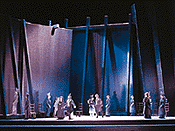
The stark and moving Wozzeck
Photo: Courtesy of the Metropolitan Opera
I've always wanted to direct Wozzeck," says Mark Lamos, who this season gets his wish at the Metropolitan Opera, where the conductor James Levine is revisiting the bleak masterpiece he has made a cornerstone of his quarter-century tenure (February 10-24; 212-362-6000). "It's upsetting, revolting, revelatory, as fresh as any opera on which the ink isn't yet dry." Set to disjointed dramatic fragments by that precocious, short-lived harbinger of expressionism Georg Büchner (1813-1837), and based on fact, Alban Berg's opera (1925) traces the mental and spiritual disintegration of a much-persecuted common soldier to the point of murder. Wozzeck gives no comfort to the many, but among serious music folk few operas of any century (and none of our own) stand in higher regard. If much of the vocal writing is harsh, the orchestra's contribution is phenomenal, fastidiously crafted and yet overwhelming, conjuring up a universe that by turns crushes the soul and leaves it in bereft isolation. Between these extremes there is nowhere to make a life, so the riddle is why Wozzeck, alone among the characters, is unstrung by the human condition.

| February 1997 Cover Page | Pop and Jazz | Dance and Theater |

Austin Baer is a writer based in New York.

Discuss this feature in the Arts & Literature conference of Post & Riposte (First-time users enter here).


Copyright © 1997 by The Atlantic Monthly Company. All rights reserved.


Home | Post & Riposte | The Magazine | Atlantic Unbound | The Exchange | Search