
Return to the December 1997 A&E Preview Cover
|
Arts & Entertainment Preview - December 1997


B Y N A N C Y D A L V A & J O H N I S T E L

A Sugarplum-Free Holiday Treat

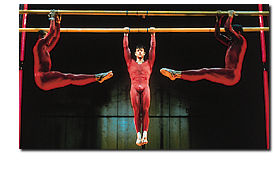 | Streb/Ringside performs Up
|
At first glance the decorum and décor of the
traditional Christmas chestnut The Nutcracker and the vivid
activity that Elizabeth Streb -- the recent winner of a MacArthur "genius"
award -- calls "pop action" don't have much in common. But glance again and you
see two family entertainments full of interesting embedded morals that can
occupy the adult mind most pleasantly, and perhaps seep into the child's. (If
you want to tell the kids right up front that Streb adores math, and that her
work puts geometry into motion, go ahead. If not, you can bring it up later at
homework time.) Streb's thrilling troupe Ringside has no party dresses or toy
soldiers with swords; everyone wears a unitard, and males and females leap and
leap alike; all the razzle-dazzle is for real. Children see Up and love
it: all the interaction is in the air, the six performers bounding and
rebounding, zinging among two tall towers, a set of high-wire parallel bars, an
Olympic-quality "hot bed" trampoline, and the nearly bare ground, where their
plummeting dives are cushioned by some improbably ordinary foam mats. In her
question-and-answer sessions with her audiences (part of every performance, and
wonderfully entertaining), Streb lets kids know that these moves are not
something they should try at home and that the work -- just like a trapeze
act -- is rehearsed to a fine point, no false moves, all true, all timed.
Children instinctively understand Streb's convergence of courage and fun. They
don't trouble about the meaning -- it simply finds them, just as it finds us.
Streb gives us all the kinesthetic rapture of pure velocity in a gift wrapping
both wondrous and familiar: people, unadorned, all presence and no pretense.
That the work lends itself so readily to metaphor tells us much about plain
speaking. The Nutcracker is all about the nineteenth century; Ringside
is all about the twenty-first. (Joyce Theater, New York, December 16 - January 4; for more information and tickets call 212-242-0800.) --N.D.
Space Exploration Redefined
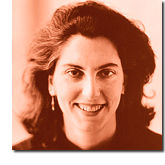 | Tina Landau
|
Expect a close encounter of the extra-theatrical kind when you visit Chicago's
Steppenwolf Theatre Company this month. The world premiere of Tina Landau's
Space (November 28-January 24; 312-335-1650) orbits the home stage of
America's pre-eminent acting ensemble (members include Gary Sinise, John
Malkovich, and Laurie Metcalf). Landau is best known for her directorial
bravura, which she applied to the award-winning off-Broadway musical Floyd
Collins, about a 1920s media frenzy caused by a man stuck in a Kentucky
cave, and to Time to Burn, Charles Mee Jr.'s adaptation of Gorky's
The Lower Depths, which she spectacularly spelunked for Steppenwolf last
season. Although noted for her brilliant physical use of stage space, the
thirtysomething Yale grad writes, too: everything from a Hudson River-side
history play, Stonewall: Night Variations, to a Friday the 13th
sequel. On the surface Space revels in our fascination with alien
abductions and other assorted paranormal activity. The central character is
a neuropsychiatrist set upon by patients whose similar tales of bee-eyed,
Munchkin-sized visitors with a thing for strange surgical procedures soon suck
him toward a big black hole of doubt. Ultimately Landau is more interested
in existentials than extraterrestrials--and, of course, in redefining
space--"whether it is the space of the universe, or the space of the mind, or
the space of intimacy." Make "contact," Space suggests, and you won't
feel so alienated from this world.
--J.I.
In Their Own Words
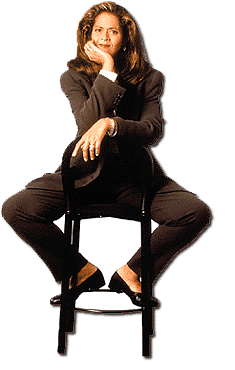 Anna Deavere Smith is a modern Tocqueville on tour through the American psyche armed with a tape recorder. She interviews dozens, sometimes hundreds, of participants in a variety of events, and then performs them onstage. Smith first garnered national attention with Fires in the Mirror: Crown Heights, Brooklyn, and Other Identities (produced at New York's Public Theatre and later filmed for PBS) and Twilight: Los Angeles, 1992, which briefly ran on Broadway. Both one-person shows, they relied solely on Smith's uncanny ability to "repeat" the interviewees' own words (she won't say "act"), to portray everyone from Lubavitcher housewives to the Reverend Al Sharpton, from Senator Bill Bradley to Rodney King's aunt. Her answer to the riots that affected these people is a mythic, virtuosic act of performance as mediation. Anna Deavere Smith is a modern Tocqueville on tour through the American psyche armed with a tape recorder. She interviews dozens, sometimes hundreds, of participants in a variety of events, and then performs them onstage. Smith first garnered national attention with Fires in the Mirror: Crown Heights, Brooklyn, and Other Identities (produced at New York's Public Theatre and later filmed for PBS) and Twilight: Los Angeles, 1992, which briefly ran on Broadway. Both one-person shows, they relied solely on Smith's uncanny ability to "repeat" the interviewees' own words (she won't say "act"), to portray everyone from Lubavitcher housewives to the Reverend Al Sharpton, from Senator Bill Bradley to Rodney King's aunt. Her answer to the riots that affected these people is a mythic, virtuosic act of performance as mediation.
Smith's latest play, House Arrest: First Edition, takes the Stanford
professor and part-time film actor (The American President,
Philadelphia) from the incendiary to what most consider the insipid: the
press and politics. Smith spent 1996 interviewing participants in the
presidential campaign--from convention delegates to the Commander-in-Chief.
Through January 4 a large cast, directed by Mark Rucker, portrays several dozen
of her subjects on the Arena Stage, in Washington, D.C. (202-488-3300). This
latest installment in her project "On the Road: A Search for American
Character," begun in 1983, raises the question Does American politics have any
character, given the wooden nature of stump speeches and canned, vacuum-packed
conventions? Smith's Richter scale-ear, capable of detecting the faintest
tremors of the human soul, will surely be tested. --J.I.
Nancy Dalva is the author of Dance Ink: The Photographs.
John Istel is a senior editor at Stagebill.
Go to ...
 
Copyright © 1997 by The Atlantic Monthly Company. All rights reserved.
|