OPERA FOR COUCH POTATOES
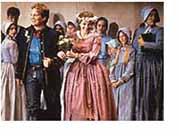
No need for tickets: Emmeline on PBS
Photo: David Stein
|
Carp as one may about opera on television (and the match was not made in heaven), broadcasts do save one a lot of running around. Last summer cognoscenti crossed seas and continents for the world premiere of Tobias Picker's Emmeline, in Santa Fe, New Mexico, and for the Peter
Sellars staging of Handel's oratorio Theodora at England's high-toned
festival at Glyndebourne. On April 2 both may be seen from the comfort of one's
armchair. Emmeline (on PBS) recounts the supposedly true history of an
unwed mother who unwittingly married her long-lost son. As the heroine goes
from rural New England poverty to the abuse of the dark, satanic textile mills
of Lowell, Massachusetts, Picker's score gives each scene along her Dickensian
way a sharp musical profile. No less important, his characters have voices. If
some of those voices verge on caricature, Emmeline's does not: her anxieties,
joys, and anguish are expressed with unaffected, richly varied eloquence. The
spare, stylized staging probably registered more powerfully in the theater than
it does on television, but the work's quality comes through, and in the
demanding title role Patricia Racette delivers all Picker could have hoped for
and more. Theodora (on Ovation) is a more schizoid affair, Handel's
mostly action-free hagiography serving strictly as a pretext for the latest
Sellars study of a narrow band of abnormal psychology. As usual, the characters
are conceived as fanatics, paranoiacs, or (if wicked) buffoons. Once again, the
chorus signs as it sings, accompanying itself with redundant semaphore. Of
course the action is transposed, irrelevantly, to these here United States,
circa now. Yet there are inspired touches--a double execution by lethal
injection, hauntingly hand in glove with the music. Thanks to the
conductor, William Christie, and a superlative cast, the performance
entrances the ear. The telecast is also good to look at: lighting and camera
work invite comparison with the landmark advertising campaigns for Clinique
cosmetics. Whether one buys the package as a contribution to serious public
discourse on serious matters, which the director claims it is, is a question of
conscience.
| April 1997 Cover Page
| Pop and Jazz
| Film
|
COMPOSING NATURE
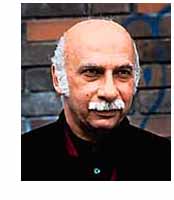 Kancheli captures the elements
Photo: Ruth Walz
|
Giya Kancheli was nineteen when he realized that geology was not for him. "My first expedition," he has said, "was a twelve-mile walk in ninety-five-degree
heat, carrying a very heavy load. When I got back that evening, I drew up a
list of professions that would not require much walking." He chose composing.
More than four decades later his music bears witness, perhaps, to the
susceptibility that once attracted him to the study of earth: a spiritual
hunger for landscapes carved by the elements and untouched by the hand of man,
vastnesses in which the spirit can hear the universe and hear itself. A native
of the former Soviet republic of Georgia, now resident in Berlin, Kancheli
writes music in which instrumental voices sound like human voices and human
voices can sound like instruments. He renders silence in a thousand
gradations, as Nature does, or unleashes cataclysms from a clear sky. His
inspiration, he has said, depends greatly on the view from his window. And what
does he like to see? His answer, in Georgian, comes only after a long pause. "A
big open space is very nice," his daughter translates, "but when it's small, I
try to find some beauty in a small space. What is most important is not what I
can see but what I can't see." Into those negative spaces he pours his
music. Last month ECM New Series issued Caris Mere (After the
Wind), the label's fourth luminously realized Kancheli offering. Symphonies
are another point of entry into the Kancheli canon. A notable Sony
Classical disc couples the sixth and seventh (but beware dynamic spikes
that can blow a speaker or an eardrum). And next month the exciting young
maestro Franz Welser-Möst performs the third with the
New York
Philharmonic (May 8-10; 212-721-6500).
| April 1997 Cover Page
| Pop and Jazz
| Film
|
A GROUP WITH LOTS OF PLUCK
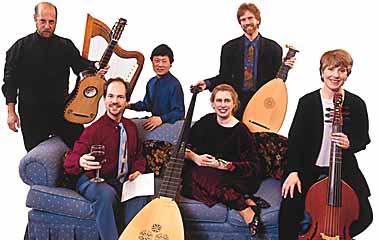 Photo: Beatriz Schiller
|
|