

NOVEMBER 1996
LIVING IN THE SHADOWS
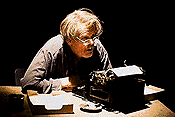
Few writers understand as well as Kurt Vonnegut the primacy of unintended consequences over design in shaping our lives, especially amid the lunacy of war. Keith Gordon's wonderfully acute adaptation of Vonnegut's novel Mother Night stars Nick Nolte as Howard W. Campbell Jr., an American playwright living in Germany and ducking the horrors of World War II by creating a "nation of two" with his beautiful wife, Helga (Sheryl Lee). When an American secret agent (an uncredited John Goodman) persuades Campbell to broadcast anti-Semitic propaganda that contains encoded information for the Allies, he becomes an unwitting Nazi mascot. Devastated by reports of his wife's death, Campbell returns to America and lives aimlessly under a false identity, until his cover is blown by crazed white supremacists. Hailed by them and hounded by Holocaust survivors and American patriots, Campbell becomes the ideological property of all factions. Nothing is what it seems, even when he befriends a fellow artist (a witty Alan Arkin) and when Helga, apparently risen from the dead, returns to him. With his identity crumbled (in one heart-stopping scene Nolte, an old pro at playing broken men, stops dead on a Manhattan street and tells us in voiceover, "I had absolutely no reason to move in any direction"), Campbell winds up on trial for war crimes in an Israeli prison, one cell below the disembodied voice of Adolph Eichmann (Henry Gibson). Gorgeously shot by Tom Richmond, who also shot Gordon's outstanding film A Midnight Clear, Mother Night captures perfectly Vonnegut's shifts between darkness and light, tragedy and comedy, and his shattering of the moral complacency that divides the world into heroes and villains.
Down and out once again
Photo: Atilla Dory
WHEN THE TRUTH COMES OUT
Although he's never less than a magnificent filmmaker, Mike Leigh at times visits a savagery on his characters that sends some moviegoers scuttling for the exits. After the bitter brilliance of Naked, the British director's fine new film, Secrets and Lies, which won the Palme d'Or at Cannes this year, marks a return to the more generous spirit of his 1990 picture, Life Is Sweet. Not that Secrets and Lies is flabby or sentimental. In a stunning performance the English stage actress Brenda Blethyn plays Cynthia, a single mother crushed by life and supported only by her good-hearted brother Maurice (the versatile Timothy Spall, last seen as the world's worst restaurateur in Life Is Sweet). When a skeleton dances out of Cynthia's closet in the form of Hortense (a poised Marianne Jean-Baptiste), whom she gave up for adoption at birth, Cynthia is initially horrified, not least because Hortense is black and a successful optometrist. Taken aback herself by Cynthia's weepy passivity, Hortense nonetheless hangs in, and the two form a warm bond that fills a hole in both their lives. When Cynthia blurts out the truth about Hortense at a family party, she triggers a chain confession of everyone's lies and secrets that leads to bedlam. As always in a Mike Leigh movie, anger and pain rub shoulders with a kind of appalling hilarity to expose the bonds of love and suffering between ordinary people condemned--and redeemed--by their endless struggle to preserve a fragile sense of identity.
A mother-and-child reunion
Photo: Courtesy of October Films
VICTORIAN LOVERS
There's English scenery to burn in Jude, a respectful adaptation of Jude the Obscure, Thomas Hardy's great novel of lovers ground beneath the wheel of Victorian opprobrium. Directed by Michael Winterbottom, who made the truly horrible killer-lesbian feature Butterfly Kiss, Jude stars the excellent Christopher Eccleston (the nerdy accountant in Shallow Grave), all anguish and sunken eye sockets, as the country lad bent on self-improvement. The shyer they come, the harder they fall in Hardy's austere view. After a brief, disastrous marriage to the seductive wench Arabella (talented Rachel Griffiths, of Muriel's Wedding fame), Jude repairs to Christminster to study and fall in love with his free-spirited and neurotic cousin Sue (a rather too sensible Kate Winslet), who plays him off against the teacher (Liam Cunningham) he idolizes before finally acknowledging her love for Jude. Competent and good-looking though it is, the movie plods along at a sedate pace that does insufficient justice to Hardy's melodrama. When Winterbottom finally starts piling on the shock tactics toward the end, the shift feels more jarring than radical.
Insecure Jude and heartbreaking Sue
Photo: Joss Barratt
Ella Taylor is a film critic for LA Weekly.
Go to the November 1996 Classical page
Go to the November 1996 Pop and Jazz page
Return to the November 1996 cover page