Return to the July/August A&E Preview cover page.
S P E C I A L A D V E R T I S I N G S E C T I O N
Arts & Entertainment Preview | July/August 2001 | Sponsored by Chrysler

 by Bob Blumenthal and Charles M. Young
Collective Effort
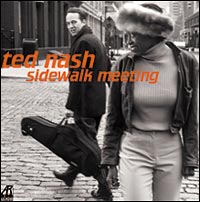
For the past decade, some of the most original and intriguing sounds to be heard in New York jazz circles have emanated from the Jazz Composers Collective. This nonprofit alliance of the bassist Ben Allison, the pianist Frank Kimbrough, the saxophonists Michael Blake and Ted Nash, and others has produced a series of concerts that feature the members' own music and diverse ensembles. Uncommon instrumental combinations, fresh approaches to improvisation, and an inclusive use of source materials are the collective's norm. Sidewalk Meeting (Arabesque), by Nash's band Odeon, is an ideal representation of the JCC aesthetic. A sextet that employs trombone or sousaphone, violin, accordion, and two drum sets, as well as Nash's saxophones and clarinets, Odeon finds strains of tango, klezmer, New Orleans second line, and European classicism coexisting in one glorious melting pot of affirmative sounds, rhythms, and colors. Nash recruited the singular talents of brass master Wycliffe Gordon (a former fellow member of the Lincoln Center Jazz Orchestra), Israeli violin phenom Miri Ben-Ari, percussion dynamos Matt Wilson and Jeff Ballard, and the startlingly versatile accordion player Bill Schimmel. He then provided this talented crew with a program of atmospheric original music and invigorating arrangements of Debussy, Ellington, and Monk. Sidewalk Meeting continues a stellar JCC year on disc which has also seen the release of Allison's Riding the Nuclear Tiger (Palmetto) and Blake's Drift (Intuition), with new albums by Kimbrough's quartet, Noumena, and Kimbrough and Allison's Herbie Nichols Project, soon to follow. —B.B.
Newport Blues
The mecca of roots music when country blues got rediscovered in the late fifties and early sixties, the Newport Folk Festival attracted a lot of really old blues singers who hadn't recorded or even performed much since the thirties. Everyone except Mississippi John Hurt was amazed to discover that Mississippi John Hurt was still alive, not to mention Skip James, Bukka White, and a host of other extravagantly talented and nearly forgotten artists who promptly performed at Newport and found a new place in the sun. Newport Folk Festival, Best of the Blues 1959-68 (Vanguard), a three-disc anthology, presents fifty-one songs by eighteen performers who are obviously thrilled to have an audience that is equally obviously thrilled to hear them. Radiating humility and a sly sense of humor, Hurt had an almost saintly presence, while Son House and the Reverend Gary Davis truly howled the blues. Best known as the composer of "I'm So Glad," made famous by Cream during the psychedelic era, James had an eerie tenor, at once terrifying and hypnotic. Lightnin' Hopkins and John Lee Hooker both added an element of boogie to the blues. Muddy Waters demonstrated that he could leave his electric band behind in Chicago and knock out an audience with just one acoustic guitar. In fact, almost all the artists here do that: just one guitar and one voice, each amazingly varied within the strictures of a simple musical form that can still entrance. —C.M.Y.
Activism's Soundtrack
Punks come in all shapes, sizes, and political beliefs, sharing only a militant commitment to widely varying interpretations of libertarianism and individualism. Vying to carry the long-fallen banner of the Dead Kennedys on punk's left wing, Anti-Flag takes its musical cues from the generation of English bands that arose after the Sex Pistols. In other words, they are fast, tight, melodic, and extremely listenable for fans of raucous rock and roll. Politically, they've grown less vague in their idealism and more specific in their anarchism on their third album, Underground Network (Fat Wreck). Quoting such antihierarchical heroes as Noam Chomsky (the MIT linguist) and Howard Zinn (author of A People's History of the United States) in their liner notes, they attack the education system, the corporate media, and the military in their songs. They also provide some insight into the history of Pittsburgh's punk subculture, with "Spaz's House Destruction Party," in which they reminisce fondly about a friend who received an eviction notice and decided to throw a three-day party, leaving the landlord almost nothing to rent to the next tenants. Quoting a sticker on Woody Guthrie's guitar for the song "This Machine Kills Fascists," they demand that right-wing punks get out of the scene, accusing them of fomenting violence at shows and just being stupid. Relentlessly on the road since forming in 1994, and having opened for rock's most prominent revolutionary band, Rage Against the Machine, during the Battle of Los Angeles tour last year, Anti-Flag provides an invigorating soundtrack to the great revival of activism currently sweeping America's campuses. Watch for them at your next anti-WTO protest. —C.M.Y.
Bob Blumenthal is a jazz critic for The Boston Globe.
Charles M. Young reviews music for Playboy and other publications and for Allmusic.com.
Sidewalk Meeting CD cover: Arabesque.
Copyright © 2001 by The Atlantic Monthly Group. All rights reserved.