Arts & Entertainment Preview | December 2001 | Sponsored by Chrysler
by Nancy Dalva and John Istel
Joys of the Season
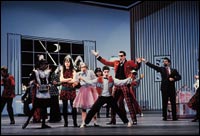
Mark Morris's Nutcracker, The Hard Nut
There are two ideal ways to see The Nutcracker—or perhaps one should say a Nutcracker, since there are a multiplicity of versions, some weird, some wonderful. The best way to go is with your grandmother. She should have a cozy soft shoulder to lean on, and cookies in her purse, and a perfumed hankie in case you want to blow your nose. The second-best way is with a child, even if you have to borrow one. I once took a child who brought her pet mouse. The mouse was very little, and white. I know this because she took him out of her knapsack and revealed him to me, cupped in her palm, sometime after the lights went down and the music started. But even if you have to frisk them first, children make good companions at the theater—and not, as you might think, because they find it novel. On the contrary, it is because they love the familiar. Children like to hear the same story night after night at bedtime. They like to eat the same thing every day for lunch. And they don't mind going to see the same ballet every year over the holidays. And really, I don't either. For ballet is never quite the same from one performance to the next. Dancers are people, and people are changeable, even the same ones in the same roles. We don't go to see what happens in a story ballet (we know that already); we go to see how it happens. This is true of The Nutcracker, and it is equally true of Swan Lake, Sleeping Beauty, or any other ballet. (In fact, it is true of any work of art, including a painting. In that latter case, it doesn't change, but you do.) We go to see a favorite dancer grow in a role or to see how that dancer changes with a new partner. We go to see different casts, because each tells its own story. The better we know the ballet, the more these performances will say to us, the more nuances will matter. But there is also, inherently, a degree of the familiar in any traditional production not touted for its radical novelty. Just as there is comfort food, there is comfort art. At The Nutcracker, you get to see a party, a magician, a battle, and a transformation. On the stage, snow falls. A sugar plum dances. Presiding over everything is a little girl who, emboldened by love, both saves and is saved. Watching her, we rediscover the blessings of the familiar, the known, and the re-known. In ballet, as in love, the truth is that more is more. (Mark Morris's version of The Nutcracker, The Hard Nut, can be seen at Berkeley's Zellerbach Hall, December 7-16. George Balanchine's, performed by the New York City Ballet, runs from November 23 to December 31. Robert Joffrey's, by the Joffrey Ballet of Chicago, runs from November 23 to December 23. The Nutcracker at the Pacific Northwest Ballet, in Seattle, runs from November 24 to December 27, and features Maurice Sendak's notable décor.) —N.D.
War Cries
Eve Ensler's Vagina Monologues may be the most efficacious American political play since the 1930s, when Odets's Waiting for Lefty caused theatergoers to storm out into the street yelling "Strike, strike, strike" in solidarity with cab drivers. Ensler's play doesn't cause this kind of reaction; instead, audiences financially support Ensler's cause—stopping violence against women—because the playwright insists that commercial productions donate a portion of ticket proceeds. Now, Ensler's long-awaited follow-up, Necessary Targets, is set to open. It's both an innocent-American-abroad drama and another spin on the odd couple, focusing on an uptight society psychiatrist who is appointed by a presidential commission to study women in a Bosnian refugee camp, and the young idealistic writer who is hired to accompany her. Most of the play's seventeen scenes consist of the duo's faltering attempts at therapy sessions with battle-scarred women who wish for simpler attentions. An elderly villager yearns for her favorite cow; a housewife wants her shell-shocked husband to make love to her again; a young woman wants to find the baby she dropped in the woods while escaping rapists. The play hasn't received a full staging yet, suggesting its clunky form and overt sympathies put off possible producers (although two star-studded staged readings were held in New York and Sarajevo in 1998, with Meryl Streep and Glenn Close, respectively, handling the lead). Enter director Michael Wilson, a master at subduing and enlivening the most florid dialogue, whether from Tennessee Williams or other native playwrights. Wilson stages the world premiere at Connecticut's Hartford Stage, which he heads; it will run through December 23, as part of the company's "American Season." Considering recent events, American audiences will be able to empathize even more strongly with the victims onstage, no longer easily dismissible as foreign unfortunates. Distances have dwindled; the drama is close by. —J.I.