
Return to the February 2000 A&E
Preview Cover
|
Arts & Entertainment Preview - February 2000

B Y N A N C Y D A L V
A & J O H N I S T E L

Rare Jewels in Florida

 | Sparkling, live "Emeralds"
|
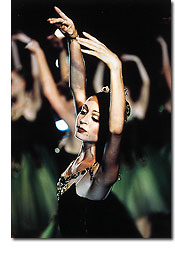
The Prodigal Son nearly came home last fall; he got as far as Newark. There, at the New Jersey Performing Arts Center, Edward Villella, who memorably played the eponymous hero in George Balanchine's vivid work (and later used its title for his autobiography), brought his wonderful Miami City Ballet to dance just over the river from his old home at New York City Ballet. It was a triumphant evening, happily to be repeated in Florida throughout February. The ballet of that autumn evening was Balanchine's three-act Jewels. It was a howling success when Villella performed in the 1967 debut, heating up the stage in the jazzy, syncopated, set-to-Stravinsky middle number called "Rubies." "Emeralds," a mysterious, wafting, ineluctably verdant homage to France and to Faure, precedes; "Diamonds," a brilliant, formal homage to St. Petersburg and Tchaikovsky, follows. In recent years the last two acts have been performed separately. Even when all three are reunited, as by New York City Ballet, the effect has been incomplete. "Emeralds" in particular has the reputation of being difficult and remote, yet in actuality it shows in very clear terms that love is now and time is fleeting. The Miami company's performance made this and any number of other truths apparent in a revelation of what reverence -- and, when called for, a lack of it -- can do. It is as if someone had picked up the entire ballet, dunked it in a sink of soapy water, rinsed it off thoroughly, and polished it dry. The original Miami stagers were Karin von Aroldingen, Elyse Borne, and none other than Villella himself. Seeing him sit in the audience watching his dancers do what he once did is a compelling experience, bittersweet and buoyant. (Miami, February 4-6; West Palm Beach, February 11-13; Fort Lauderdale, February 23-27; 305-532-7713.) -N.D.
The Empress Jones
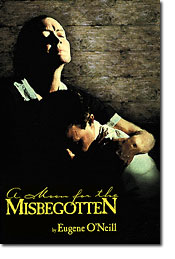
Great tragedies always give audiences a sense of the inevitable made visible. Last season's revival of Eugene O'Neill's The Iceman Cometh is a perfect example, a play as primal, mysterious, and awe-inspiring as a cyclone. This season the inevitable is made visible when O'Neill's A Moon for the Misbegotten begins previews on Broadway, directly after its run at Chicago's Goodman Theatre concludes, on February 19. Cherry Jones, American theater's pre-eminent acting force of nature, has always seemed fated to play the mythic-sized Josie Hogan, described by the playwright as standing five-feet-eleven and weighing 180 pounds, with "the map of Ireland stamped on her face." Ireland or no, Jones's face has such expressiveness that one can forget how completely she wrestles herself into whatever role she's playing. Conjure up memories of past triumphs -- from her barefoot, feral prisoner in Our Country's Good to her Tony Award-winning performance in The Heiress -- and it's clear why Jones is set to be crowned the successor to Colleen Dewhurst, who gave Josie a landmark interpretation in 1973, opposite Jason Robards. Jones's James Tyrone? Gabriel Byrne, as luck would have it. -J.I.
A Mid-Winter's Bounty
 | Wilson's Jitney
|
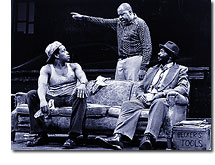
This month an enterprising theatergoer with dollars and desire to spare could attend a veritable seminar in postwar African-American playwriting. The lesson would begin with Amiri Baraka's harrowing 1964 subway screech of a morality play, Dutchman, running at Hartford Stage (January 13-February 13; 860-527-5151). Lulu, an archetypal seductress (she seduces the young black protagonist, Clay, with apples before killing him) stands in for white culture. Few plays have excavated the tensions of American race relations better. Ntozake Shange's for colored girls who considered suicide / when the rainbow was enuf breaks hearts by combining abstract movement with gritty confessional monologues in a way that still seems radical after a quarter century. Having enjoyed a Broadway run in the 1970s, the "choreopoem" is revived by Baltimore's Center Stage, under George Faison's direction (January 7-February 13; 410-332-0033). Any of Shange's colored girls could be related to the central character in Dr. Endesha Ida Mae Holland's autobiographical play From the Mississippi Delta, which details a young woman's journey from prostitution to a professorship. The triumphant, gutsy work, running at Connecticut's Stamford Theatre Works (February 2-20; 203-359-4414), has been one of the most-often-produced plays in the American theater over the past several seasons. Finally, Jitney, August Wilson's first play, gets revived at the Mark Taper Forum, in Los Angeles (February 3-March 19; 213-972-7376), under the direction of Marion McClinton. Wilson, who made headlines in 1996 with his sharp criticism of the lack of American theaters devoted to black plays, would claim that all this activity by predominantly white theaters was but window-dressing leftovers from Black History Month. But the vibrant range of offerings affirms that there's a history well worth our attention. -J.I.
Nancy Dalva's essays appear in the magazine 2wice.
John Istel is the editor-in-chief of Stagebill.
Go to ...
 
Photo Credits -- Jewels: Jamie Rae Walker. O'Neill: The Goodman Theatre. Jitney: T. Charles Erickson.
Copyright © 2000 by The Atlantic
Monthly Company. All rights reserved.
|