


JAZZ IN THE '90S
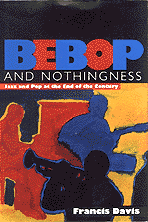 Francis Davis, who
has been writing on jazz for The Atlantic Monthly since 1984, looks
around at the much-touted jazz revival of the 1990s, with its crop of fresh
young faces, and wonders what went wrong. Is it just him, or is there
really not as much to celebrate as "trend" pieces in national publications,
proclaiming a "New Jazz Age," would have us believe? "If Time and
the New York Times say that jazz is experiencing a renaissance," he
writes in the introduction to Bebop
and Nothingness (Schirmer Books, 1996), his
latest collection of essays, "it is. That's how it works. So why am I
yearning for the Dark Ages?" Davis says he bears today's talented young
jazz musicians no malice. It's just that they're not the real story. "The
real story," he feels, "is the commodification of youth." Having followed
jazz and the jazz business for the past thirty years, first as a listener
and then as a critic, Davis sees that the target audience for young players
such as Joshua Redman, James Carter, and Nicholas Payton, is people in
their forties and older "who've stuck with jazz through the decades even
though they haven't much liked anything they've heard since around 1965,
when Miles [Davis] still had his band with Herbie [Hancock] and Wayne
[Shorter], and before [John] Coltrane went too far out."
Francis Davis, who
has been writing on jazz for The Atlantic Monthly since 1984, looks
around at the much-touted jazz revival of the 1990s, with its crop of fresh
young faces, and wonders what went wrong. Is it just him, or is there
really not as much to celebrate as "trend" pieces in national publications,
proclaiming a "New Jazz Age," would have us believe? "If Time and
the New York Times say that jazz is experiencing a renaissance," he
writes in the introduction to Bebop
and Nothingness (Schirmer Books, 1996), his
latest collection of essays, "it is. That's how it works. So why am I
yearning for the Dark Ages?" Davis says he bears today's talented young
jazz musicians no malice. It's just that they're not the real story. "The
real story," he feels, "is the commodification of youth." Having followed
jazz and the jazz business for the past thirty years, first as a listener
and then as a critic, Davis sees that the target audience for young players
such as Joshua Redman, James Carter, and Nicholas Payton, is people in
their forties and older "who've stuck with jazz through the decades even
though they haven't much liked anything they've heard since around 1965,
when Miles [Davis] still had his band with Herbie [Hancock] and Wayne
[Shorter], and before [John] Coltrane went too far out."
Is jazz showing its age? (From the July, 1996, issue of The Atlantic Monthly.)
Interview
A conversation
with Francis Davis, author of Bebop and Nothingness: Jazz and Pop at the
End of the Century.
Articles
Writing on jazz as it has appeared in The Atlantic since
1922.
Links
A selective guide to jazz sites on the Web.
In "Like Young," a new piece in the July issue of The Atlantic Monthly, Davis surveys the contemporary jazz scene and addresses these issues head on, contemplating what he fears is an uncertain future for a music that is stuck on the past and marketed toward an aging Baby Boomer audience. Both the article and Davis's new book open up controversial questions about the present state of jazz and its history. We recently interviewed Davis and asked him to elaborate on some of these ideas and to add some personal background to his discussion.
Francis Davis is the author of Bebop and Nothingness: Jazz and Pop at the End of the Century (1996) and The History of the Blues: The Roots, the Music, the People (1995) as well as two previous collections of essays on jazz, Outcats (1990) and In the Moment (1986). He is a contributing editor to The Atlantic Monthly and also writes for a variety of other publications, including The Village Voice and Stereo Review. A 1994 Pew Fellow in the Arts, he teaches at the University of Pennsylvania.
Copyright © 1996 by The Atlantic Monthly Company. All rights reserved.
 |
 |
 |
 |
 |
 |