


The Atlantic Monthly
September 1896
The Awakening of the Negro
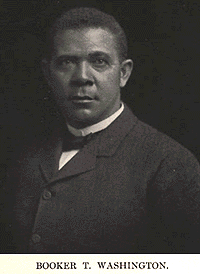 WHEN a mere boy, I saw a young colored man, who had spent several years in
school, sitting in a common cabin in the South, studying a French grammar.
I noted the poverty, the untidiness, the want of system and thrift, that
existed about the cabin, notwithstanding his knowledge of French and other
academic subjects. Another time, when riding on the outer edges of a town
in the South, I heard the sound of a piano coming from a cabin of the same
kind. Contriving some excuse, I entered, and began a conversation with the
young colored woman who was playing, and who had recently returned from a
boarding-school, where she had been studying instrumental music among
other things. Despite the fact that her parents were living in a rented
cabin, eating poorly cooked food, surrounded with poverty, and having
almost none of the conveniences of life, she had persuaded them to rent a
piano for four or five dollars per month. Many such instances as these, in
connection with my own struggles, impressed upon me the importance of
making a study of our needs as a race, and applying the remedy
accordingly.
WHEN a mere boy, I saw a young colored man, who had spent several years in
school, sitting in a common cabin in the South, studying a French grammar.
I noted the poverty, the untidiness, the want of system and thrift, that
existed about the cabin, notwithstanding his knowledge of French and other
academic subjects. Another time, when riding on the outer edges of a town
in the South, I heard the sound of a piano coming from a cabin of the same
kind. Contriving some excuse, I entered, and began a conversation with the
young colored woman who was playing, and who had recently returned from a
boarding-school, where she had been studying instrumental music among
other things. Despite the fact that her parents were living in a rented
cabin, eating poorly cooked food, surrounded with poverty, and having
almost none of the conveniences of life, she had persuaded them to rent a
piano for four or five dollars per month. Many such instances as these, in
connection with my own struggles, impressed upon me the importance of
making a study of our needs as a race, and applying the remedy
accordingly.Return to Flashback: Black History, American History
While there I resolved that when I had finished the course of training I would go into the far South, into the Black Belt of the South, and give my life to providing the same kind of opportunity for self-reliance and self-awakening that I had found provided for me at Hampton. My work began at Tuskegee, Alabama, in 1881, in a small shanty and church, with one teacher and thirty students, without a dollar's worth of property. The spirit of work and of industrial thrift, with aid from the State and generosity from the North, has enabled us to develop an institution of eight hundred students gathered from nineteen States, with seventy-nine instructors, fourteen hundred acres of land, and thirty buildings, including large and small; in all, property valued at $280,000. Twenty-five industries have been organized, and the whole work is carried on at an annual cost of about $80,000 in cash; two fifths of the annual expense so far has gone into permanent plant.
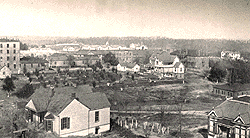 The Tuskegee Institute, 1905 |
The problem that the Tuskegee Institute keeps before itself constantly is how to prepare these leaders. From the outset, in connection with religious and academic training, it has emphasized industrial or hand training as a means of finding the way out of present conditions. First, we have found the industrial teaching useful in giving the student a chance to work out a portion of his expenses while in school. Second, the school furnishes labor that has an economic value, and at the same time gives the student a chance to acquire knowledge and a skill while performing the labor. Most of all, we find the industrial system valuable in teaching economy, thrift, and the dignity of labor, and in giving moral backbone to students. The fact that a student goes out into the world conscious of his power to build a house or a wagon, or to make a harness, gives him a certain confidence and moral independence that he would not possess without such training.
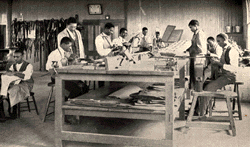 Tuskegee Students working in the school's harness shop, 1905 |
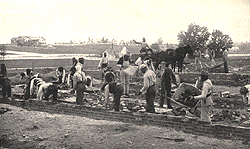 Starting a new building: Tuskegee student masons laying the foundation in brick, 1905 |
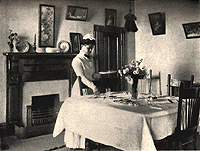 Tuskegee: a model dining-room (from the department where table-service was taught), 1905 |
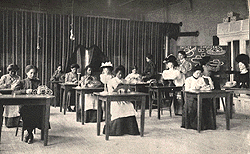
A Tuskegee class in millinery, 1905 |
Soon a large proportion of the people were in condition to make contracts for the buying of homes (land is very cheap in the South), and to live without mortgaging their crops. Not only this: under the guidance and leadership of this teacher, the first year that he was among them they learned how, by contributions in money and labor, to build a neat, comfortable schoolhouse that replaced the wreck of a log cabin formerly used. The following year the weekly meetings were continued, and two months were added to the original three months of school. The next year two more months were added. The improvement has gone on, until now these people have every year an eight months' school.
I wish my readers could have the chance that I have had of going into this community. I wish they could look into the faces of the people and see them beaming with hope and delight. I wish they could see the two or three room cottages that have taken the place of the usual one-room cabin, the well-cultivated farms, and the religious life of the people that now means something more than the name. The teacher has a good cottage and a well-kept farm that serve as models. In a word, a complete revolution has been wrought in the industrial, educational, and religious life of this whole community by reason of the fact that they have had this leader, this guide and object-lesson, to show them how to take the money and effort that had hitherto been scattered to the wind in mortgages and high rents, in whiskey and gewgaws, and concentrate them in the direction of their own uplifting. One community on its feet presents an object-lesson for the adjoining communities, and soon improvements show themselves in other places.
Another student who received academic and industrial training at Tuskegee established himself, three years ago, as a blacksmith and wheelwright in a community, and, in addition to the influence of his successful business enterprise, he is fast making the same kind of changes in the life of the people about him that I have just recounted. It would be easy for me to fill many pages describing the influence of the Tuskegee graduates in every part of the South. We keep it constantly in the minds of our students and graduates that the industrial or material condition of the masses of our people must be improved, as well as the intellectual, before there can be any permanent change in their moral and religious life. We find it a pretty hard thing to make a good Christian of a hungry man. No matter how much our people "get happy" and "shout" in church, if they go home at hight from church hungry, they are tempted to find something before morning. This is a principle of human nature, and is not confined to the negro.
The negro has within him immense power for self-uplifting, but for years it will be necessary to guide and stimulate him. The recognition of this power led us to organize, five years ago, what is now know as the Tuskegee negro Conference, -- a gathering that meets every February, and is composed of about eight hundred representative colored men and women from all sections of the Black Belt. They come in ox-carts, mule-carts, buggies, on muleback and horseback, on foot, by railroad; some traveling all night in order to be present. The matters considered at the conferences are those that the colored people have it within their power to control: such as the evils of the mortgage system, the one-room cabin, buying on credit, the importance of owning a home and of putting money in the bank, how to build schoolhouses and prolong the school term, and how to improve their moral and religious condition.
As a single example of the results, one delegate reported that since the conferences were started five years ago eleven people in his neighborhood had bought homes, fourteen had got out of debt, and number had stopped mortgaging their crops. Moreover, a school-house had been built by the people themselves, and the school term had been extended from three to six months; and with a look of triumph he exclaimed, "We is done stopped libin' in de ashes!"
Besides this negro Conference for the masses of the people, we now have a gathering at the same time know as the Workers' Conference, composed of the officers and instructors in the leading colored schools of the South. After listening to the story of the conditions and needs from the people themselves, the Workers' Conference finds much food for thought and discussion.
Nothing else so soon brings about right relations between the two races in the South as the industrial progress of the negro. Friction between the races will pass away in proportion as the black man, by reason of his skill, intelligence, and character, can produce something that the white man wants or respects in the commercial world. This is another reason why at Tuskegee we push the industrial training. We find that as every year we put into a Southern community colored men who can start a brick-yard, a sawmill, a tin-shop, or a printing-office, -- men who produce something that makes the white man partly dependent upon the negro, instead of all the dependence being on the other side, -- a change takes place in the relations of the races.
Let us go on for a few more years knitting our business and industrial relations into those of the white man, till a black man gets a mortgage on a white man's house that he can foreclose at will. The white man on whose house the mortgage rests will not try to prevent that negro from voting when he goes to the polls. It is through the dairy farm, the truck garden, the trades, and commercial life, largely, that the negro is to find his way to the enjoyment of all his rights. Whether he will or not, a white man respects a negro who owns a two-story brick house.
What is the permanent value of the Tuskegee system of training to the South in a broader sense? In connection with this, it is well to bear in mind that slavery taught the white man that labor with the hands was something fit for the negro only, and something for the white man to come into contact with just as little as possible. It is true that there was a large class of poor white people who labored with the hands, but they did it because they were not able to secure negroes to work for them; and these poor whites were constantly trying to imitate the slave-holding class in escaping labor, and they too regarded it as anything but elevating. The negro in turn looked down upon the poor whites with a certain contempt because they had to work. The negro, it is to be borne in mind, worked under constant protest, because he felt that his labor was being unjustly required, and he spent almost as much effort in planning how to escape work as in learning how to work. Labor with him was a badge of degradation. The white man was held up before him as the highest type of civilization, but the negro noted that this highest type of civilization himself did not labor; hence he argued that the less work he did, the more nearly he would be like a white man. Then, in addition to these influences, the slave system discouraged labor-saving machinery. To use labor-saving machinery intelligence was required, and intelligence and slavery were not on friendly terms; hence the negro always associated labor with toil, drudgery, something to be escaped. When the negro first became free, his idea of education was that it was something that would soon put him in the same position as regards work that his recent master had occupied. Out of these conditions grew the Southern habit of putting off till to-morrow and the day after the duty that should be done promptly to-day. The leaky house was not repaired while the sun shone, for then the rain did not come through. While the rain was falling, no one cared to expose himself to stop the leak. The plough, on the same principle, was left where the last furrow was run, to rot and rust in the field during the winter. There was no need to repair the wooden chimney that was exposed to the fire, because water could be thrown on it when it was on fire. There was no need to trouble about the payment of a debt to-day, for it could just as well be paid next week or next year. Besides these conditions, the whole South, at the close of the war, was without proper food, clothing, and shelter, -- was in need of habits of thrift and economy and of something laid up for a rainy day.
To me it seemed perfectly plain that here was a condition of things that could not be met by the ordinary process of education. At Tuskegee we became convinced that the thing to do was to make a careful systematic study of the condition and needs of the South, especially the Black Belt, and to bend our efforts in the direction of meeting these needs, whether we were following a well-beaten track, or were hewing out a new path to meet conditions probably without a parallel in the world. After fourteen years of experience and observation, what is the result? Gradually but surely, we find that all through the South the disposition to look upon labor as a disgrace is on the wane, and the parents who themselves sought to escape work are so anxious to give their children training in intelligent labor that every institution which gives training in the handicrafts is crowded, and many (among them Tuskegee) have to refuse admission to hundreds of applicants. The influence of the Tuskegee system is shown again by the fact that almost every little school at the remotest cross-roads is anxious to be known as an industrial school, or, as some of the colored people call it, an "industrious" school.
The social lines that were once sharply drawn between those who labored with the hand and those who did not are disappearing. Those who formerly sought to escape labor, now when they see that brains and skill rob labor of the toil and drudgery once associated with it, instead of trying to avoid it are willing to pay to be taught how to engage in it. The South is beginning to see labor raised up, dignified and beautified, and in this sees its salvation. In proportion as the love of labor grows, the large idle class which has long been one of the curses of the South disappears. As its members become absorbed in occupations, they have less time to attend to everybody else's business, and more time for their own.
The South is still an undeveloped and unsettled country, and for the next half century and more the greater part of the energy of the masses will be needed to develop its material opportunities. Any force that brings the rank and file of the people to a greater love of industry is therefore especially valuable. This result industrial education is surely bringing about. It stimulates production and increases trade, -- trade between the races, -- and in this new and engrossing relation both forget the past. The white man respects the vote of the colored man who does $10,000 worth of business, and the more business the colored man has, the more careful he is how he votes.
Immediately after the war, there was a large class of Southern people who feared that the opening of the free schools to the freedmen and the poor whites -- the education of the head alone -- would result merely in increasing the class who sought to escape labor, and that the South would soon be overrun by the idle and vicious. But as the results of industrial combined with academic training begin to show themselves in hundreds of communities that have been lifted up though the medium of the Tuskegee system, these former prejudices against education are being removed. Many of those who a few years ago opposed general education are now among its warmest advocates.
This industrial training, emphasizing as it does the idea of economic production, is gradually bringing the South to the point where it is feeding itself. Before the war, and long after it, the South made what little profit was received from the cotton crop, and sent its earnings out of the South to purchase food supplies, -- meat, bread, canned vegetables, and the like; but the improved methods of agriculture are fast changing this habit. With the newer methods of labor, which teach promptness and system, and emphasize the worth of the beautiful, -- the moral value of the well-painted house, and the fence with every paling and nail in its place, -- we are bringing to bear upon the South an influence that is making it a new country in industry, education and religion.
"The Awakening of the Negro" by Booker T. Washington, The Atlantic Monthly, September 1896; Volume 78, No. 466; pages 322-328.
Photographs from Tuskegee & Its People: Their Ideals and Achievements, Booker T. Washington, ed., New York: 1905.
 |
 |
 |
 |
 |
 |