


Return to this issue's Table of Contents.
J A N U A R Y 1 9 9 9

by Brenda Bell
Related links:
News about recent landslides, maps depicting which areas in the United States are especially vulnerable, information about research- and hazard-reduction programs, and more.
Federal Emergency Management Agency guidelines for what to do in the event of a landslide.
"The World's Largest Website Devoted to the Geological and Political Causes of a Landslide." Includes photos, maps, a comprehensive links page, newspaper articles, and government documents pertaining to the problem of landslides in California's Anaheim Hills.
An instructive presentation by the USGS, using the Sleeping Bear Dunes landslide as a case study.
 E live near Seattle, on
Bainbridge Island, which is roughly the size of Manhattan but has a population
of only 19,000. As in most small communities, news travels rapidly by word of
mouth. We heard about the mudslide about four hours after it happened, on
Sunday, January 19, 1997. Our friend Dave told us about it late that morning,
as he scuffed his muddy shoes on the mat inside our front door, waiting to pick
up his daughter from a sleepover at our house. It was raining -- not hard, but
steadily. Almost twenty-six inches of precipitation had fallen since the
beginning of the rainy season, in October -- 40 percent above normal -- and the
ground had been slipping all around the Puget Sound area for weeks.
E live near Seattle, on
Bainbridge Island, which is roughly the size of Manhattan but has a population
of only 19,000. As in most small communities, news travels rapidly by word of
mouth. We heard about the mudslide about four hours after it happened, on
Sunday, January 19, 1997. Our friend Dave told us about it late that morning,
as he scuffed his muddy shoes on the mat inside our front door, waiting to pick
up his daughter from a sleepover at our house. It was raining -- not hard, but
steadily. Almost twenty-six inches of precipitation had fallen since the
beginning of the rainy season, in October -- 40 percent above normal -- and the
ground had been slipping all around the Puget Sound area for weeks.Dave said that the slide had demolished a house in Rolling Bay, a picturesque old neighborhood on the east side of the island, with sweeping views across the sound to the dark glitter of Seattle and the serrated backdrop of the Cascade Mountains. The house was one of about twenty squeezed onto a sliver of beach beneath a high cliff that parallels the Rolling Bay shore. It was owned by a couple who had been remodeling it while they lived in the basement with their children. Their living quarters were buried now, and rescuers were digging through tons of mud to find the family. It didn't look good, Dave said.
After he left, I yelled upstairs to our seventeen-year-old daughter, Anna. "Did you hear about that? A big mudslide over on Rolling Bay."
"Rolling Bay? That's where I was baby-sitting last night." Anna had come home around midnight and told me how nervous the mother had been about leaving her children -- a three-month-old baby and his two-year-old brother -- with a sitter. Now, for the first time, I realized that we had not bothered to ask Anna where she had been. "Was the house on the water?" I asked.
"Yeah."
A tremor of alarm prickled the back of my neck. "Who were you baby-sitting for?"
"Mr. Herren -- you know, the biology teacher." Herren taught advanced-placement classes at the high school, where his exuberant teaching style, good looks, and long honey-colored hair made him a standout.
"Were they sleeping in the basement?"
"Well, yeah. But it's not really a basement. They're just on the bottom floor."
That prickle again. I thought of my daughter giving the baby his bottle, hoisting the sturdy two-year-old onto her hip. They had watched the video Babe together just hours ago. I thought of cold gray mud smothering them all.
Anna went upstairs to call her friends, to find out if anyone knew anything. No one did. The phone rang once, and she had a brief conversation. Then her father and I heard her feet on the stairs. She took them slowly, one step at a time. Someone had heard something on the TV news, Anna said. Step, step. Her voice was matter-of-fact. They weren't releasing names, but they knew the ages of the children in the house. Step. Step. Anna stood at the bottom of the stairs, her expression strangely unreadable. "They were two years old and three months old," she said, and her words dissolved abruptly in a hard sob.
 T was still raining when I got to Rolling Bay Walk that afternoon. The sky
was a flat, dead gray -- the same color as the water, and the beach, and the mud
surrounding what was left of the Herren house. A portion of the top floor lay
on its side, the windows framed in raw plywood and the roof lapped by the
incoming tide. An orange excavating machine reached over mounds of weeping
earth and shattered timbers, its segmented arm gingerly scooping up debris in
the search for survivors. Emergency workers in raincoats and hard hats
clambered around, but it was impossible to tell what they were doing -- or what
they could do. There was no way to know what the three-story house had looked
like. Save for the empty shell of the toppled roof, it was gone.
T was still raining when I got to Rolling Bay Walk that afternoon. The sky
was a flat, dead gray -- the same color as the water, and the beach, and the mud
surrounding what was left of the Herren house. A portion of the top floor lay
on its side, the windows framed in raw plywood and the roof lapped by the
incoming tide. An orange excavating machine reached over mounds of weeping
earth and shattered timbers, its segmented arm gingerly scooping up debris in
the search for survivors. Emergency workers in raincoats and hard hats
clambered around, but it was impossible to tell what they were doing -- or what
they could do. There was no way to know what the three-story house had looked
like. Save for the empty shell of the toppled roof, it was gone. 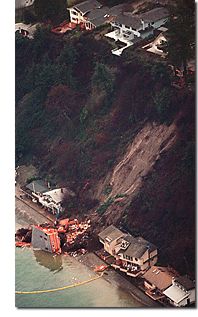 |
| Bainbridge Island, Washington: slide scar, and the remains of the Herren house on Rolling Bay Walk, January, 1997. (Photograph by Teresa Tamura, The Seattle Times.) |
Farther up the beach the street was blocked by a recent slide, a small one that had not yet been shoveled away. Next to the roadblock a vacant house bore a notice that it was unsafe for occupation. Several such notices had been posted the previous year after a slide had destroyed another house. Why did people persist in living here, when the proof of disaster was all around them?
As darkness fell on Rolling Bay Walk, neighbors called for the Herrens' big Labrador, Henry. The dog didn't turn up, but other reminders of the family did. In the days that followed, detritus washed up on the beach -- ruined clothing, remnants of electronic equipment, shattered kitchen utensils. Tiny disposable diapers were half buried in the sand. A little parade of rusting Tonka trucks rested nearby. People put some of the items on top of a concrete bulkhead, out of reach of the tides. "For the father," a neighbor said, meaning Dwight Herren's despairing father, Vern, who walked the beach daily, trying to salvage what he could. A week after the slide I found a pair of broken binoculars, a shattered tape cassette, a packet of allergy medicine. I added them to the bleak collection. Nothing was left of this family's life but pieces of worthless trash.
The three-story house on the beach had been Dwight Herren's dream; he was building it with his own hands and the help of family members, who pitched in on weekends. He and his two brothers had grown up on a stony beach on the west side of the island, in the lee of a forested cliff much like the one at Rolling Bay, and Dwight wanted the same for his own sons. "He had an attraction to the sea, to the water," his father, an avid sailor, told me. "I have it too."
After Dwight received a master's degree from Cornell, he got a job as a marine biologist for the State of Washington, diving in water so cold that he wore two wet suits, mapping beds of geoduck clams and sea cucumbers. It was dangerous work, but he was careful. He believed utterly in himself, and that confidence was contagious. When Dwight and Jennifer bought the beach house, their fathers had voiced doubts. "We both advised them not to build there; it didn't look good to us," Vern Herren said. "But Dwight said those houses had been there for sixty or seventy years and nothing had ever happened."
A neighbor was watching when Henry was finally found. A crane unearthed the dog's corpse while clearing away the last remains of the house. "He was right under the house, in the place where he used to sleep," the man said. He spoke softly, his voice blurred with sadness, and he had to clear his throat.
Once the crane finished its dreary work, the scene looked as if no house had ever stood there, no dog had ever bounded to the front door, no children had been rocked to sleep within the walls. There was just another gap in the tattered bulwark of houses along Rolling Bay Walk, their backs to the treacherous cliff and their trusting faces fixed on the heedless sea.
 ANDSLIDES are perhaps the most widespread geologic hazard, and,
since they are a function of gravity, an intractable one. They play an
essential role in the synchrony by which the uplifting continents are
continually worn down, their sediments swept away and deposited somewhere else
to start anew. They made their first known appearance in written history in
1767 B.C., when earthquake-triggered slides in China dammed the Yi and Lo
Rivers. Peruvians have been well acquainted with terrible landslides for
thousands of years, and have words to distinguish different kinds of them:
huaico is a mudslide containing large and small rocks, llapana a smooth
mudflow. Entire villages are easily lost to avalanches in the Andes -- 18,000
people were killed in a single slide in 1970, and a devastating series of
mudflows claimed more than 20,000 victims in Colombia in 1985. The kind of
slide that killed the Herrens is known to geologists as a debris flow -- a rapid
collapse of the surface that is characteristic of slope failures in many parts
of the world.
ANDSLIDES are perhaps the most widespread geologic hazard, and,
since they are a function of gravity, an intractable one. They play an
essential role in the synchrony by which the uplifting continents are
continually worn down, their sediments swept away and deposited somewhere else
to start anew. They made their first known appearance in written history in
1767 B.C., when earthquake-triggered slides in China dammed the Yi and Lo
Rivers. Peruvians have been well acquainted with terrible landslides for
thousands of years, and have words to distinguish different kinds of them:
huaico is a mudslide containing large and small rocks, llapana a smooth
mudflow. Entire villages are easily lost to avalanches in the Andes -- 18,000
people were killed in a single slide in 1970, and a devastating series of
mudflows claimed more than 20,000 victims in Colombia in 1985. The kind of
slide that killed the Herrens is known to geologists as a debris flow -- a rapid
collapse of the surface that is characteristic of slope failures in many parts
of the world. 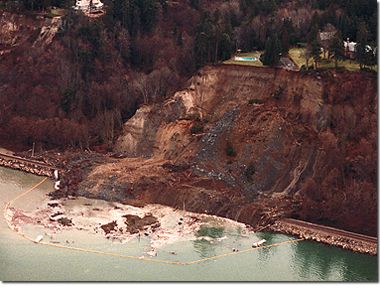 |
| Tracks north of Seattle where, in January of 1997, mud swept a freight train into Puget Sound. (Photograph by Mike Siegel, The Seattle Times.) |
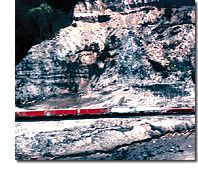 |
| A month later, the track repaired. (Photograph by Ed Harp, USGS.) |
Ground failures of various sorts occur in every state; according to the National Research Council, they annually cause more deaths (twenty-five to fifty) and greater economic loss (roughly estimated at $1.5 billion) than all other natural hazards combined. Yet they get little public attention. Because there is no nationwide system for reporting landslides, hard statistics are difficult to come by: the last inventory of landslide hazards was completed in the 1980s by a geologist working for the U.S. Geological Survey who toured all fifty states (most of them in his own van) -- a 70,000-mile survey that took him three years.
Though the American West Coast is one of the most slide-prone regions in the world, other natural disasters there steal the headlines -- earthquakes, volcanoes, floods, wildfires. Debris flows are widely seen as cosmological misfires, freaks of nature, and as a result people tend to underestimate the risks they pose. Such misperceptions contribute to the general neglect of landslide studies by research entities including the USGS, which in recent years has been distracted by personnel cutbacks and congressional threats to eliminate the agency. "The USGS competes with the Forest Service as the most demoralized federal resource agency," says Bill Dietrich, a professor of geology at the University of California at Berkeley. "It came under attack from various political points of view -- it was no longer seen as so essential." Meanwhile, the agency has struggled -- unsuccessfully, its critics say -- to mount a comprehensive landslide-hazards program. "I don't think it's for lack of trying," Dietrich says. "It's for lack of getting people's attention."That struggle is reflected in the staffing of the USGS landslide group, which numbers only fifteen employees. Its annual budget of $2.4 million is dwarfed by the $49 million earthquake program, which has a staff ten times as large.
Compared with other geological hazards, landslide zones are very narrow, very specific, and relatively easy to avoid. Unfortunately, they're often also attractive places to live. The Puget Sound lowlands are a good example. Born of mud and ice, these unstable hills of sand, silt, and gravel were bulldozed and compacted by glaciers that obliterated much of the geological record before the Holocene. The jagged shoreline edges some of the newest real estate in the country, and some of the most coveted. But a third of it -- some 660 miles along the islands and mainland -- is composed of steep bluffs continually subject to collapse.
The Rolling Bay slide took about three seconds, scooping a narrow track only about three feet deep down the face of the cliff. The cumulative weight of even a shallow debris flow is enormous: in this case 2,000 tons of rocks, trees, and sodden soil landed with uncanny accuracy on the Herrens' house. It was all over before the couple next door, who were sitting outside in their hot tub, realized what was happening. There was a sudden giant exhalation -- whumpf! -- as the air was pushed out of the collapsing house. A forty-foot fir tree, its saucer-shaped root system intact, slid down the cliff and halted atop the wreckage, as erect as if it had been planted there. Seven houses down in the opposite direction another neighbor heard the noise and walked outside in her bathrobe to look around. She saw the shattered plywood walls on the beach, the mountain of mud, and the tree standing serenely. She heard no more sounds. "It was utterly still,"she later told me. "So still that I thought this must have happened the night before, and I just hadn't noticed."
When Dave Montgomery, an assistant professor of geology at the University of Washington, saw the front-page story in the newspaper the next day, he shook his head. "I looked at that picture in the paper," he told me afterward, "and I thought, My God -- here's a cliff that's been moving backward for 10,000 years. Why would you live below it?" Since the last Ice Age the cliff at Rolling Bay has not so much stood as retreated, retaining a steep pitch that teases the angle of repose -- the maximum angle at which a slope will hold fast. "Normal slopes tend to round over time. A steep, straight slope is something that is created and maintained by landslides," Montgomery says.
In the stormy weeks before the Herrens were killed, Seattle newspapers carried many reminders of the dangers of steep slopes: a man's house was destroyed beneath him as he rode it into the water like a ship's captain; a mudslide slammed into a freight train and threw it into Puget Sound, from the same tracks where an Amtrak train carrying 650 passengers had passed only two hours before; city officials spent $900,000 in a Sisyphean effort to stabilize a sagging section of Seattle's Magnolia Bluff, where a half dozen homes were losing their precarious perch. These stories were read not as cautionary tales but as entertaining anecdotes about life in the rainy Northwest.
"We all live with risks," Dietrich says. "But we have some sense of those risks. Most people have no sense of the landslide risk. You don't live through a landslide at your house very often. Now, we have places that we can easily identify that were formed by periodic debris flows. I would never live in one of those places. You couldn't pay me anything to live there. If that's the case, then how do I inform a person who's thinking of living there, or is already living there, enough to realize the decision they're making?"
The online version of this article appears in three parts. Click here to go to part two. Click here to go to part three.
Brenda Bell has written for the Los Angeles Times Magazine and Utne Reader. She is at work on a historical novel set in the Southwest.
Illustration by Bryant Wang
Copyright © 1999 by The Atlantic Monthly Company. All rights reserved.
The Atlantic Monthly; January 1999; The Liquid Earth; Volume 283, No. 1; pages 58 - 72.
 |
 |
 |
 |
 |
 |