


Return to the Table of Contents.
M A Y 1 9 9 8


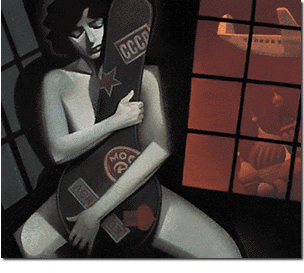
by John Updike
 HRUSHCHEV was in power, or we thought he was, that month
I spent as cultural ambassador and banjo-picking bridge between the
superpowers, helping to stave off nuclear holocaust. It was September into
October of 1964. We had a cultural-exchange program with the Soviets at the
time. Our State Department's theory was that almost any American paraded before
the oppressed Soviet masses would be, just in his easy manner of walking and
talking, such an advertisement for the free way of life that cells of
subversion would pop up in his wake like dandelions on an April lawn. So my
mission wasn't as innocent as it seemed. Still, I was game to undertake it.
HRUSHCHEV was in power, or we thought he was, that month
I spent as cultural ambassador and banjo-picking bridge between the
superpowers, helping to stave off nuclear holocaust. It was September into
October of 1964. We had a cultural-exchange program with the Soviets at the
time. Our State Department's theory was that almost any American paraded before
the oppressed Soviet masses would be, just in his easy manner of walking and
talking, such an advertisement for the free way of life that cells of
subversion would pop up in his wake like dandelions on an April lawn. So my
mission wasn't as innocent as it seemed. Still, I was game to undertake it.
Go to part two of this story.
The airport was illuminated dimly, as if by those bedside lamps that hotels give you, not to read by. One of the young soldiers was pawing through a well-worn Playboy that some discomfited fur trader had tried to smuggle in, and my first impression of how life worked under communism was the glare of that poor centerfold's sweet bare skin under those brownish airport lights. The magazine was confiscated, but I don't want to believe that the traveling salesman was sent to the gulag. He had a touch of Asia in his cheekbones -- it wasn't as if we had corrupted a pure-blooded Russian. The State Department boys swooped me out the customs door into a chauffeured limo that smelled not of boiled potatoes, exactly, but very deeply of tobacco, another natural product. My granddaddy's barn used to smell like that, even after the cured leaf had been baled and sold. I knew I was going to like it here.
On the airport road into Moscow in those days there was this giant billboard of Lenin, leaning forward with a wicked goateed grin and pointing to something up above with a single finger, like John the Baptist pointing to a Jesus we couldn't see yet. "I love that," my chief State Department escort said from the jump seat. "To three hundred million people -- 'Up yours.'" He was Bud Nevins, cultural attaché. I saw a lot of Bud, Bud and his lovely wife, April, in the weeks to come.
Washington had been an adventure already. I had been briefed on a couple of afternoons by a combination of our experts and some refugees from the Soviet Union. One portly old charmer, who had been upper-middle management in the KGB, filled a whole afternoon around a long leather-topped table by telling me what restaurants to go to and what food to order -- smoked sturgeon, piroshki, mushroom pie. His mouth was watering, though from the look of him he hadn't exactly starved under capitalism. Still, no food like home cooking; I could sympathize with that.
Those Washington people loved to party. Each briefing would be followed by a reception, and at one of the receptions a little black-haired coffee fetcher from that afternoon's briefing came up to me as if this time her breasts were being offered on a tray. They were sizable, pert breasts, in a peach-colored cotton chemise that had just outgrown being a T-shirt.
"Sir, you are my god," she told me. That's always nice to hear, and she shouldn't have spoiled it by adding "Except of course for Earl Scruggs. And that nice tall Allen Shelton, who used to fill in on banjo with the Virginia Boys -- oh, he was cute! Now, have you heard those new sides the McReynoldses have cut down in Jacksonville, with this boy named Bobby Thompson? He is the future! He has this whole new style -- you can hear the melody! 'Hard Hearted.' 'Dixie Hoedown.' Oh, my!"
"Young lady, you know I'm not exactly bluegrass," I told her politely. "Earl, well, he's beginning to miss notes, but you can't get away from him; he's a giant, and Don Reno likewise. Nevertheless, my idol intellectually is Pete Seeger, if you must know; he's the one, him and the Weavers, brought back the five-string after the war, after the dance bands all but turned the banjo into a ukelele."
"So folksy and pokey and phony, if you're asking me," she said, with a hurried overemphasis that I was beginning to get used to, while her warm black eyes darted back and forth on my face like stirred-up horseflies. "And a traitor to his country besides."
"Well," I admitted, "you won't find him on Grand Ole Opry real soon, but the college kids eat him up, and for his sheer sincere picking -- none of that show-biz flash that sometimes bothers me about Earl. Young lady, you should calm yourself and sit down and listen sometime to those albums Pete cut with Woody and the Almanacs before the war."
"I did," she said eagerly. "I did, I did. 'Talking Union.' 'Sod Buster Ballads.' Wonderful true-blue lefty stuff. The West Coast Communists must have loved it. Mr. Chester, did you ever in your life listen to a program called Jamboree, out of Wheeling?"
"Did I? I got my first air time on it, on good old WWVA. Me and Jim Buchanan on fiddle, before he got big. 'Are You Lost in Sin?' and 'Don't Say Good-bye If You Love Me,' with a little 'Somebody Loves You, Darlin'" for a rideout. Did I catch your name, may I ask?"
"You'll laugh. It's a silly name."
"I bet now it isn't. You got to love the name the good Lord gave you."
"It wasn't the good Lord, it was my hateful mother." Momentarily holding a deep breath that rounded out her cheeks like a trumpet player's, she said, "Imogene." Then she exhaled in a blubbery rush and said, "Imogene Frye. Isn't it silly?"
"No," I said. That was my first lie to her. She seemed a little off-center right from the first, but Imogene could talk banjo, and here, in this city of block-long buildings and charcoal suits, that was as welcome to me as borscht and salted cucumber would have been to that homeless KGB colonel, locked out forever as a traitor from the land he loved.
"I loved," this Imogene was saying, "the licks you took on `Heavy Traffic Ahead.' And the repeat an octave higher on `Walking in Jerusalem Just Like John.'"
"It wasn't an octave, it was a fifth," I told her, settling in and lifting two bourbons from a silver tray that a kindly Negro was carrying around. I saw that this was going to be a conversation. Banjos were getting to be hot then, what with that Beverly Hillbillies theme, and I didn't want to engage with any shallow groupie. "Do you ever tune in WDBJ, out of Roanoke?" I asked her. "And tell me exactly why you think this Bobby Thompson is the future."
She saw my hurt, with those hot bright eyes that looked to be all pupil, and hastened to reassure me in her hurried, twitchy way of talking that I was the present, the past, and the future as far as she was concerned. Neither of us, I think, had the habit of drinking, but the trays kept coming around, brought by black men in white gloves, and by the time the reception broke up, the whole scene might have been a picture printed on silk, waving gently in and out. The Iron Curtain experts had drifted away to their homes in Bethesda and Silver Spring, and it seemed the most natural thing in the free world that little Imogene, to whom I must have looked a little wavy myself, would be inviting me back to her apartment somewhere off in one of those neighborhoods where they say it's not safe for a white man to show his face late at night.
 LACK and white, that's most of what I remember. Her hair was black and
soft, and her skin was white and soft, and her voice had slowed and gotten
girlish with the effects of liquor and being romanced. I was on the floor,
peeling down her pantyhose while she rested a hand on the top of my head for
balance. Then we were sitting on the bed while she cupped her hands under those
sizable breasts, pointing them at me like guns. "I want them to be even
bigger," she told me so softly that I strained to hear, "for you." Her
breasts being appreciated made her smile in the slanted light from the street
like a round-faced cartoon character, a cat-and-canary smile. When I carried
the courtesies down below, this seemed to startle her, so she stiffened a bit
before relaxing her legs. I was striving to keep my focus amid the swaying
caused by government-issue alcohol, the jostling of my conscience, my wondering
what time it was, and the glinting strangeness of this environment, with its
sadness of the single girl. Black and white -- her little room sucked dry of
color, like something on early TV; her bureau with its brushes and
silver-framed photos of the family that had hatched her; an armchair with a
cellophane-wrapped drugstore rental book still balanced on one arm, where she
had left it before heading off this morning into her working day; her
AM-FM-shortwave portable radio, big enough to pick up stations from Antarctica;
her narrow bed with its brass headboard that was no good to lean on when we had
done our best and needed to reminisce and establish limits.
LACK and white, that's most of what I remember. Her hair was black and
soft, and her skin was white and soft, and her voice had slowed and gotten
girlish with the effects of liquor and being romanced. I was on the floor,
peeling down her pantyhose while she rested a hand on the top of my head for
balance. Then we were sitting on the bed while she cupped her hands under those
sizable breasts, pointing them at me like guns. "I want them to be even
bigger," she told me so softly that I strained to hear, "for you." Her
breasts being appreciated made her smile in the slanted light from the street
like a round-faced cartoon character, a cat-and-canary smile. When I carried
the courtesies down below, this seemed to startle her, so she stiffened a bit
before relaxing her legs. I was striving to keep my focus amid the swaying
caused by government-issue alcohol, the jostling of my conscience, my wondering
what time it was, and the glinting strangeness of this environment, with its
sadness of the single girl. Black and white -- her little room sucked dry of
color, like something on early TV; her bureau with its brushes and
silver-framed photos of the family that had hatched her; an armchair with a
cellophane-wrapped drugstore rental book still balanced on one arm, where she
had left it before heading off this morning into her working day; her
AM-FM-shortwave portable radio, big enough to pick up stations from Antarctica;
her narrow bed with its brass headboard that was no good to lean on when we had
done our best and needed to reminisce and establish limits."Lordy," I said. This was something of a lie, since when the main event came up, I had lost a certain energy to the good times behind us, beginning hours ago at the party. I had felt lost in her.
She touched my shoulder and said my full name tentatively, as if I wouldn't like it: "Eddie Chester." She was right; it sounded proprietary, and something in me bristled. "You really are a god."
"You should catch me sober sometime."
"When?" Her voice pounced, quick and eager, as it had been at first. The pieces of white beside her swollen pupils glinted like sparkles on TV; her propped-up pillow eclipsed half of her round face and half a head of black hair, mussed out to a wild size.
Mine had been just a manner of speaking. "Not ever, it may be, Imogene," I told her. "I have a week of gigs out west, and then I'm off on this trip, helping to keep your planet safe for democracy."
"But I'll see you when you come back," she insisted. "You must come back to Washington, to be debriefed. Eddie, Eddie, Eddie," she said, as if knowing it galled me. "I can't ever let you go."
I longed for a taxi out of there. "I got a wife, you know. And three little ones."
"Do you love your wife?"
"Well, honey, I wouldn't say I don't, though after fifteen years a little of the bloom rubs off."
"Do you do to her everything you did to me?"
This seemed downright forward. "I forget," I said, and pushed out of the bed into the bathroom, where the switch brought color back into everything, all those pinks and blues and yellows on her medicine-cabinet shelves; it seemed that she needed a lot of pills to keep herself functional.
"Eddie, don't go," she pleaded. "Stay the night. It's not safe out there. It's so bad the taxis won't come even if you call."
"Young lady, I got a hired car coming to the Willard Hotel at seven-thirty tomorrow morning to carry me back to western Virginia, and I'm going to be there. I may not be the future of banjo picking, but I take a real professional pride in never having missed a date." Putting on my underwear, I remembered how the taxi had gone around past the railroad station and then the Capitol, all lit up, and I figured we hadn't gone so far past it that I couldn't steer myself by its tip, or by the spotlights on the Washington Monument.
"Eddie, you can't go; I won't let you," Imogene asserted, out of bed except for one sweet, fat white leg caught in the sheet. Her breasts didn't look quite so cocky without her holding them up for me. That's the trouble with a full figure; it ties you to a bra.
I crooned a few lines of "Don't Say Good-bye If You Love Me" until my memory ran out, though I could see Jim Buchanan's face right across from me, squeezed into its fiddle, at the WWVA microphone. And then I told Imogene, as if still quoting a song, "Little darlin', you ain't keeping me here, though I must say it was absolute bliss." This was my third lie, but a white one, and with some truth in it. "Now, you go save your undying affection for an unattached man."
"You'll be killed!" she shrieked, and clawed at me for a while, but I shushed and sweet-talked her back into her bed, fighting a rising headache all the while, and let myself out into the stairwell. The street, one of those numbered ones, was as still as a stage set, but stepping out firmly in my cowboy boots, I headed what I figured was west -- you get a sense of direction growing up in the morning shadow of the Blue Ridge -- and, sure enough, I soon caught a peek of the Capitol dome in the distance, white as an egg in an eggcup. A couple of tattered colored gentlemen stumbled toward me from a boarded-up doorway, but I gave them each a dollar and a hearty God bless and strode on. If a man can't walk around in his own country without fear, what business does he have selling freedom to the Russians?
John Updike is the author of the Pulitzer Prize-winning Rabbit Is Rich (1981) and Rabbit at Rest (1990), and sixteen other novels. His most recent book is Toward the End of Time (1997).
Illustration by Gary Kelley
Copyright © 1998 by The Atlantic Monthly Company. All rights reserved.
The Atlantic Monthly; May 1998; Licks of Love in the Heart of the Cold War; Volume 281, No. 5; pages 80 - 90.
 |
 |
 |
 |
 |
 |