


 The Vanity of Human Markets
Robert Kuttner challenges the prevailing orthodoxy of laissez-faire economics
February 26, 1997
In a recent column appearing on The New York Times op-ed page, Thomas L. Friedman referred to the now-famous remark by Alan Greenspan that Wall Street's ongoing rise is being driven by "irrational exuberance." Friedman countered that when looking at the United States economy from abroad (especially from Europe and Japan), "some exuberance seems quite rational." In fact, if you had to design a country best suited to compete in a world whose defining feature is "globalization," he continued, "in many respects you would have designed today's America." This view reflects the other defining feature of our historical moment: free-market capitalism is ascendant across the planet, while here at home the ideology of laissez-faire economics has returned with a vengeance during the past fifteen years after decades of Keynesian liberalism.
But if the prevailing winds are blowing in favor of ever-expanding and freer markets, in the past few months there have been some notable gusts in other directions. The billionaire financier and philanthropist George Soros wrote in the February issue of The Atlantic Monthly that the main threat to our "open society" is no longer Communism but capitalism. A widely noted book by the journalist William Greider, One World, Ready or Not: The Manic Logic of Global Capitalism, warns that "Our wondrous [economic] machine ... appears to be running out of control toward some sort of abyss." And of course there's Greenspan himself, whose comment about "irrational exuberance" gave many in the financial world pause.
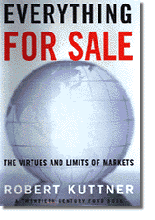
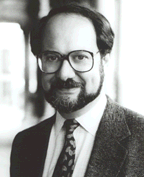
Enter Robert Kuttner, a founder and co-editor of The American Prospect magazine, a longtime contributor to The Atlantic, and the author of Everything For Sale: The Virtues and Limits of Markets (Alfred A. Knopf, 1997). Kuttner conceives of his new book "not as a manifesto" but as "a sober sorting out." Exploring the way markets really work, he asks what are their proper boundaries and seeks "to reclaim a defensible middle ground." Kuttner recently spoke with Atlantic Unbound editor Wen Stephenson.
From The American Prospect, March-April 1997
Generally, yes. Having one's book on the cover of The New York Times Book Review is always nice for an author. The Washington Post's review was very gratifying, too, because it was by a conservative woman from the American Enterprise Institute who treated it respectfully. On the other hand, The Wall Street Journal ridiculed it, as did the online magazine Slate. I think free-market zealots who are almost religious in their enthusiasm are going to see anybody who dissents from that view as a kind of flat-earth type. But it's better to be attacked than ignored.
 Central to your argument in Everything for Sale is a conviction that a "mixed economy"--one in which the government intervenes to temper the free market--is necessary not only for a healthy economy but also for a decent, civil society. Don't most economists and economics writers take the mixed economy for granted? Is anyone really advocating true laissez-faire economics? Does your definition of the mixed economy differ from that of others?
There has been a whole intellectual current, beginning in the 1970s, that has argued that most of what government does can be done better by the private market. There's a whole spectrum of opinion, of course, but the center of gravity is much further to the right on this issue than it was twenty years ago. For example, you have the great influence of so-called "Chicago Economics." You've got the movement to deregulate and privatize, the feeling that when government has to intervene at all it should intervene in a market-like way. Then you've got the more extreme people who are almost absolutist libertarians. There's a book out by Charles Murray that basically says you can shut down most of the government. There's the Law and Economics movement in the law schools, which benefits from tens of millions of dollars of right wing foundation money. So there are economists and other ideologues who may not think that we can exist with no government but who do think we ought to have a "night-watchman state," where the only role of government is to protect one's personal security and property--and everything else you can leave up to the market.
In Everything for Sale you suggestively cast the conflict between a laissez-faire and a mixed economy in terms of a quasi-religious struggle, as though the forces of a zealous ideological orthodoxy or fundamentalist dogma are lined up against those of moderate, common-sense, rational dissent. Is there reason to think there's a kind of economic Reformation brewing in the West? If so, are you Luther nailing your theses to the church door?
I would take issue with the framing of the question in the following way: I think those of us who believe in a mixed economy really are more pragmatic and those people who think that almost everything can be left to the market really are more zealous, and I'll tell you why.
You can reduce the free-market zealotry to a bumper sticker: Marketize Everything. And you really can't reduce the other side of the argument to a bumper sticker, because people like me who believe in a mixed economy would certainly say that there are some things that can be very efficiently left to the market, other things that require government programs, and still other things that are a complicated blend of some government and mostly market, and that you have to get down to cases. So almost by definition my side of the argument is more practical and more guided by what you actually find when you look at the economy, whereas the other side of the argument is just more doctrinaire.
Now, is there a backlash starting? I think there is. Let me give you some examples. First of all, the market is trying to rationalize health care through managed care. The market does that by denying people benefits to which they're entitled, by giving secret incentives to doctors who work for HMOs, and by trying to figure out who's likely to get sick and then denying them insurance in the first place. People don't like that. There's also a backlash against the conversion of labor markets into something that more nearly resembles a textbook model. It used to be that there was a kind of bond, a kind of implicit social compact between the company and the individual. Today if there is somebody on the street who will do your job for 20 percent less, you're out of work unless you take the pay cut. More and more people are contingent workers-- temps and part-timers. The labor market is more brutal, more like a product market. People don't like that. There's a backlash on the environment, too. A statement out this week signed by 2,000 economists says that global warming is a genuine threat and that there needs to be a world-wide regulatory scheme to deal with it or we're going to face a catastrophe. These are economists, not environmental nuts. In The Atlantic's February cover story the world's most astute trader of currencies, George Soros, said that he used to be worried about the communist threat as the greatest threat to civil society, but that now he's worried about the capitalist threat. These are all straws in the wind. Alan Greenspan--not somebody who doesn't trust markets--says that there's a stock-market bubble. So there is reason to worry and there is the beginning of a backlash.
In the Atlantic cover story you mention ("The Capitalist Threat," February, 1997), George Soros makes this statement: "Wealth does accumulate in the hands of its owners, and if there is no mechanism for redistribution, the inequities can become intolerable." Do you believe that such inequities are becoming--or have already become--intolerable in the United States? How do you react to such a statement coming from someone like George Soros?
Clearly the division of society into more rich and more poor is the direct result of the erosion of all of the buffers that were constructed during the period when the mixed economy was thriving. We have lower rates of tax on wealthy people; we have less transfer of income to poor people; we have relatively less money going to institutions that give people what the English call social income--that is, income that you get as a citizen rather than as an employee, whether you're rich or poor. The kind of society that bolsters people against the extremes of the marketplace has been under assault for twenty years, and not surprisingly the distribution of income is more extreme than it was a generation ago. That's problem number one.
Second, in addition to the problem of income distribution there is the problem of the market's encroaching on realms that are not supposed to be marketized, like public life. You see this in the campaign-finance scandals where money thinks it can buy everything. Politics is supposed to exist in a realm different from markets, and yet in practice public office is for sale.
The third problem is the stability and efficiency of an economy that is totally marketized. I make the argument that we need to temper markets not just because of distributional extremes and not just because there are realms where markets don't properly belong, but also, and somewhat more controversially, because markets sometimes price things wrong or because markets go haywire, as in stock market crashes and depressions. You need to temper markets in order to make capitalism itself more stable and efficient.
You're talking about the marketizing of the public, political realm. Nicholas Lemann, writing in the February issue of The Atlantic, pointed to something that seems like a reverse trend: the politicizing of the private realm. In the article "Citizen 501(c)3" he observes that in domestic social policy there has been a shift in power in the United States from government to private, non-profit foundations such as Soros's. Do you agree that there has been such a shift? If so, do you think it's a good thing or a bad thing?
Big foundations have been very influential for at least forty years. I think the difference in the last twenty years is that very conservative foundations with a very explicit ideological agenda have become much more influential. There are dozens and dozens of right-wing think tanks that did not exist before that have very explicitly ideological agendas. The big traditional foundations like Ford and Rockefeller and Carnegie are not what you'd call left wing, but they do have a social conscience, and they are concerned about poverty. They don't have a party line, however, in the way that the right-wing foundations do.
Furthermore, non-profit institutions are increasingly responsible for social services. This has been going on in one form or another since the 1960s--in a sense, if you go back to the settlement-house movement around the turn of the century, it's been going on for almost a hundred years. As government recedes as a player, to some extent non-profit institutions try to fill the void. There's much, much more of that than there was twenty or thirty years ago, and I think that's probably, on balance, a good thing. These community institutions, which are typically non-profits, tend to be less bureaucratic, tend to have more of a real community sense of mission.
There needs to be a clearer examination of what charitable organizations can and cannot properly do. Gingrich's little problem is an illustration of that: it's very, very tempting to use nonprofit money for political objectives.
In The Atlantic's March cover story Peter Edelman condemns last year's welfare-reform legislation as "The Worst Thing Bill Clinton Has Done," saying it sets in motion a "race to the bottom" that will harm millions of poor children and legal immigrants. Edelman argues that the first and most important part of any effort to fix the bill must be "jobs, jobs, jobs." In your estimation, is there any hope that our economy can create enough jobs on its own to move significant numbers of those currently receiving assistance from welfare to work? How does wealth redistribution fit into the picture? What, if anything, can the government do at this point, given the political realities of the moment?
I think Edelman is right about "jobs, jobs, jobs." For me, the real crime of that bill was that the Republicans cut some $50 billion from AFDC and other programs for the poor, putting that money into tax relief for the rich instead of into job creation--which can be done in two ways.
First of all, the Federal Reserve can take its foot off the brake, let the economy grow faster, and let the unemployment rate in the private sector come down. Secondly, we need to recognize that a lot of people who have been on welfare are people who are difficult to make employable. Employers, not without reason, have some hesitancy in hiring former welfare recipients. People need training, people need child care. A lot of people on AFDC have very disorganized lives--they have difficulty meeting the expectations of conventional jobs. It's the role of goverment to get these people back into the job market.
Now, on the other question--wealth redistribution--I don't think there's much support, politically, in the United States for explicit wealth redistribution, but I think there's a lot of support for implicit wealth redistribution. A very good example of that is Social Security. Another very good example is Medicare. If you didn't have Social Security and Medicare a lot more people would be poor. So by using the tax system you reduce poverty. But people don't think of it as redistribution. The same thing is true of public schools, and of subsidized mass transit, where you are subsidizing a service that poor people, because they don't have as much private purchasing power, would otherwise get less of.
Lester Thurow, reviewing William Greider's new book, One World, Ready or Not: The Manic Logic of Global Capitalism, in the March Atlantic, points to what he calls "the ideological paradox of our time." He writes, "Capitalism is myopic and cannot make the long-term social investments in education, infrastructure, and research and development that it needs for its own future survival. It needs government help to make those investments, but its own ideology won't allow it either to recognize the need for those investments or to request government help." This sounds very much like what you and others are saying right now. What, if anything, can be done to alter the prevailing ideology of unfettered laissez faire? Are we stuck with Thurow's paradox? Will fundamental change only come as the result of some global crisis, as Greider suggests in his book?
Well, if one is a pessimist one concludes that fundamental change will only come as a result of a global crisis. I don't think that that's a very good view to hold, because you never know what you're going to get in a crisis. In the last great crisis we got Roosevelt, but the Germans got Hitler. I also think that it is possible for public opinion to change in the absence of a catastrophic crisis. For example, the increased support for public institutions and public remedies in the 1960s was just a normal swing of the pendulum. It did not require a great crisis.
There are a couple of ways you change minds and change policies. One is through the power of ideas and the other is through politics. What is the counterweight to the ideology of unfettered laissez faire? The political mobilization of ordinary people. It is wealthy and powerful people, for the most part, who think that you shouldn't interfere with free markets, and it's people who are more vulnerable, who don't have the kind of security that wealth buys, who think that you need "countervailing institutions," as John Kenneth Galbraith called them. Right now there's so much cynicism about politics that ordinary people don't bother to vote. If you restore faith in the possibility of public improvement, ordinary people will start voting and you'll get a countervailing ideology that translates into new public policy.
You've written that "The grail of a market economy untainted by politics is the most dangerous illusion of our age," and that "There is no escape from politics." Who are the readers you most want to reach with Everything for Sale? Is there anything you'd say to that intended audience now, in light of political events since the book was written?
I'm very much trying to reach a general audience: the kind of people who read The Atlantic, the kind of people who do not have degrees in economics but who worry about the economy and society and who are capable of reading a general, intellectually serious book. I think the fact that there are several hundred-thousand such people who subscribe to The Atlantic augers well for this kind of dialogue.
Even laissez faire requires ground rules, ground rules in turn require laws, and laws--which are written by legislators who are freely elected--are a reflection of politics. The idea that you can use markets to pursue public purposes is very much in vogue right now. Look at things like school vouchers, tradable pollution rights, and the auction of the broadcast spectrum. To some extent that's right, but you can't do that without a clear set of policy objectives and a clear set of ground rules--and those reflect legislation, and legislation reflects politics. So the idea of a market existing in some realm that's divorced from civil society, divorced from politics--Robinson Crusoe's island--I think is a very dangerous fantasy.
Copyright © 1997 by The Atlantic Monthly Company. All rights reserved.
 |
 |
 |
 |
 |
 |