



For more, see the complete Atlantic Abroad Index.

by Jeffrey Tayler
January 7, 1998
|
Return to Part One: Inside the Hungry Duck. |
 Shirota dushi permeates night life in Moscow. It flows through Russian
veins like an empowering ichor, more potent even than vodka, and mixes with
fast cash and a carpe diem profligacy -- or, better said, carpe noctem -- that
derives much from a fear well-rooted in history. In a land still recovering
from a heritage of serfdom and autocracy, from Bolshevik repression, from
purges that swept away whole strata of society, from a world war that killed
twenty million, from a cold war that sowed distrust of anything Western, from
the collapse of a paternalistic state and empire, it is easy to believe that
doomsday is nigh. With its clash of titans the current political scene
reinforces the notion that Judgment is at hand: Boris Yeltsin's arch-rival, General
Lebed (one of the most popular politicians in Russia) promises to impose law
and order on a country that has almost corrupted itself out of existence.
Indeed, newspaper headlines on any given day proclaim what look like the
portents of national apocalypse: Russia's key economic indices continue to
plummet; average life expectancy for Russian males drops to fifty-seven years;
top defense officials declare that the country's nuclear weapons may no longer be
under their control. Thus the fear that lurks behind carpe noctem for young
Russians, bandity and businessmen and students all: sooner or later
another wave of history will crash down on them and carry away their new
freedom, their new money, and even their lives.
Shirota dushi permeates night life in Moscow. It flows through Russian
veins like an empowering ichor, more potent even than vodka, and mixes with
fast cash and a carpe diem profligacy -- or, better said, carpe noctem -- that
derives much from a fear well-rooted in history. In a land still recovering
from a heritage of serfdom and autocracy, from Bolshevik repression, from
purges that swept away whole strata of society, from a world war that killed
twenty million, from a cold war that sowed distrust of anything Western, from
the collapse of a paternalistic state and empire, it is easy to believe that
doomsday is nigh. With its clash of titans the current political scene
reinforces the notion that Judgment is at hand: Boris Yeltsin's arch-rival, General
Lebed (one of the most popular politicians in Russia) promises to impose law
and order on a country that has almost corrupted itself out of existence.
Indeed, newspaper headlines on any given day proclaim what look like the
portents of national apocalypse: Russia's key economic indices continue to
plummet; average life expectancy for Russian males drops to fifty-seven years;
top defense officials declare that the country's nuclear weapons may no longer be
under their control. Thus the fear that lurks behind carpe noctem for young
Russians, bandity and businessmen and students all: sooner or later
another wave of history will crash down on them and carry away their new
freedom, their new money, and even their lives.In Russia, Valentine's Day is a recent, non-Soviet accretion to the holiday calendar. As such it has been seized upon as cause for some of the grandest bashes of the year -- an occasion, thus, for carpe noctem recklessness and the expression of unbridled shirota dushi. Olya promised to take me to a club in Moscow famed for New Russian excess: the Titanik. Our date falls on Valentine's Day.
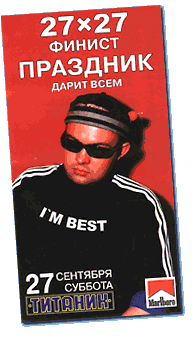
 At the Titanik's entrance I stand waiting for Olya and her friend, Natasha --
an affluent, London-educated interior designer who will use her membership to
get us in on the director's list (the club will be filled to capacity). The
Titanik at first glance seems an unlikely venue for New Russian extravagance.
Located in the former Stadium of Young Pioneers, from the outside it resembles
a bunker or a Quonset-hut. But over the box office hangs a sign reading SINKING
PRICE -- 250,000 RUBLES (forty dollars), and an alarm light flashes red alert
above the portholed entrance. BMWs and Mercedes, all blue-gray-black and
casting halogenous fog lights into the snow, rumble to the door to disgorge
their feathery, powdered, perfumed charges, then pass into the slush trenches
of the parking lot. At least a thousand young people are clamoring for
admission.
At the Titanik's entrance I stand waiting for Olya and her friend, Natasha --
an affluent, London-educated interior designer who will use her membership to
get us in on the director's list (the club will be filled to capacity). The
Titanik at first glance seems an unlikely venue for New Russian extravagance.
Located in the former Stadium of Young Pioneers, from the outside it resembles
a bunker or a Quonset-hut. But over the box office hangs a sign reading SINKING
PRICE -- 250,000 RUBLES (forty dollars), and an alarm light flashes red alert
above the portholed entrance. BMWs and Mercedes, all blue-gray-black and
casting halogenous fog lights into the snow, rumble to the door to disgorge
their feathery, powdered, perfumed charges, then pass into the slush trenches
of the parking lot. At least a thousand young people are clamoring for
admission.I hear the rum-rum of a powerful engine and a skid: down the driveway roars a black, low-slung sports car with cobalt-tinted windows. It stops in front of me. Natasha jumps out with her boyfriend, Igor, then Olya. Natasha is tanned, dressed in black designer jeans and a black-leather bomber jacket. She picks her way across the icy sidewalk near the porthole and elbows her way toward the front of the line; looking back, she shouts that she will put us on the "boarding list."
 Olya and I stand apart from the line. Midnight comes and goes. The crowd grows.
The ethereal finesse of many of the women (models, Olya says) contrasts wildly
with the Zileri- and Armani-clad bandity in black, their apish mugs set
below mini-craniums and capped by crew cuts, their gorilla arms hanging from
hunched shoulders, their fingers fidgeting with wads of hundred-dollar bills.
Some of these are middle-tier thugs; a few must be high-ranking bosses; all
spew pure mat -- the foulest of oaths -- into their talk of deals and
figures, and address one another by nicknames such as "Bull" and "Rambo."
Others are not thugs at all, but the crème de la crème of the New
Russia, who, like Olya, dine at the Ekipazh and doubt the surety of
tomorrow.
Olya and I stand apart from the line. Midnight comes and goes. The crowd grows.
The ethereal finesse of many of the women (models, Olya says) contrasts wildly
with the Zileri- and Armani-clad bandity in black, their apish mugs set
below mini-craniums and capped by crew cuts, their gorilla arms hanging from
hunched shoulders, their fingers fidgeting with wads of hundred-dollar bills.
Some of these are middle-tier thugs; a few must be high-ranking bosses; all
spew pure mat -- the foulest of oaths -- into their talk of deals and
figures, and address one another by nicknames such as "Bull" and "Rambo."
Others are not thugs at all, but the crème de la crème of the New
Russia, who, like Olya, dine at the Ekipazh and doubt the surety of
tomorrow.We discover that the listed glitterati exceed those who would pay the sinking price. It is two in the morning by the time we pass through the metal detectors, suffer a drugs search by machine-gun-toting Interior Ministry troops, and get within sight of the single, list-waving bouncer standing at what looks to be the portal to Armageddon; through it, chthonian figures leap and gambol in a gaseous, ultrasonically pounding gloom that flickers with red and blue and strobe-white lightning.
Once we make it into the hold, through the porthole windows we see purple bubbles rising amid lolling drifts of seaweed. Wild-eyed patrons hurl themselves through clouds of dry-ice fog; a second-floor-balcony reveler releases her crystal-chaliced vodka in a silvered arc onto the crowd below. I lose Olya immediately and find myself repelling from one throng to another, trying to make my way toward the dance floor's edge. Just when I am breaking free someone grabs my hand and a deliberate, piercing burn scorches my wrist. I jerk my hand but a woman is gripping it tight; she has stabbed me with her lit cigarette. She presses her lips into my ear -- "I didn't mean to do that!" she shouts, and pulls me into the dancers. Three apes in black suits move toward me. I yank my hand loose and make for the steps.
I find Natasha and Igor sitting on the balcony.
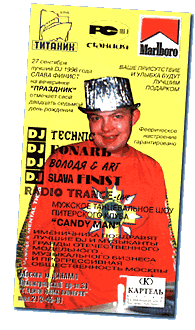 "This hell is Titanik! This is rave!" Natasha shouts, waving her arms over the
masses below. Rave. A panorama of beings writhing in dry-ice fog spreads to the
limits of the hold; a red-green laser roves the room, probing one raver, then
another, its touch galvanizing the fatigued into further oscillations. Everyone
on the dance floor is drugged, Natasha says. "Ecstasy. They're all on
ecstasy."
"This hell is Titanik! This is rave!" Natasha shouts, waving her arms over the
masses below. Rave. A panorama of beings writhing in dry-ice fog spreads to the
limits of the hold; a red-green laser roves the room, probing one raver, then
another, its touch galvanizing the fatigued into further oscillations. Everyone
on the dance floor is drugged, Natasha says. "Ecstasy. They're all on
ecstasy."I move on, and run into Olya. There is a corridor. We enter. Bodies cover the sofas. Some people seem to be sleeping with their eyes open. There are no drinks; those taking ecstasy shun alcohol.
Back in the main hold Jamaican acrobats somersault across the stage, a nearly naked Russian male-female-male ensemble imitates menage-à-trois. The music -- pounding techno-pop -- harries and disorients. Again I lose Olya. Following the wall, almost blind in the crush of perfumed bodies and clouds of dry-ice, I reach a succession of side rooms. In the first one is a teenage girl gyrating herself out of a hot-pink bikini in front of a gaping huddle of thugs; in the next room a covey of young men and women squirm under an inch-thick layer of pink carnations. Blue bottles of mineral water litter the tables. Ecstasy.
I bump into a sloe-eyed blonde in alligator bootlets and ask her to dance. We peal out into the midst of the ravers, to Titanik's ground zero. The crowd around us, stomping frantically, pupils dilated wide as black saucers, gyrates stageward, whence cooling blasts of fog blow, split and probed by the roving laser. On key, eyes close, ravers raise their arms as if in supplication; some people drop to their knees, others shimmy together, all with their eyes on the laser, which takes on the aspect of a dawning sun. My partner disappears; I, too, raise my hands to the light.
Five-thirty in the morning finds me collapsed on a sofa by the back wall. Even in fatigue my heart pounds with the ineluctable rhythm of the place. The rave wanes: above me dancers circumvolve and wamble in the mists of closure. At six, when I grab my coat and slip through the exit, dawn hasn't paled the murk, the red light on the roof still spins silent alarm into the rippling curtains of descending snow.
I start off toward Leningradsky Prospekt to find a taxi. Kiosks are already plastered with newspapers and the portents of apocalypse. Looking back at the club, it occurs to me that Russia, lurching from liberation to judgment, free-falling, waiting for impact, is rave; plundered wealth courses through its arteries like torrents of ecstasy. A Lada crunches its way through the snow and stops for me, and I climb in.
Jeffrey Tayler is a freelance writer and traveler based in Moscow. He has recently written on Moscow, Transylvania, Siberia, and Zaire for The Atlantic Monthly. He contributes regularly to Atlantic Abroad.
Share your tales of life abroad in the Global Views forum of Post & Riposte.
Copyright © 1997 by The Atlantic Monthly Company. All rights reserved.